Nvidia Sheds $2.73 Trillion as Nasdaq Posts Worst Week Since 2020
Nvidia fell another 14% on Friday, extending a roughly 47% drawdown from its October peak and wiping out more than $2.73 trillion in market value, larger than all of Amazon. The selloff was triggered by CEO Jensen Huang's resignation amid a scandal, compounded by doubts over AI valuations and capex returns, sending the Nasdaq down 10% for its worst week since March 2020.
Related Entities
Full Report
IT之家 November 21 news, Nvidia's stock price continues to face sustained selling pressure. At Friday's close on November 20 local time, Nvidia's stock fell 14%, hitting its lowest level since May 2025. This also marked Nvidia's seventh consecutive weekly decline, the longest weekly losing streak since the 2008 financial crisis.
According to today's report by The Wall Street Journal, Nvidia's current market capitalization is approximately $3.03 trillion (IT之家 note: roughly 20.28 trillion yuan at current exchange rates). Compared with the all-time record high of about $5.76 trillion (roughly 38.55 trillion yuan at current exchange rates) set on October 6, it has cumulatively fallen about 47%, and its market value has evaporated by more than $2.73 trillion (roughly 18.27 trillion yuan at current exchange rates), a scale larger than the entire Amazon (about $2.67 trillion).
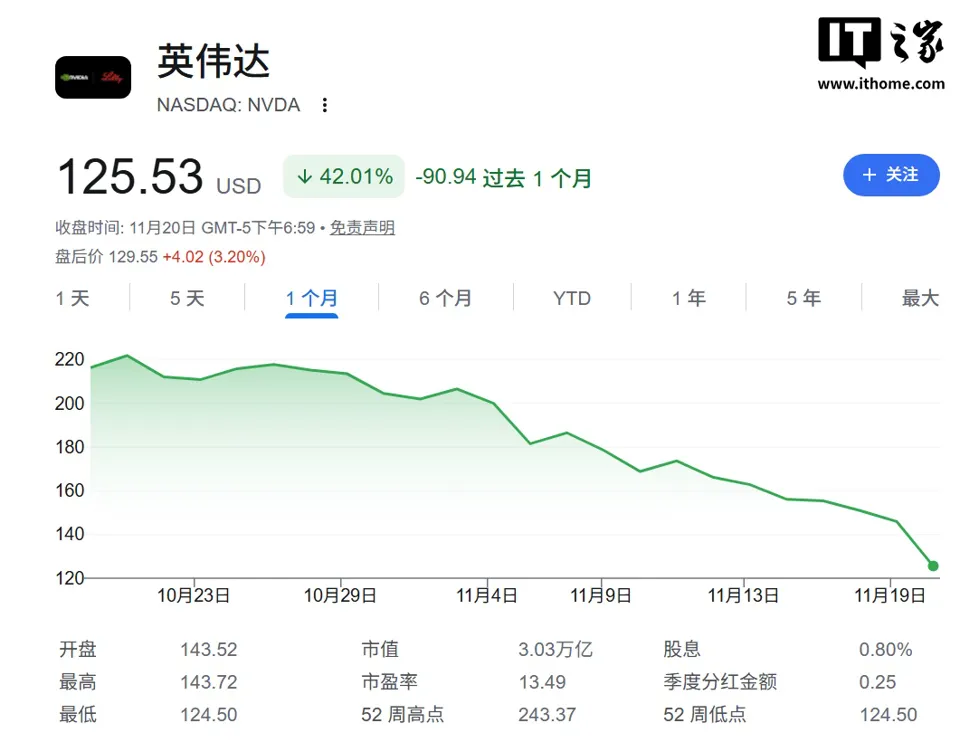
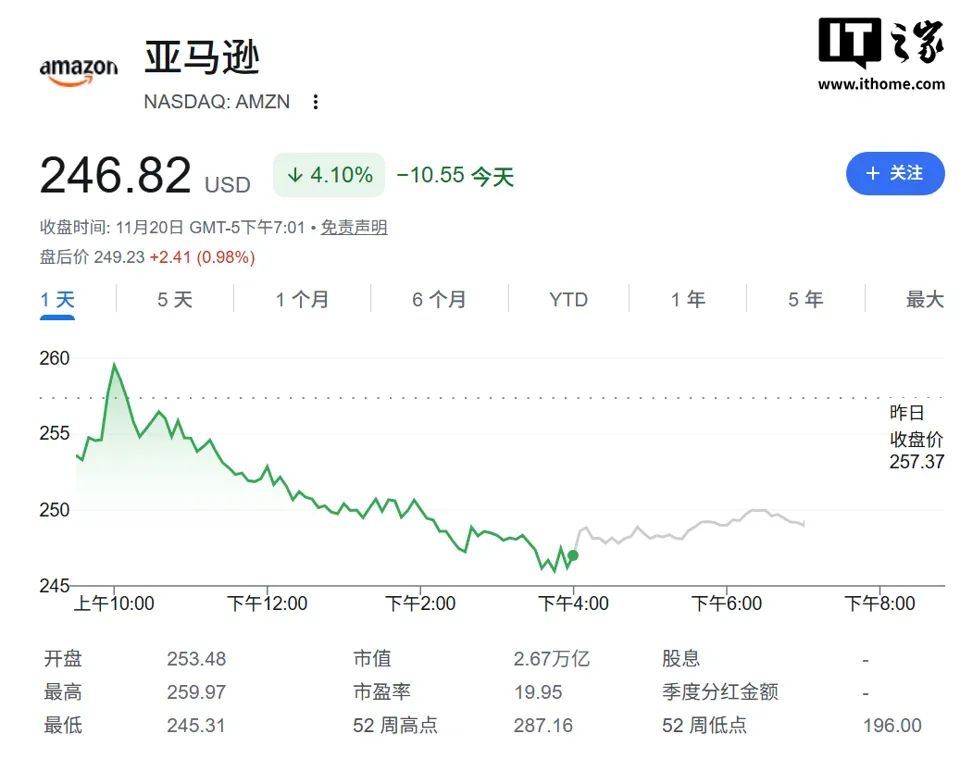
The Associated Press noted that on Friday, U.S. technology stocks and AI-related stocks broadly suffered heavy losses, with the S&P 500 falling 3.7%, the Nasdaq Composite falling 5.3%, and AMD and Micron dropping 13.3% and 13.9%, respectively.
Market concerns over the AI industry's high valuations, whether massive capital expenditures can be sustained, and the returns on related investments are intensifying the selloff in technology stocks. At the same time, stocks across the AI supply chain are under broad pressure, and the semiconductor sector has also seen sharp declines.
The direct trigger for this selloff points to a leadership upheaval at Nvidia. On November 8 local time, Nvidia co-founder Jensen Huang admitted to an extramarital affair in a letter to employees, and subsequently resigned on November 12 from his positions as president, chief executive officer, and board director.
On November 17, Nvidia Chairman Harvey Jones explicitly stated on the earnings call that the board "unanimously accepted his resignation and has no intention of letting Jensen Huang return as chief executive officer." Huang had previously publicly stated that he was ready to return to the company, but received no response from the board.
Nvidia's earnings report released on Tuesday itself beat Wall Street expectations, but investors were more focused on the impact of the scandal on corporate governance and strategic continuity than on the quarter's financial figures. Questions surrounding the reasons for Huang's resignation were not adequately explained on the earnings call, and selling pressure continued.
Nvidia's decline is not an isolated event. This week, the Nasdaq Composite fell 10% cumulatively. The Nasdaq 100 shed $2.1 trillion in market value in a single day, marking its worst weekly performance since the COVID-19 pandemic hit global markets in March 2020. The S&P 500 fell 8.6%, entering correction territory; the Dow fell 8%. The Cboe Volatility Index (VIX), known as the market's "fear gauge," rose to its highest level this year.
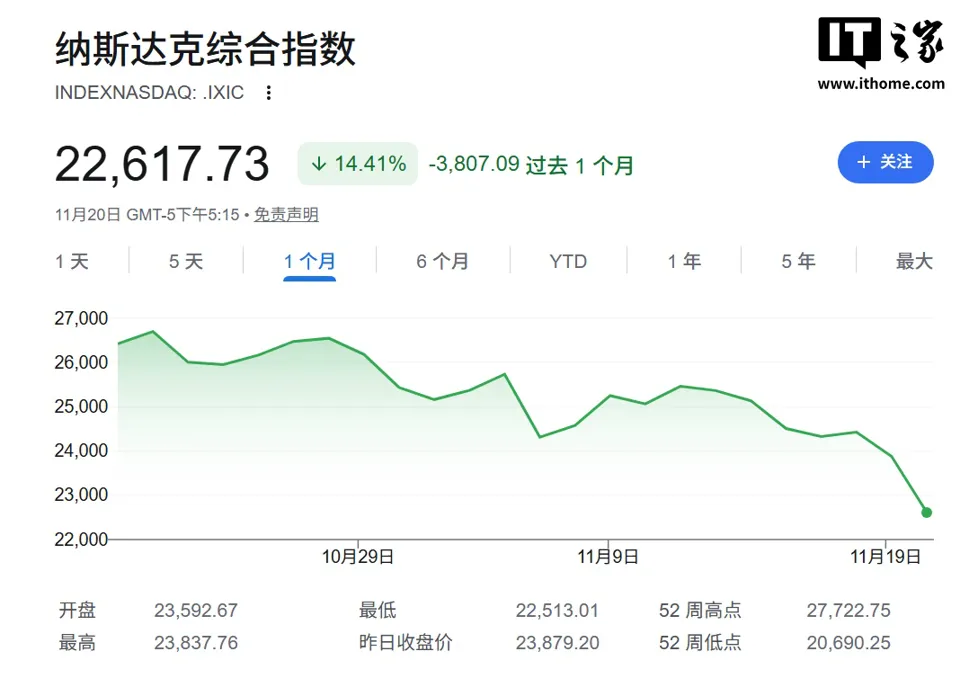
Almost no part of the AI sector was spared. Constituents collectively known as the "Magnificent Seven" all closed lower, and chipmakers and neocloud companies focused on GPU compute leasing generally recorded double-digit declines.
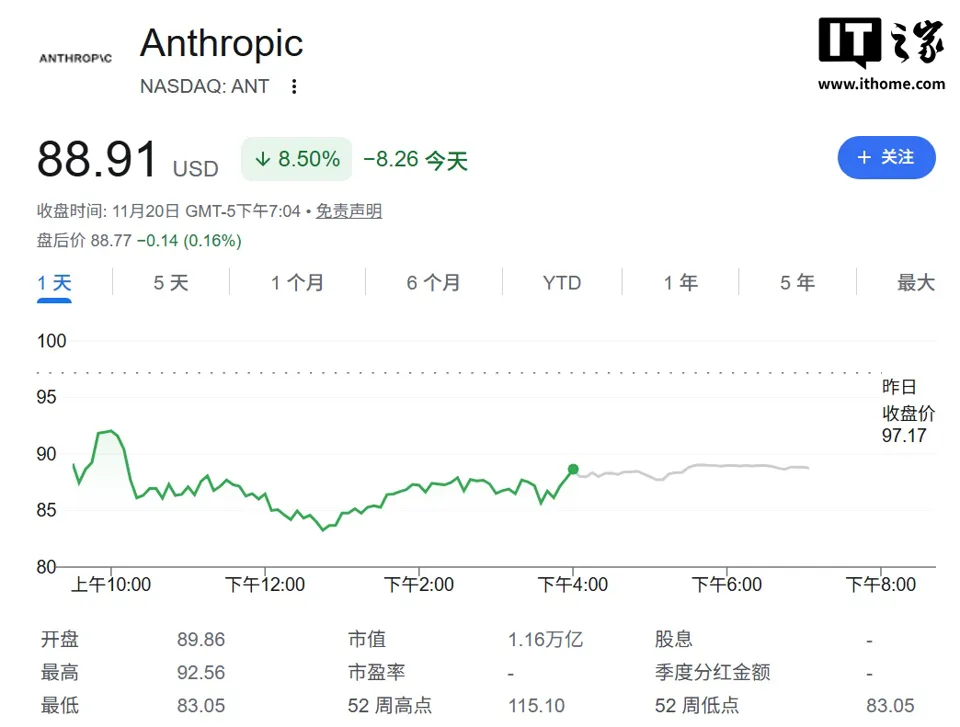
Anthropic's IPO had been seen by some market participants as a shot in the arm for the AI trade, but it failed to deliver. On November 19, Anthropic listed on the Nasdaq at an issue price of $83 per share, opened at $111.50, up about 34%, and its intraday market value briefly surpassed $2 trillion. But the gains were quickly given back after the open, and it closed its first day up only 17% from the issue price at $97.17.
On Friday, Anthropic fell further by 8.5%, with its stock price approaching the issue price. This largest IPO in history (raising about $81.3 billion) failed to prevent the Nasdaq Composite from erasing its year-to-date gains that day.
The Wall Street Journal noted that the shift in market sentiment was not caused by a single event. Rising social resistance to data center construction after the midterm elections, the change of Nvidia's CEO, and concerns over AI-related cyberattacks have together amplified investors' doubts about earnings forecasts for AI infrastructure companies.
Keith Lerner, chief investment officer at Truist Advisory Services, described this as a "buyers' strike" — investors have not lost confidence in AI's long-term potential, but they have lost confidence in the earnings forecasts underpinning current valuations.
The interest rate environment has further weighed on risk assets. Since Federal Reserve Chair Kevin Warsh took office in May 2026, the federal funds rate has remained in the 3.5% to 3.75% range, and the rate cuts the market had previously expected have not materialized. CME data shows that the market now expects a 96.4% probability that the Federal Reserve will raise rates by 25 basis points in December. Rising bond yields have both pushed up corporate borrowing costs and prompted some funds to shift from equities to fixed-income assets.