新智元 (微信公众号) · 10/8/2026, 08:13:00
GPT-6 Astra Solves 59-Year Nuclear Fusion Magnetic Surface Problem in 20 Minutes
OpenAI's latest model, GPT-6 Astra, derived a family of exact analytical solutions to a 59-year-old nuclear fusion magnetic surface problem in just 20 minutes and 34 seconds. Disclosed by a Kyoto University-affiliated AI blogger on X, this breakthrough demonstrates that large language models can now produce verifiable new theoretical results in complex mathematical physics, moving beyond mere approximate simulations.
SOURCE COVERAGEOriginal coverage
A nuclear fusion problem that had remained unsolved for 59 years was cracked by GPT-6 Astra in just 20 minutes and 34 seconds.
The physicist who posed the question simply added a line of encouragement at the end of the prompt:
"You have already solved many open mathematical problems, so I know that if you persist long enough, you can do it!"
Then, ChatGPT returned a family of exact solutions that no one had been able to derive in 59 years.
The first family of solutions found by Astra: nested magnetic surfaces stacked layer by layer, with the red and yellow lines representing magnetic field lines.
Recently, this breakthrough went viral on X (formerly Twitter).
An AI blogger, formerly a graduate student specializing in nuclear fusion at Kyoto University, posted a lengthy thread exclaiming that the era of AI and humans discovering new science together has truly begun!
The problem recently defeated was a conjecture left by plasma physicist Harold Grad in 1967.
At the time, he asserted that without symmetry, smooth three-dimensional plasma equilibria could not exist.
This statement hung over the stellarator route in nuclear fusion research for 59 years.
In late September, two papers published just one day apart jointly refuted it. Of the three families of counterexamples presented, two were discovered by Astra.
In two days, Astra delivered two families of solutions that no one had written down in 59 years
At 6 AM on September 10, Matt Landreman, a plasma physicist at the University of Maryland, sent a prompt to GPT-6 Astra Pro.
He wanted Astra to design a magnetic cage capable of confining plasma, specifically an asymmetric one.
The requirements included:
- The magnetic field must consist of nested magnetic surfaces, layered like an onion.
- The divergence must be zero, meaning magnetic field lines cannot appear or disappear out of nowhere.
- As the field lines follow the toroidal path (like a donut), they must also twist around the cross-section, spiraling forward like a rope. The number of twists is known as the "rotational transform," denoted by ι.
- Finally, the entire magnetic cage must satisfy MHD (magnetohydrodynamic) force balance, where the outward pressure of the plasma is exactly canceled by the magnetic forces everywhere.
He specifically noted that ι should preferably not be an integer, though this was not a strict requirement.
He even provided three conceptual approaches for generating the rotational transform: twisting the magnetic axis, rotating the cross-section along the path, or driving a current along the magnetic axis.
As he wrote the final two sentences, his tone shifted, sounding like he was encouraging a PhD student pulling an all-nighter.
When Astra submitted its answer, the first sentence was:
I have found a family of explicit, exact solutions.
This family of solutions satisfies all the hard constraints listed by Landreman.
The pressure is not constant; it varies layer by layer from the inside out. The nested magnetic surfaces can also be precisely described by formulas.
The central magnetic axis undulates up and down as a non-planar curve. As you go around the torus, the shape varies at every point—there is no axisymmetry.
Cross-sections of the first family of solutions show different shapes at three positions, with the magnetic axis shifting up and down accordingly.
Next, it proactively disclosed its shortcomings. In this family of solutions, the rotational transform ι is an integer. A field line travels once around the torus, completing exactly two full turns around the cross-section before returning to its starting point, forming a closed loop.
In its own words, the return map after one toroidal circuit is the identity map.
Landreman had stated in the prompt that ι being non-integer was merely a bonus criterion, so this family of solutions technically passed. However, what he truly desired were solutions where ι is irrational, ensuring field lines never return to their starting point but instead densely cover the magnetic surface over time.
At 4 PM the next day, Landreman sent this family of solutions back as an attachment, asking Astra to secure the bonus points this time.
Specifically, ι must be non-integer, preferably irrational, so that field lines never close on themselves. He ended with the same encouraging remark.
This time, Astra spent 33 minutes and 37 seconds thinking. Its first submission was simply: "Could not solve."
But it didn't come back empty-handed; instead, it proved a fundamental limitation.
The first family of solutions relies on a "quadratic oscillator" construction. The motion of field lines along the x, y, and z directions behaves like three spring oscillators with frequencies of 1, 1, and 2, respectively.
No matter how the frequencies and parameters are adjusted, these three frequencies remain locked in integer ratios. Consequently, ι is always an integer, and field lines inevitably close.
In other words, trying to patch or modify the first family of solutions is fundamentally flawed.
Within the same conversation, it then switched to a new construction and delivered a second family of solutions.
This time, ι varies across magnetic surfaces—a phenomenon physicists call magnetic shear. On nearly every magnetic surface, ι is irrational.
Second family of solutions: Magnetic surfaces twist as they progress; red and yellow lines represent field lines.
Before submitting, it performed its own verification. It substituted the equations into 1,202 points, checked errors using 64-bit automatic differentiation, and independently verified the results using fourth-order finite differences.
At 8 PM that evening, Landreman followed up with two specific questions.
First, is the magnetic axis a planar curve? Second, is the vacuum rotational transform non-zero? That is, do field lines still rotate around the cross-section relying solely on external coils, without any current from the plasma itself?
Eleven minutes later, Astra provided the answers.
The magnetic axis lies in a plane and forms an ellipse. The vacuum rotational transform is small but indeed non-zero.
In just two days, Astra produced two families of solutions. The remaining ten-plus days were human work.
He used the stellarator equilibrium solver DESC to compute both families of solutions, and further derived the equations term by term using SymPy and Mathematica.
On September 22, the paper was posted to arXiv. The acknowledgments began with:
These solutions were discovered by the AI model GPT-6 Astra Pro, which also drafted parts of the paper. All equations were manually verified by the authors.
He also exported the three dialogue sessions into a PDF and included them, along with the verification scripts, in the paper's GitHub repository.
Papers that fully disclose even the original prompts are rare.
Grad’s assertion left stellarators in limbo for 59 years
The goal of nuclear fusion is to confine plasma at temperatures exceeding hundreds of millions of degrees within a donut-shaped magnetic cage.
An ideal magnetic cage consists of nested magnetic surfaces, layered like an onion. Magnetic field lines wrap around their respective layers, while pressure decreases layer by layer from the center outward.
Physicists call this state MHD equilibrium, where the outward force of the plasma is perfectly balanced by the magnetic force at every point.
Tokamaks (such as ITER and China’s EAST) are axisymmetric; their cross-sectional shape remains constant as they loop around the torus. This equilibrium reduces to the two-dimensional Grad-Shafranov equation, which was solved decades ago.
The "Grad" in the equation’s name refers to the very person who later proposed the conjecture discussed here.
Stellarators (such as Germany’s Wendelstein 7-X) take a different approach, generating magnetic fields via twisted coils that are intentionally asymmetric.
The magnets of Wendelstein 7-X; the blue components are the twisted non-planar coils.
The problem lies precisely in this asymmetry.
In 1967, Harold Grad of New York University’s Courant Institute published a paper in Physics of Fluids, stating:
We believe it unlikely that there exists a general class of toroidal equilibria with smooth pressure.
In 1985, he pushed further, asserting that apart from symmetric exceptions, no families of solutions depend smoothly on parameters. In other words, if asymmetric solutions happen to exist, they can only be isolated cases.
That paper was titled "Theory and Applications of the Nonexistence of Simple Toroidal Plasma Equilibria."
This effectively told the stellarator camp: the perfect magnetic cage you aim to build may strictly speaking not exist.
For decades afterward, stellarators continued to be designed and built using approximate solutions and numerical computations. No one could guarantee whether the calculated equilibrium truly existed or was merely an artifact of approximation.
Two types of attempts came closest to a rigorous answer.
One was near-axis expansion, which yields approximate solutions only near the magnetic axis; these become invalid as distance from the axis increases.
The other was physicist Lortz’s proof in 1970. He demonstrated that an asymmetric equilibrium with mirror symmetry does indeed exist. However, the rotational transform for such solutions equals zero, meaning magnetic field lines do not twist around the cross-section, failing to confine the plasma. Moreover, he only proved the existence of the solution without explicitly deriving it.
Landreman’s two families of solutions fill all these gaps at once.
They hold rigorously throughout the entire torus, not just near the magnetic axis; is non-zero, so magnetic field lines genuinely twist around the cross-section; and they are exact analytical solutions, expressible directly in formulas on paper.
The magnetic field, magnetic surfaces, and pressure are all written using elementary functions—square roots, trigonometric functions, and similar basic expressions. The entire region is everywhere smooth, with pressure peaking at the magnetic axis and decreasing outward (the pressure gradient vanishes only at the magnetic axis).
In response, Landreman himself wrote at the end of his paper:
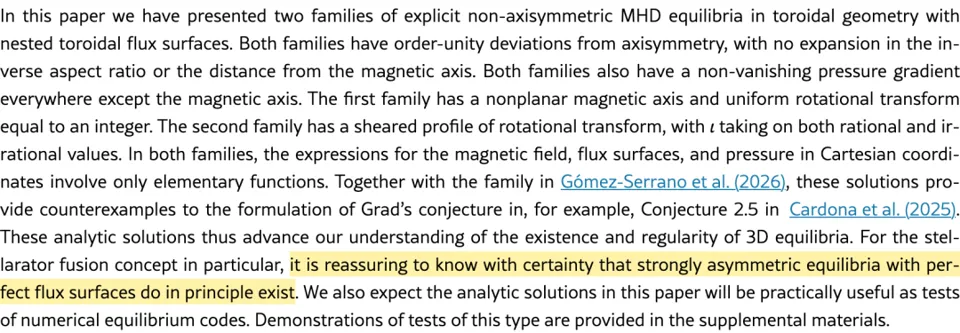
For stellarator fusion, it is reassuring to know with certainty that such strongly asymmetric, flux-surface-perfect equilibria exist in principle.
One Day Earlier, Mathematicians Used GPT and Claude to Overturn It Too
Just one day before Landreman published his paper, on September 21, another paper was posted first. Its title was straightforward: "Counterexamples to Grad's Conjecture."
The authors were Javier Gómez-Serrano from Brown University, Mitchell Taylor from Oxford University, and Lukas Liehr from Bar-Ilan University in Israel.
Gómez-Serrano had previously collaborated with DeepMind, using AI to find singularities in fluid equations, making him a familiar face in the AI-math community.
They took a pure mathematics approach, relying primarily on Nash-Moser iteration from hard analysis. The entire paper spans 147 pages.
The equilibria they constructed resemble an N-petal wreath. The shape coincides with itself every time it rotates 360/N degrees around the central axis, with no other symmetries. Mathematically, this means the symmetry group is exactly the cyclic group C_N, where N can be any sufficiently large integer.
Equilibria constructed by the Gómez-Serrano team: nested pressure surfaces, a closed magnetic field line, and the magnetic axis
Grad’s original judgment was that smooth equilibria must possess at least one of axial symmetry, mirror symmetry, or helical symmetry. This batch of "wreaths" possesses none of them. They only coincide when rotated by a fixed angle, whereas axial symmetry requires invariance under arbitrary rotations, so they do not qualify.
More critically, these equilibria can deform continuously with a parameter, forming an entire family. Grad’s 1985 assertion that "no smooth solution families exist" was also overturned along with it.
Additionally, the main result was accompanied by a formal proof in Lean 4.
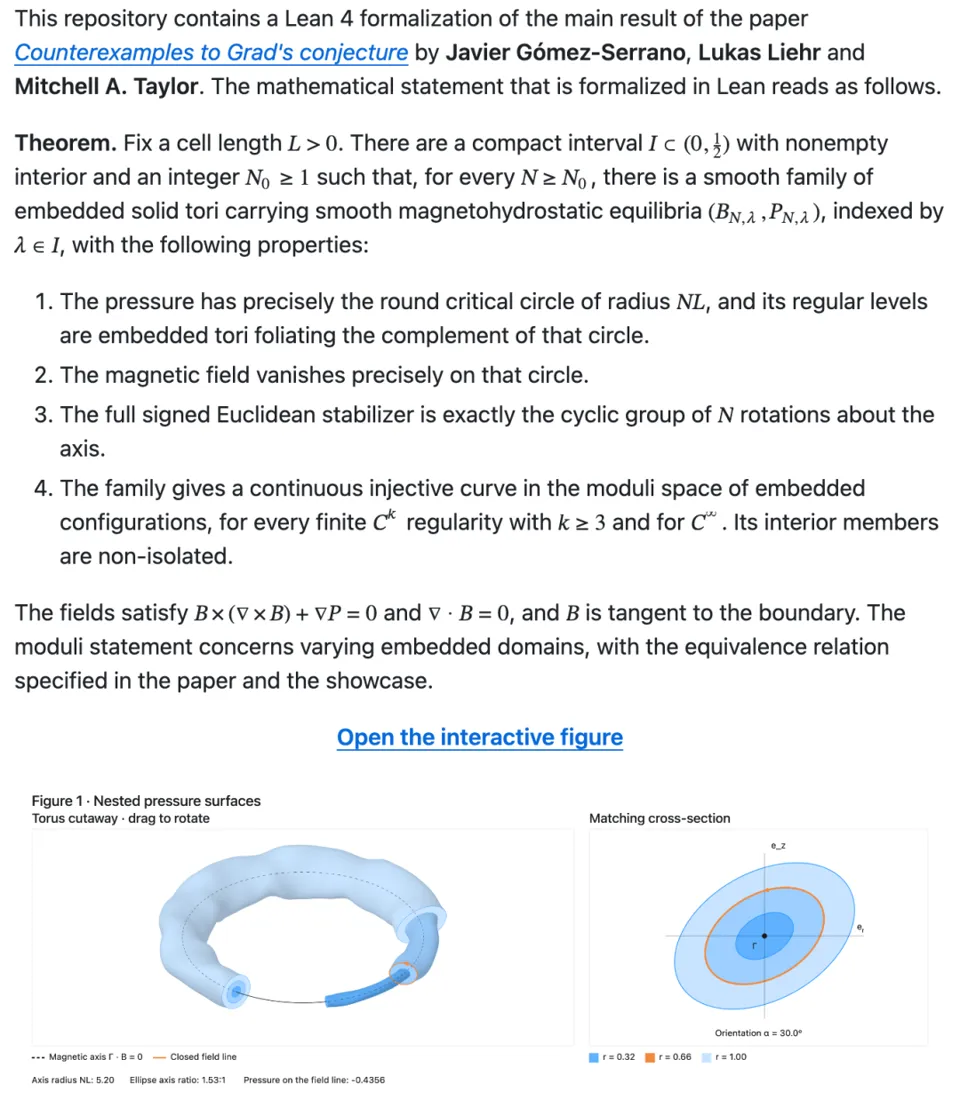
Lean repository homepage: the formalized main theorem above, interactive diagrams below
How were these 147 pages written? The paper includes a dedicated section explaining the process.
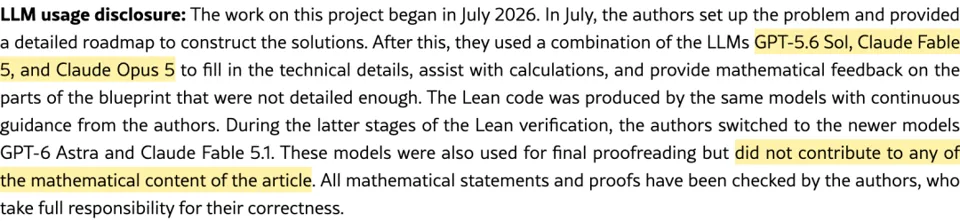
The project began in July. The three authors first set up the problem themselves and drew a detailed construction roadmap. The remaining fine-grained work was delegated to large language models.
GPT-5.6 Sol, Claude Fable 5, and Claude Opus 5 took turns filling in technical details for parts not covered in the roadmap, assisting with calculations, and identifying mathematical errors. The Lean code was also generated by these models under close supervision by the authors.
In the later stages of Lean verification, they switched to newer models, GPT-6 Astra and Claude Fable 5.1, which also handled the final proofreading.
Thus, a problem that had remained unsolved for 59 years was overturned by two papers, back-to-back within a week, with the help of AI.
The Next One to Fall Might Be in Physics
A month ago, OpenAI announced that it used tens of thousands of agents running for 88 hours to solve the Navier-Stokes Millennium Prize Problem.
This time, all it took was one physicist, a chat interface, and 20 minutes.
Landreman even made all the prompts public, allowing anyone to replicate the queries.
Within a week of the paper’s release, Przemek Chojecki, a PhD student in mathematics specializing in AI math, fed these results into GPT-6 Astra and Opus 5.5, uncovering even more families of counterexamples.
These new solutions have not yet been verified by Lean or subjected to peer review. But as soon as this family of solutions was made public, others were already using AI to dig deeper.
Going forward, more and more physicists will follow Landreman’s lead, throwing long-standing problems that have sat in their drawers for decades directly at AI.
This time it was nuclear fusion. Next, it could be materials science, astrophysics, or any equation that has been approximated for decades.
References:
https://x.com/itsolelehmann/status/2107144201314181183
Chasing ASI in Seconds
⭐ Like, Share, and "Wow" – The One-Click Triple ⭐
Star us to stay locked in on the latest from New Intelligence!