OpenAI Reorganizes Embodied AI Team to Make GPT-6 Astra the Robot Brain
OpenAI has confirmed it dissolved its standalone robotics team, folding researchers into core research and hardware staff into the applications division, stressing the move accelerates rather than exits robotics. The company says general models including GPT-6 Astra can already handle some robotic tasks, and it aims to make multimodal general models the robot brain instead of relying on robotics-specific models. An Nvidia study cited Astra-driven agents hitting 74.8% success on a simulated manipulation benchmark versus 51.0% for leading specialized models, though inference speed, cloud dependency and field data remain practical hurdles.
Related Entities
Full Report
IT之家 November 14 news: Fortune yesterday (November 13) published a blog post revealing that OpenAI has disbanded its independent robotics team and reassigned the relevant personnel to other departments within the company. OpenAI confirmed this organizational adjustment to the media, only emphasizing that this adjustment does not mean exiting the robotics field—robotics remains at the core of its long-term vision, and the restructuring is intended to accelerate research and development.
Regarding the structural adjustment, robotics researchers have been merged into the core research team, reporting to Chief Research Officer Mark Chen; the applied robotics and hardware team has been moved into the larger applications department, which is led by company President Greg Brockman. IT之家 attaches the relevant screenshot below;d
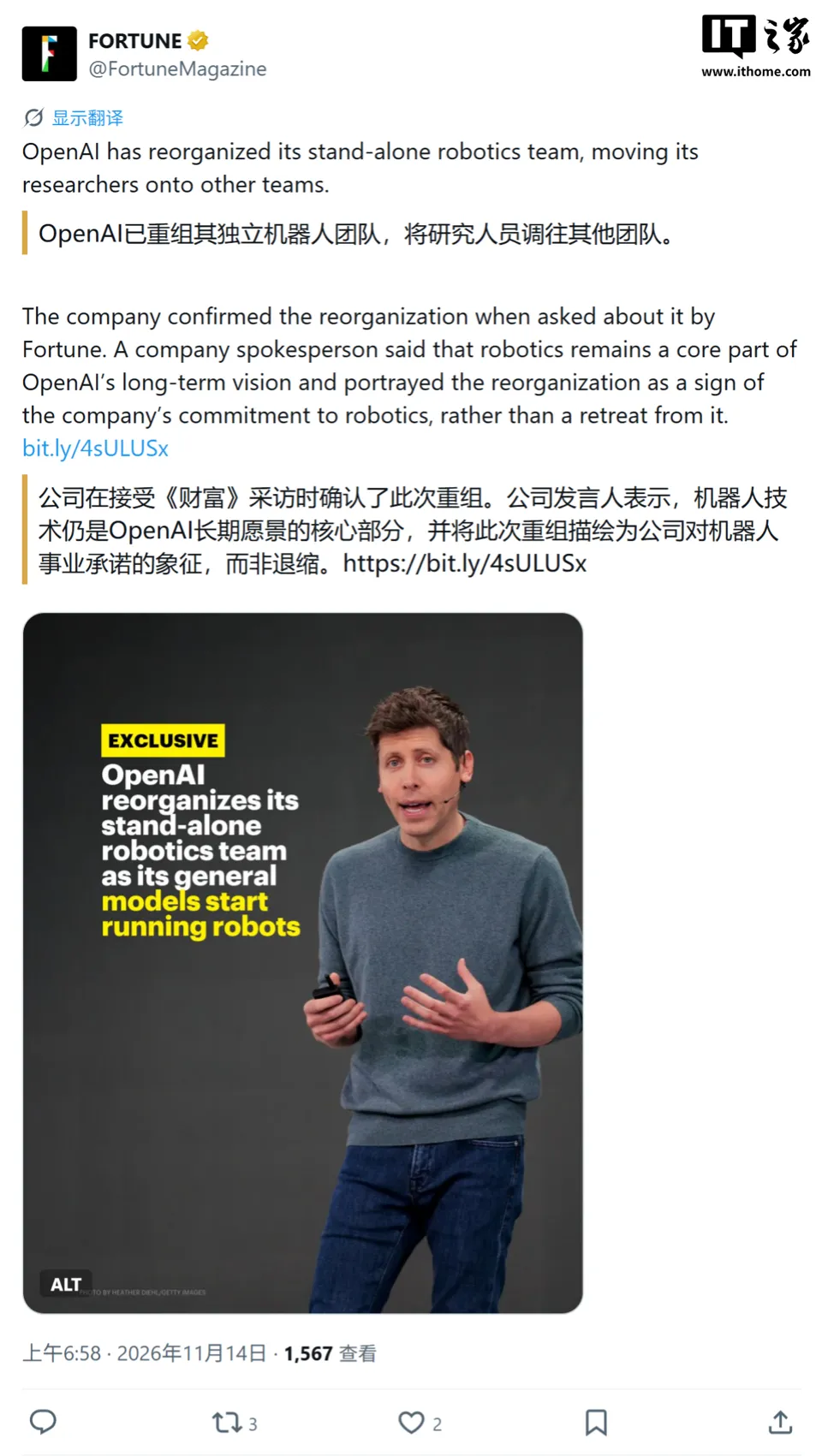
As for the root cause of this structural adjustment, OpenAI officially responded that general models, including GPT-6 Astra, can already be used directly for some robotics tasks, so it decided to further integrate the relevant research into general model development.
OpenAI hopes to make AI that can understand text, images, and code also serve as the "brain" of robots, rather than relying entirely on models developed specifically for robotics. The report cites an NVIDIA study stating that an Astra-driven agent achieved a 74.8% success rate in a simulated manipulation test, higher than the 51.0% of the leading specialized model on that leaderboard.
Whether general models can fully take over robotics still faces practical challenges. Scholars interviewed pointed out that the running speed of large models and the need for cloud connectivity constitute limitations, and the on-site experience and data accumulated by robotics companies still have value. According to reports, OpenAI is developing its own humanoid robot, with the goal of its first public demonstration in 2027.