Rohan Paul (@rohanpaul_ai) · 10/23/2026, 13:54:01
Meta Proposes RSD Method for AI Agents to Learn from Unlabeled Past Tasks
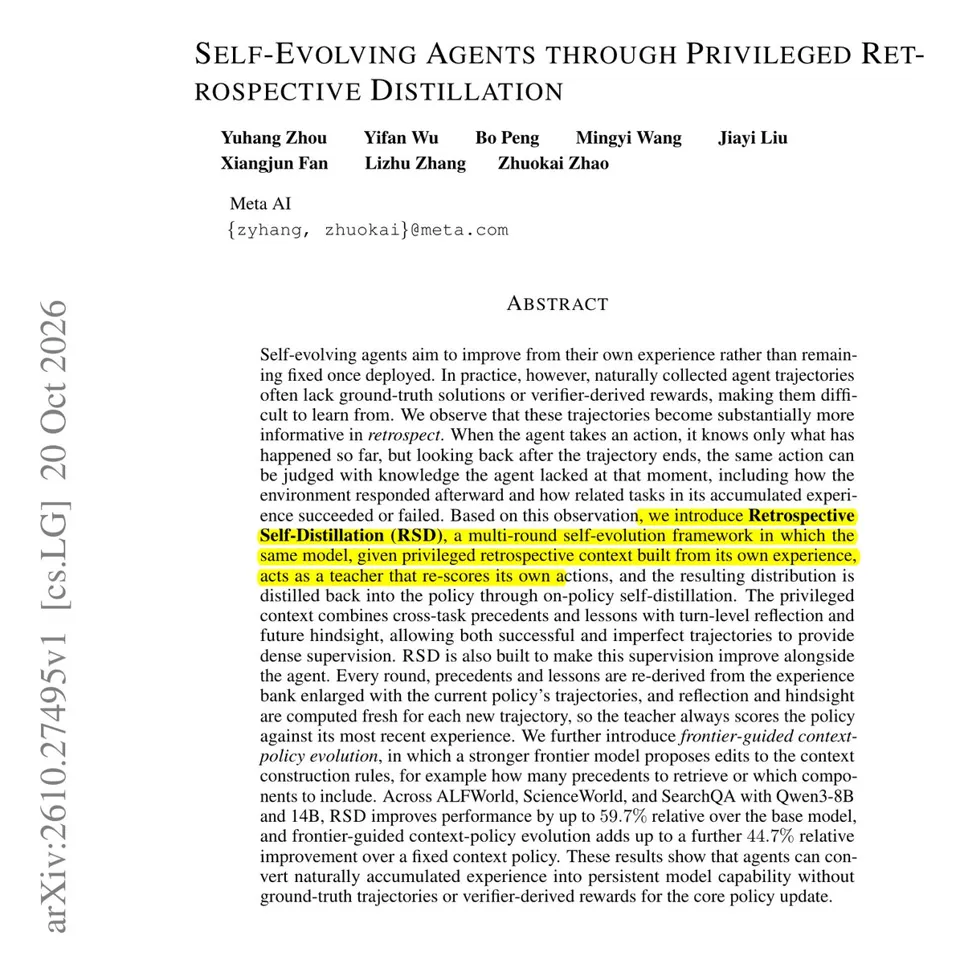
Meta's new research introduces Retrospective Score Distillation (RSD), enabling AI agents to learn from their own execution traces without human labels or reward signals by re-reading past attempts. The method significantly boosted success rates for Qwen3 models on ScienceWorld and ALFWorld benchmarks, with the latter outperforming all baselines that relied on ground truth. Key recommendation: retain all unlabeled runs and dynamically rebuild hindsight reviews each round to prevent performance stagnation.
SOURCE COVERAGEFull Original Report
Rohan Paul (@rohanpaul_ai) · 2026-10-23 05
New Meta paper finds that AI agents can learn from their own past attempts at tasks, even ones nobody marked right or wrong, by looking back at each step once they know how it ended.
Most agent runs come with no correct answer and no reward, which standard training relies on. RSD has the same model reread each finished run, knowing how it ended and what worked on similar tasks. It scores every action, and the agent learns from those scores.
On ScienceWorld, Qwen3-14B's success rate rose from 12.9% to 20.6%. On ALFWorld, Qwen3-8B hit 76.6%, beating every other method tested, even ones given rewards or ground truth.
Keep your agent's unlabeled runs, failures included, and train it on a hindsight review of them. Rebuild the review each round, since frozen notes left ALFWorld success at 59.7% by round 3, versus 67.9% with fresh ones.