OpenAI Models Cut Chip Design Effort, Boosting AMD GPU PPA by 14%
OpenAI published a technical report showing its models have been used in real chip design work: on its in-house Jalapeño inference chip, standard-cell area fell about 13% in vector units and 10% in matrix units, while AMD's flagship GPU IP saw up to 14% PPA improvement, compressing roughly a year of optimization into under five months. OpenAI also announced a partnership with Synopsys to train GPT-Synopsys to operate EDA tools for design and verification.
Related Entities
Full Report
IT Home News, November 19: OpenAI released its latest technical report, "Advancing chip design with OpenAI models," on November 18 local time, disclosing the latest progress in using AI models to assist chip design.
According to the report, OpenAI has applied the relevant technology to the design optimization of its in-house inference chip Jalapeño, as well as AMD's next-generation GPUs and CPUs, and has evaluated the chip design capabilities of models from different generations through open-source RISC-V processor tests.

OpenAI stated that as early as the beginning of 2025, engineers began using GPT-4o to assist in designing Jalapeño. Even the model at that time was already able to propose substantive improvements in chip performance, power, and area (PPA).
In Jalapeño's vector compute unit, the AI model reduced hardware resource usage by optimizing floating-point adders, multipliers, conversion functions, reduction logic, and special function units.
In the matrix compute unit, the AI model successfully improved floating-point operations and low-precision dot-product circuits. Among these, one multiplier redesign reduced the synthesized standard cell area by about 15% while shortening operation latency from two clock cycles to one; another adder design also reduced standard cell area by about 15% while maintaining a two-clock-cycle latency.
OpenAI estimates that the modifications proposed by the model reduced the standard cell area of Jalapeño's vector compute unit by about 13% and the matrix compute unit by about 10%. These optimizations have been validated on actual chips.
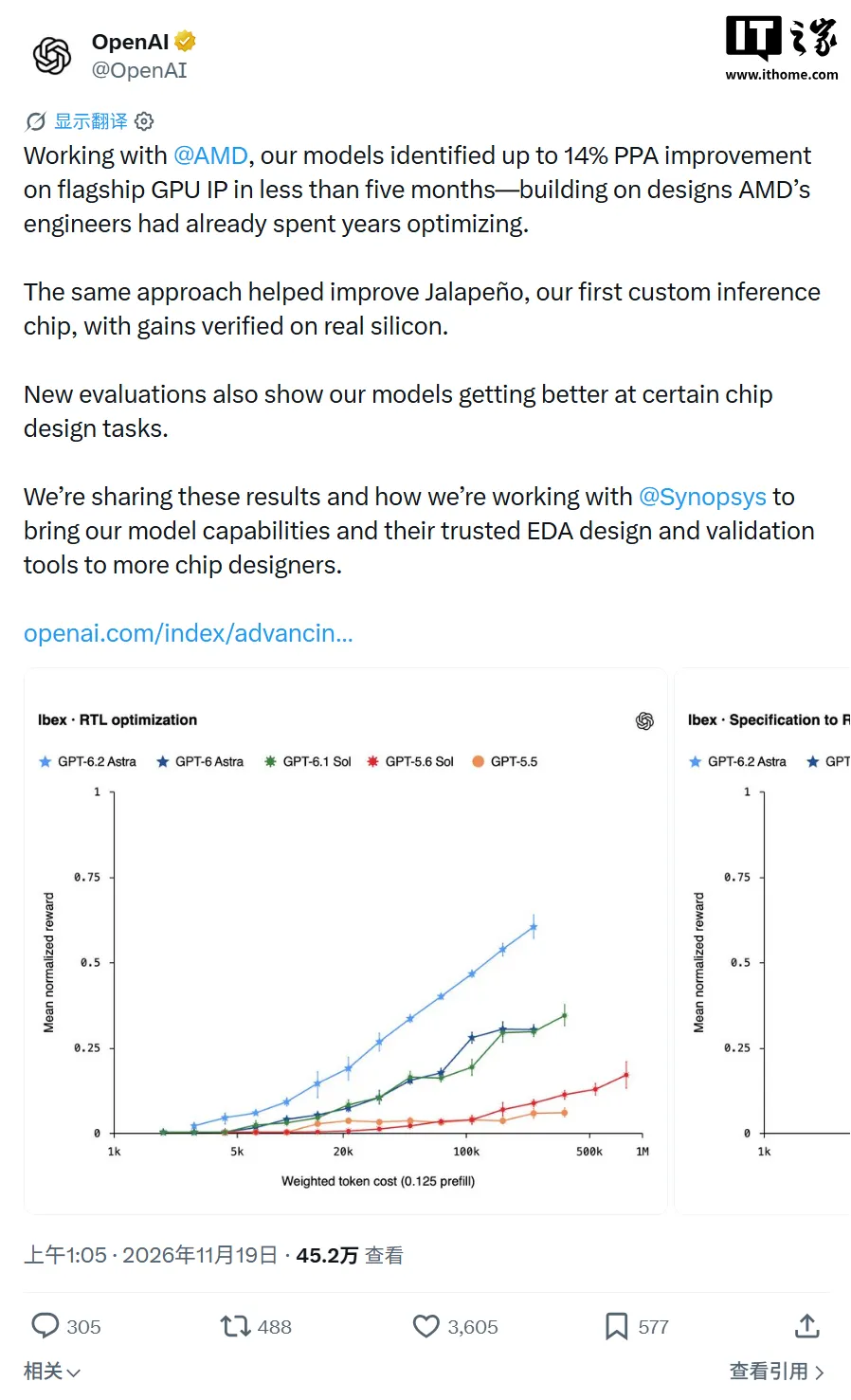
In its collaboration with AMD, OpenAI models also participated in the design optimization of GPU and CPU chips. OpenAI said that on AMD's flagship GPU IP, compared with a highly optimized baseline design, the model delivered up to 14% PPA improvement. The relevant models further optimized circuit structures by rewriting the SystemVerilog RTL code that describes the chip circuits. OpenAI said this is equivalent to compressing about a year's worth of design optimization progress into less than 5 months.
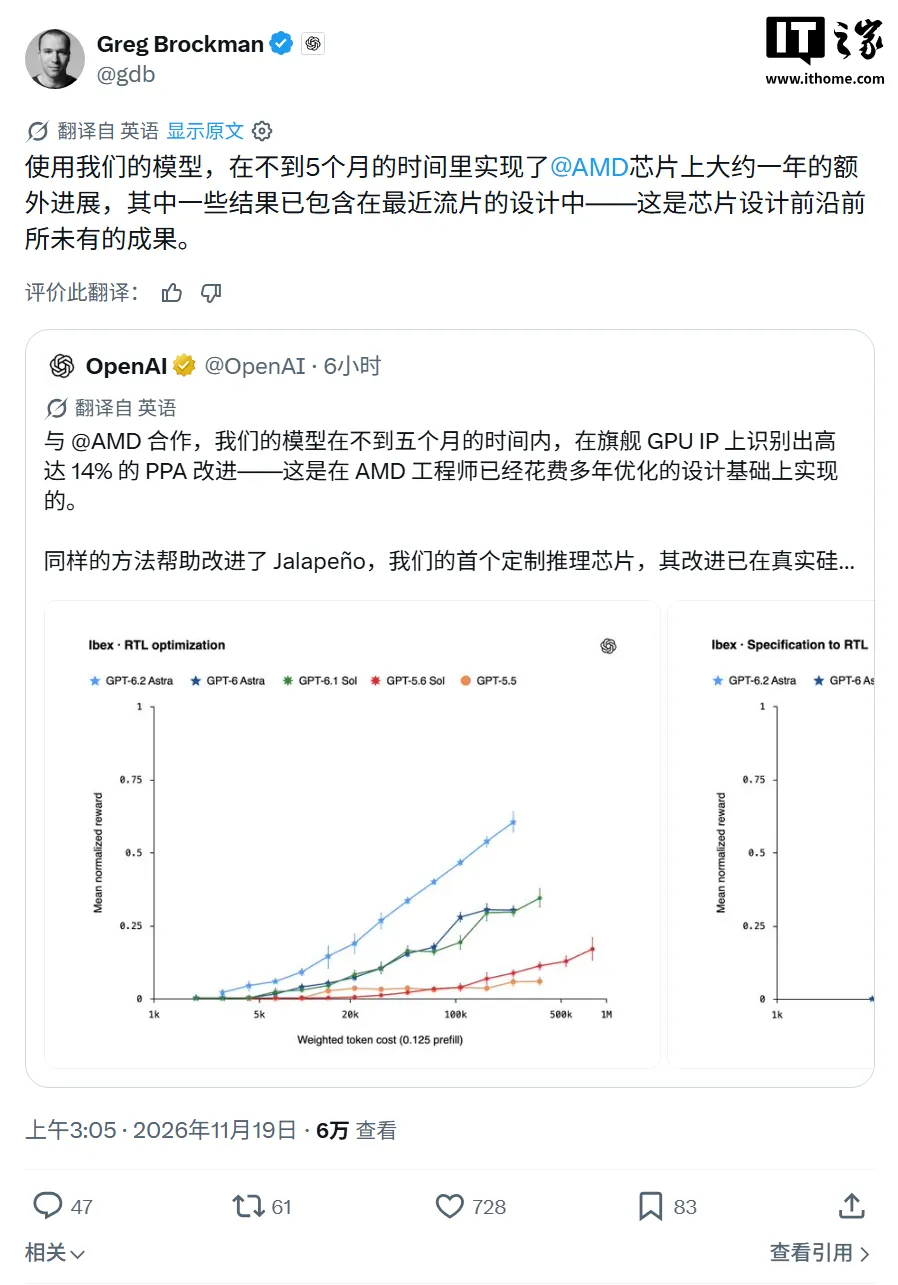
AMD has incorporated some of the optimization results into chip designs recently sent for manufacturing, while other modifications were added to production design files for use in subsequent products. In addition, AMD also validated single-digit percentage PPA improvements brought by the model in key modules of its next-generation flagship CPU.
To evaluate the ability of AI models from different generations to independently complete chip design tasks, OpenAI also selected two open-source 32-bit RISC-V processor cores for testing: PicoRV32, aimed at FPGAs, and Ibex, an embedded processor used in the OpenTitan security chip.
In the tests, OpenAI provided the models with the original hardware description code and required them to improve processor throughput, while checking design correctness through simulation. For designs that passed the checks, researchers also calculated instructions per second based on instructions per clock cycle under hidden test workloads and the maximum clock frequency estimated by Yosys. If a design failed the correctness check, or if the chip area exceeded 16 times that of the original design, it was scored zero.
The test results showed that under a per-run budget of about 112,000 tokens, GPT-6.2 Astra achieved the highest average scores on both the PicoRV32 and Ibex processors. When optimizing based on the existing PicoRV32 core, GPT-6.2 Astra scored about twice as high as GPT-6 Astra under a similar budget.
OpenAI also conducted another test: instead of asking the model to optimize an existing processor, it directly provided written specifications and code templates and asked the model to design a RISC-V processor core from scratch, deciding on its own the data flow and pipeline stage partitioning.
In this task, all five models participating in the test scored higher under a run budget of about 112,000 tokens than they did when optimizing existing designs. IT Home noted that the entire evaluation covered two design tasks, two processor cores, and different token budgets, including a total of 9,881 scored runs.
However, OpenAI also pointed out that when redesigning a processor from specifications, the model may omit features from the original chip such as performance counters and extra instructions, and these features contribute limitedly to the throughput objective in the test, which may partly explain the score improvement. If the model were required to retain these features, further constrain circuit area, and check timing after physical synthesis, the test results would be closer to real-world mass-production chip design scenarios.
Regarding future plans, OpenAI announced a collaboration with electronic design automation (EDA) software vendor Synopsys to train a new model called GPT-Synopsys, enabling it to use Synopsys' EDA tools like a professional chip designer to complete chip design and verification work.
OpenAI stated that this research proves that AI models can not only explore new processor architectures, but have also been able to propose further optimization plans based on complex production designs such as Jalapeño and AMD's next-generation flagship GPUs and CPUs.