Neuralink Reports 75 WPM Output for ALS Patient in New BCI Study
Neuralink released early feasibility data from its VOICE project, showing an ALS patient achieved 75 words per minute output within the first week of implantation, with a 5.8% word error rate on a large vocabulary. While this speed approaches normal conversation and highlights BCI potential for restoring communication, the results are based on a single participant and lack peer-reviewed validation.
Full Report
IT Home reported on October 30 that Neuralink, the brain-computer interface (BCI) company founded by world’s richest person Elon Musk, published a blog post on October 28 revealing early feasibility study results for its voice restoration project, VOICE. The system enables participants with amyotrophic lateral sclerosis (ALS, commonly known as "Lou Gehrig's disease") to convert brain signals into text and speech output at speeds approaching natural conversation.

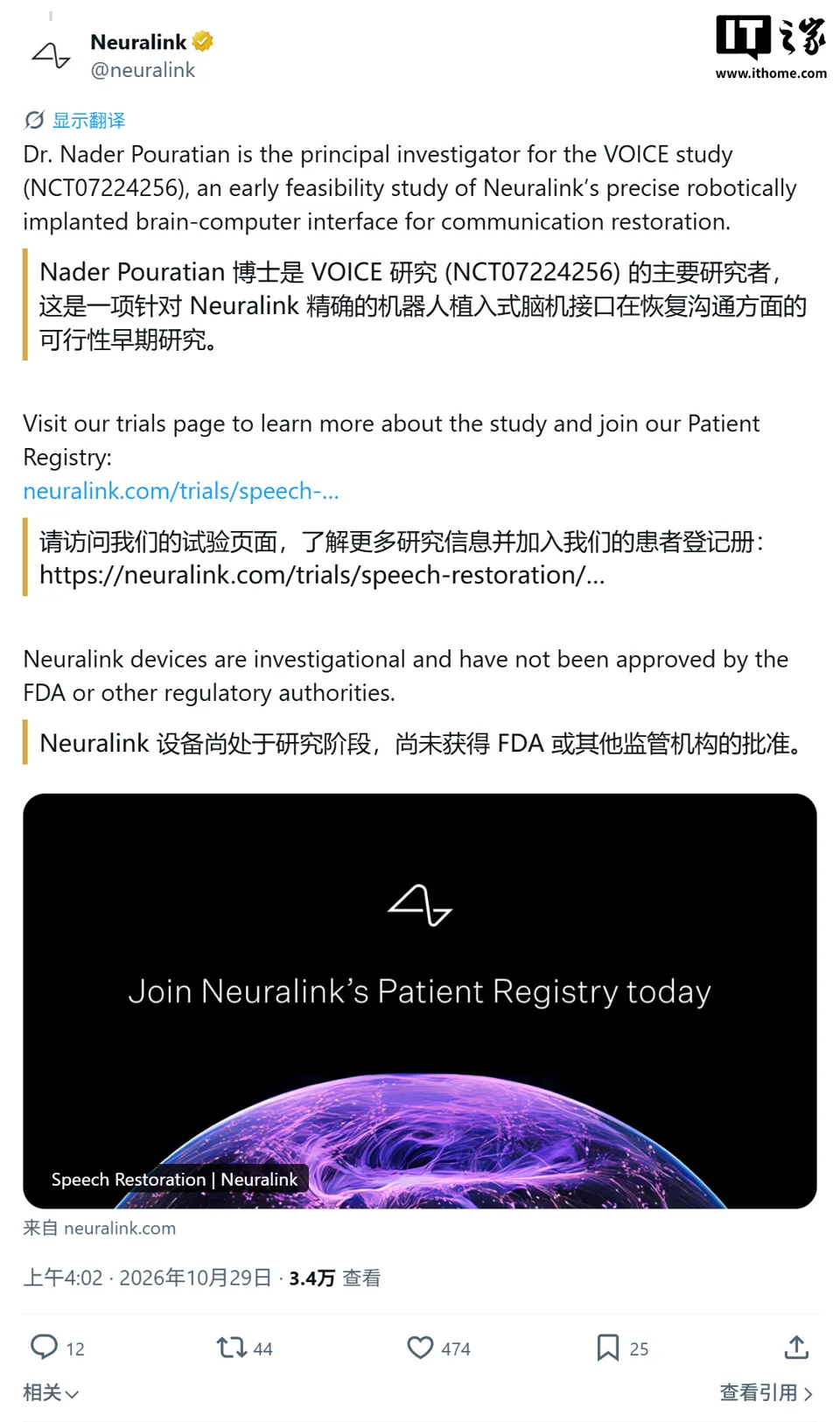
Citing tweets from the company, IT Home noted that one participant reached an output speed of 75 words per minute (WPM) during their first week of use. With a large vocabulary of 125,000 words, the word error rate (WER) was 5.8%, meaning approximately one error occurred for every 17 words.

The company stated that Dr. Nader Pouratian, the lead researcher, presented these findings at the 2026 NEALS Annual Meeting. The study plans to recruit approximately six participants who have lost communication capabilities due to ALS, spinal cord injuries, or strokes. The primary endpoint is device- or surgery-related adverse events within 12 months post-implantation, while speech performance serves as a secondary endpoint.
For ALS patients, the disease progressively impairs abilities such as speaking and typing. If BCIs can reliably decode "intended speech" into text and further synthesize it into audio, this could significantly lower the barrier to communicating with others.
The recently announced speed of 75 words per minute falls within the range capable of supporting relatively fluent conversation; a 5.8% error rate also indicates that the system retains most semantic content even when operating with a large vocabulary.
Neuralink currently discloses results via social media platforms and academic conferences but has not yet published a full peer-reviewed paper. The figures are derived from a single participant, and the company has not specified the types of testing tasks, separate performance metrics for text versus speech output, data stability, or long-term efficacy.
References
Advertisement Disclaimer: External links contained in this article (including but not limited to hyperlinks, QR codes, and passcodes) are provided to convey additional information and save selection time. Results are for reference only. All IT Home articles containing external links include this disclaimer.