InfoQ 中文 · 10/19/2026, 16:13:09
DoorDash Launches Flux Cloud Platform to Automate 130k Engineering Tasks Monthly
DoorDash migrated engineering agents from local laptops to its self-built Flux cloud platform, automating 130,000 tasks monthly and 25,000 code reviews weekly. The platform resolves compute bottlenecks, security risks, and observability gaps via isolated sandboxes, an MCP gateway, and reusable Playbooks, enabling multi-channel triggers without requiring developer devices to be online.
SOURCE COVERAGEFull Original Report
DoorDash has migrated its engineering agent workloads from developers' local laptops to its proprietary Flux cloud platform, achieving the automation of 130,000 tasks per month and 25,000 code reviews per week. By leveraging isolated sandboxes, an MCP gateway, reusable Playbooks, and multi-channel trigger mechanisms, the platform addresses bottlenecks in local compute resources, security risks, and lack of observability.
The platform provides unified control over agent execution environments and system access permissions; it supports triggers via Slack, GitHub, Cron, and other channels without requiring developer devices to be online; and its 300+ Playbooks enable workflow standardization and cross-team reuse.
Target Audience: Platform Engineers, SREs, Security Architects

DoorDash has migrated its engineering agent workloads from developers' laptops to its Flux cloud platform, which automated 130,000 engineering tasks in a single month in 2026. The platform supports over 25,000 automated code reviews weekly, features more than 300 Playbooks, and handles over 10,000 trigger invocations per week, allowing workflows to run unattended and in parallel.
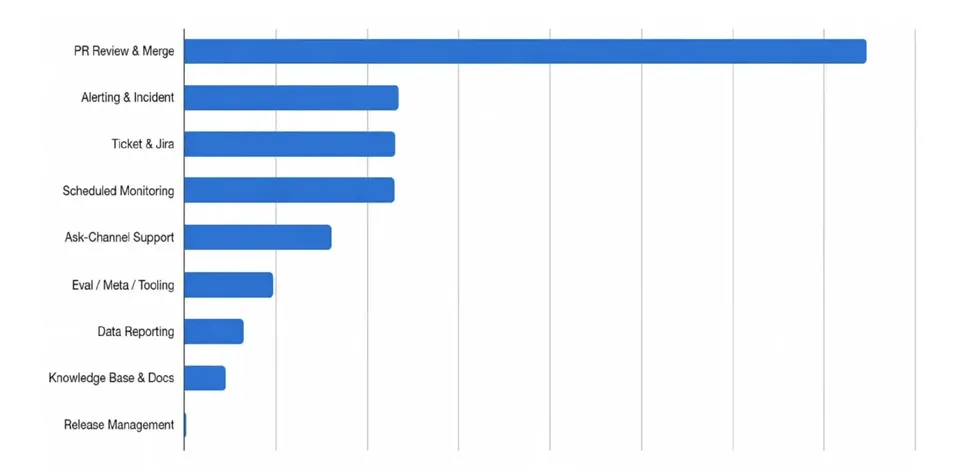
DoorDash developed Flux after encountering limitations when running agent workloads on individual laptops. Local execution was constrained by available CPU and memory, relied on developer devices remaining online, and potentially allowed autonomous agents to access credentials and internal systems already possessed by developers. DoorDash also noted that local execution made it difficult to monitor where agents were running, which systems they accessed, and on whose behalf they operated.
Security Architect Radoslav Krehlik posted about Flux on LinkedIn, stating:
It was built after laptop-based agents hit limits in compute, uptime, and security. Engineers can trigger agents from Slack, GitHub, or scheduled tasks, while DoorDash maintains full enterprise security guardrails.
Flux is built on four platform primitives: Cloud Sandboxes, an MCP Gateway, Reusable Playbooks, and Invocation Surfaces. Playbooks define the work, Sandboxes provide isolated execution environments, the Gateway controls access to internal systems, and Invocation Surfaces allow workflows to be triggered via Slack, GitHub, Cron, command line, or session interfaces.
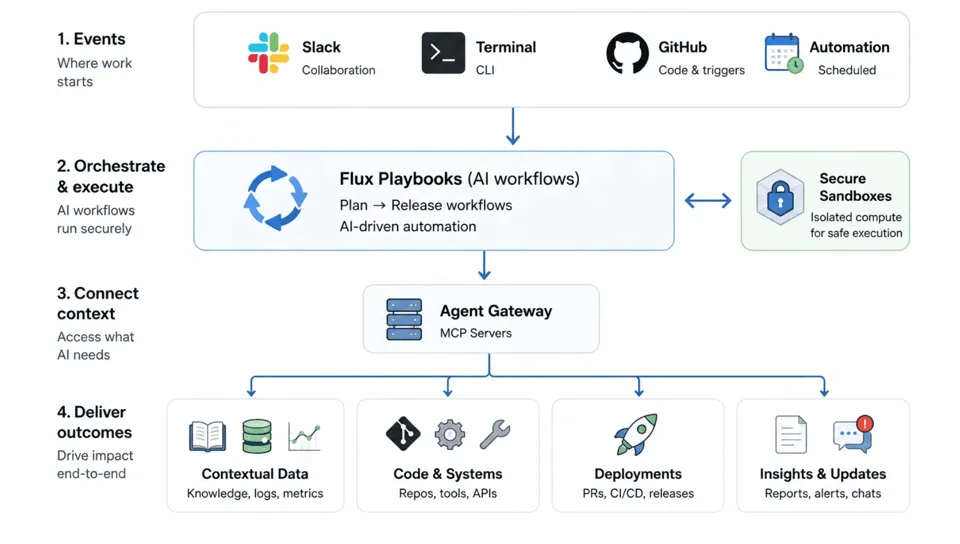
These Sandboxes use Firecracker micro virtual machines to isolate agent workloads. Each environment is pre-configured with the repositories, development tools, keys, and runtime dependencies required for the task. According to DoorDash's report, the p95 target for end-to-end Sandbox provisioning—including starting the microVM, cloning repositories, installing build tools, and configuring the coding agent harness—is under five seconds.
Agents access DoorDash's internal systems through the Agent Gateway, an internal MCP gateway that provides scoped permissions and logs agent activity for auditing and policy enforcement. YAML-defined Playbooks specify tasks, required tools, permissions, validations, and security boundaries. They can combine agent-driven steps with deterministic code, using the latter where predictable execution or validation is required.
Duy Nguyễn, Co-founder of TOP GROUP Vietnam, posted about Flux on LinkedIn, writing:
Once agents handle background work, code reviews, internal tools, and concurrent execution, the difficulty shifts from model selection to control: identity, permissions, sandboxing, audit logs, quotas, and real kill switches.
This approach is part of a broader trend toward cloud-based execution models for coding agents. GitHub provides both local and cloud Sandbox environments for Copilot, allowing developers to control file system, network, and system access permissions. Its cloud Sandbox offers agents an isolated execution environment, enabling them to run coding tasks without consuming the local developer’s compute resources. For more details on its cloud-based execution model, see GitHub’s official documentation.
DoorDash initially used Flux for automated code reviews, describing this step as a high-frequency workflow with measurable outcomes. The company subsequently expanded the platform’s application scope to CI triage, on-call duties, routine maintenance workflows, and ticket-driven development tasks. Additionally, DoorDash shifted its Slack integration from private channels to public threads, enabling engineers to observe agent executions, review results, and understand how other teams assign and delegate tasks.
View the original English article: DoorDash’s Flux Runs 130,000 Engineering Tasks Through Cloud-Based Agents