OpenAI Partners with Goodfire on Embedded Model Interpretability Audits
OpenAI launched its first Embedded Assessments program with Goodfire, Apollo Research, METR and Transluce, granting outside experts deep access to internal models, checkpoints and training data. Goodfire will embed interpretability researchers to perform model forensics on training-time anomalies. OpenAI had earlier explored acquiring Goodfire for over $5 billion, but the startup chose to stay independent and sell to multiple labs.
Related Entities
Full Report
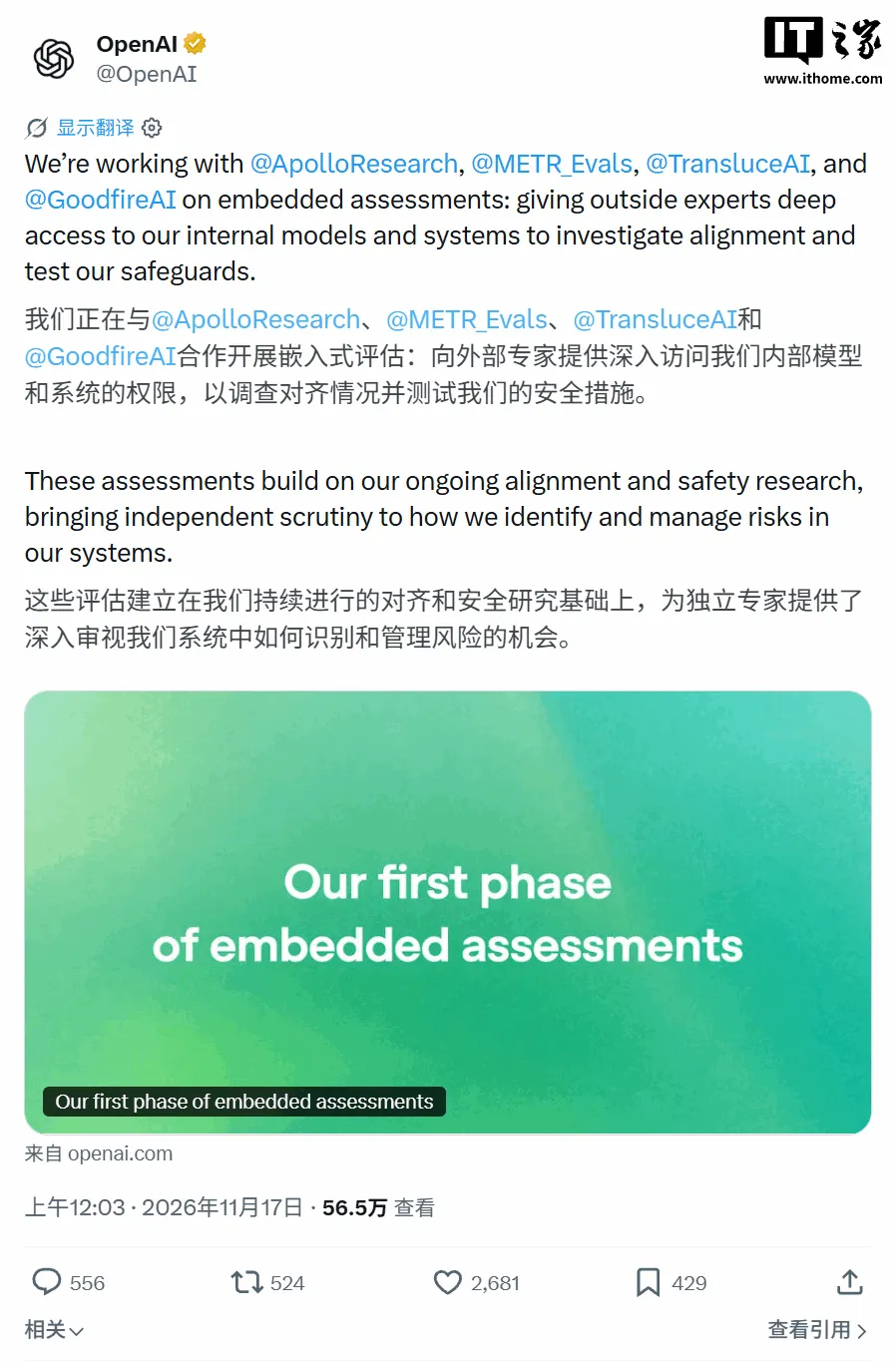
IT之家 November 17 news: Today, OpenAI announced that it has reached partnerships with Apollo Research, METR, Transluce, and Goodfire, and will launch the first phase of its Embedded Assessments program to jointly carry out work on model interpretability and safety evaluation.
Meanwhile, according to a report today by The Information, OpenAI had previously explored a plan to acquire Goodfire for more than $5 billion (IT之家 note: approximately RMB 33.392 billion at current exchange rates), but the two sides ultimately failed to reach an acquisition agreement.
According to an announcement released by Goodfire, the company will send interpretability researchers to OpenAI to use its own interpretability analysis platform to monitor the model training process, investigate unexpected behavior, and help improve model alignment and safety. The researchers will receive deep access to OpenAI's internal models and systems, specifically including internal signals during training and related technical resources.
The focus of this collaboration is Model Forensics. Goodfire will analyze the model's internal computation process to monitor known risks and anomalous behavior during training, helping OpenAI researchers identify issues that traditional monitoring methods may miss. The evaluation results will mainly be provided to OpenAI's internal research team to improve model safety. Goodfire also said that as the collaboration progresses, it will gradually publish some of the research results.
In its announcement, OpenAI said that embedded assessments allow independent experts to gain in-depth access to a lab's internal models and systems over an extended period to evaluate model alignment and the effectiveness of safety safeguards. Depending on the needs of different assessment projects, external evaluators may have access to model checkpoints, source code, training and evaluation data, monitoring systems, technical documentation, and the researchers and engineers responsible for the related work.

On the other hand, according to The Information, OpenAI contacted Goodfire multiple times this summer, and OpenAI CEO Sam Altman also participated in the related discussions. At the time, OpenAI was investigating internal and external safety incidents caused by AI models and hoped to use Goodfire's technology to gain a deeper understanding of model behavior.
People familiar with the matter said that a senior OpenAI executive had proposed acquiring Goodfire for more than $5 billion, or pursuing other forms of commercial partnership. Calculated based on the acquisition offer, its valuation would be more than four times the $1.25 billion valuation Goodfire announced during its financing in February this year.
However, the two sides ultimately did not reach an acquisition agreement. Goodfire's management believed that remaining independent and selling technology to multiple AI developers could bring higher long-term value to the company.
The Information also mentioned that Anthropic invested $1 million in Goodfire in 2025 (approximately RMB 6.678 million at current exchange rates), marking Anthropic's first direct investment in another startup. Anthropic CEO Dario Amodei said at the time that the investment reflected the company's emphasis on mechanistic interpretability technology and its hope to transform black-box neural networks into systems that are easier to understand and control.