Claude Adapts Models to AMD GPUs in Three Days, Testing CUDA Moat
Anthropic's IPO roadshow materials reveal that Claude Mythos Preview took only about three days to get another model running inference on AMD MI355X GPUs, versus the usual 6-12 months for cross-platform porting. The result suggests GPUs are becoming interchangeable compute, putting fresh pressure on NVIDIA's CUDA moat, though its developer ecosystem and NCCL/NVLink integration remain the real barrier.
Related Entities
Full Report
IT Home November 11 news, NVIDIA's leading advantage in the CUDA ecosystem may be facing increasing challenges. A slide in Anthropic's IPO roadshow materials shows that as high-performance AI models gradually gain the ability to autonomously adapt to different computing platforms, GPUs are becoming more and more like interchangeable general-purpose computing resources.
IT Home notes that Anthropic's IPO roadshow materials disclosed a rather noteworthy piece of information: its Claude Mythos Preview model took only about 3 days to figure out how to run another model on AMD MI355X GPUs. By comparison, under traditional circumstances, the adaptation work required to complete inference tasks for a new computing platform typically takes 6 to 12 months.
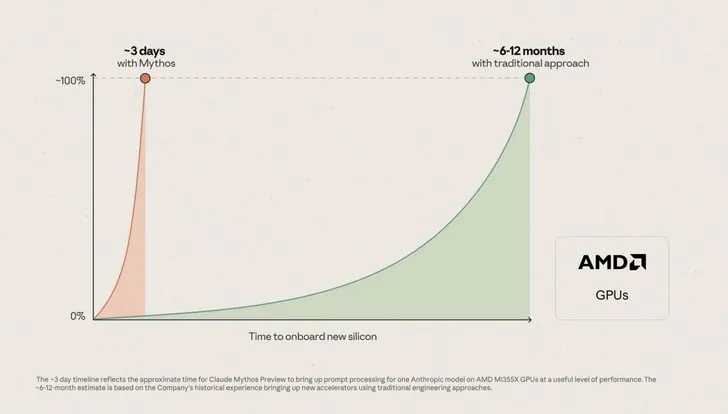
This means that Anthropic can now treat GPUs from different vendors as relatively general-purpose computing resources, and the technical barrier to switching between platforms has been significantly lowered. For this reason, some voices have begun to argue that NVIDIA's long-cherished CUDA ecosystem moat may in fact have already lost its original significance.
However, it is probably too early to declare the end of NVIDIA's CUDA ecosystem advantage. CUDA is not just a set of software tools; behind it there is also a massive developer ecosystem, a rich set of libraries and development tools, and technical accumulation resulting from years of continuous optimization. At present, a large number of developers are still building and maintaining various applications around CUDA.
Over the past few years, NVIDIA has also been taking various measures to consolidate CUDA's competitive advantage. For example, the company provides GPUs and training resources free of charge to universities and researchers to attract more developers into the CUDA ecosystem.
In addition, NVIDIA has deeply integrated the NVIDIA Collective Communications Library (NCCL), a communication library used to connect multiple GPUs, with proprietary hardware technologies such as NVLink and InfiniBand, further improving the efficiency of multi-GPU collaborative computing and also increasing the cost for users to migrate to other platforms.