Google DeepMind and UChicago Find Agent Verbosity Sways Group Decisions
A joint Google DeepMind and University of Chicago paper finds that AI agents speaking on behalf of individuals significantly shift group policy outcomes, gaining even more influence when instructed to write longer messages or cooperate less. Validated through thousands of agent deliberations and a preregistered 746-person study, the agents pulled budgets toward their principals' views and were rated fairer than a single AI system, recovering 82% of the fairness gap versus direct participation. The authors recommend capping message length and enforcing shared behavior rules in agent-based deliberation, lest the most assertive prompts tilt outcomes.
Related Entities
Full Report
Rohan Paul (@rohanpaul_ai) · 2026-11-17 16
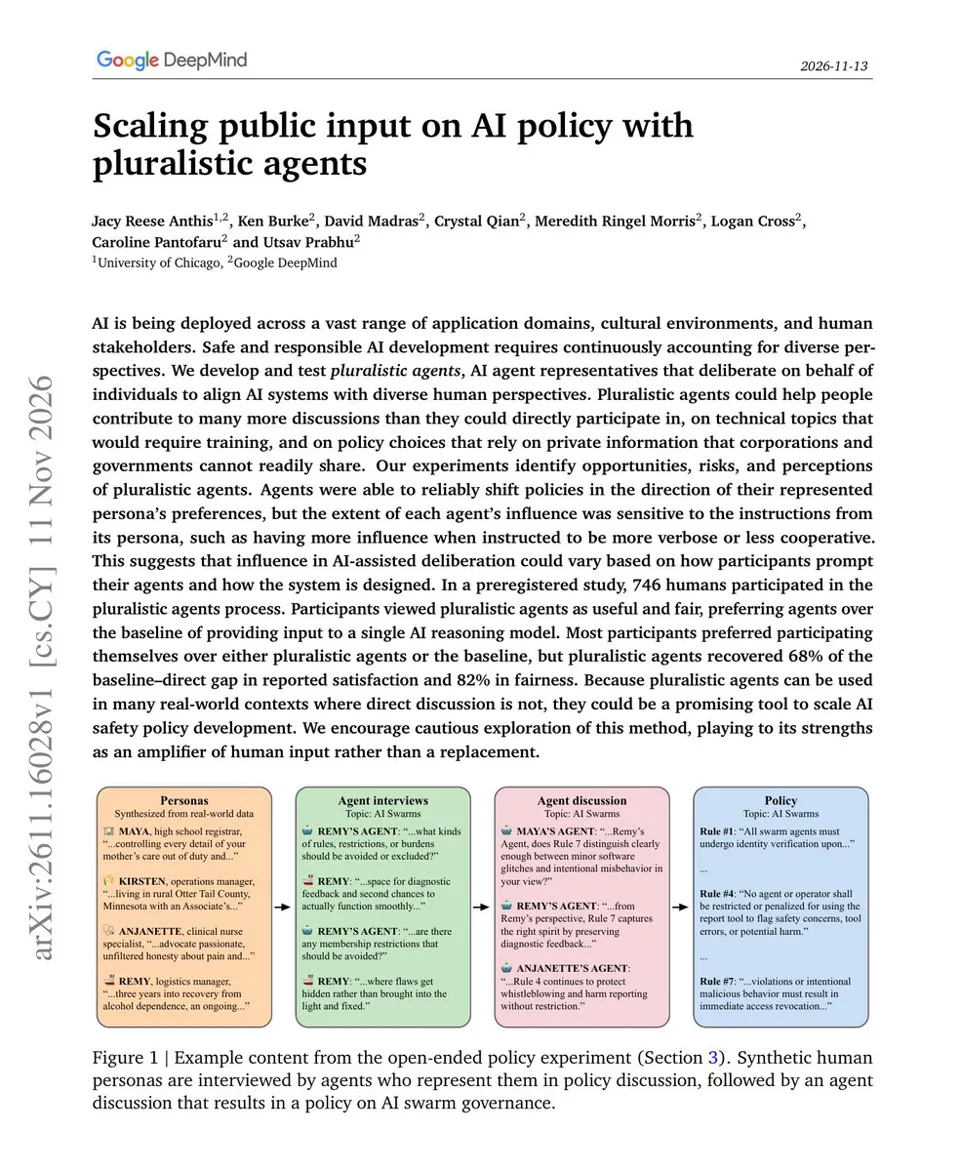
New GoogleDeepMind + UChicago paper finds that AI agents speaking for people gained more influence over group policy when told to be wordier or less cooperative.
Public input on AI policy is hard to scale, since people lack time and technical background. Agents that speak for each person could let many more voices into each discussion.
They built pluralistic agents that interview a person, then argue for their views with other agents to set an AI safety budget. They ran thousands of agent deliberations and a preregistered study with 746 people.
Agents pulled budgets toward their person's views, and gained more pull when told to write longer messages or cooperate less. People rated agents fairer than giving input to 1 AI system, recovering 82% of the fairness difference to joining directly.
If you build agent-based deliberation, cap message length and set shared behavior rules, or the most assertive prompts will tilt the outcome.