Zhiyuan Unveils Genie Master for Autonomous Robot Evolution
Zhiyuan Robotics released the embodied agent framework Genie Master, validating Physical Recursive Self-Improvement (RSI) in a real convenience store. The framework enables robots to autonomously analyze failures, adjust strategies, and accumulate experience without human intervention, closing the loop from lab to commercial deployment.
Full Report
Contents4 sections
By Heng Yu, reporting from Aofeisi QbitAI | Official Account: QbitAI
Because a small hook on the shelf was partially obscured by a price tag sign, Robot Jun missed its target during its first attempt at stocking goods in a convenience store.
In the past, this would have required human engineers to step in: first diagnosing the issue, then adjusting the program and supplementing data so the robot could retrain.
But Robot Jun is different. It figured out a new solution on its own.
Reviewing its previous execution logs, it discovered that the head camera’s resolution was insufficient, and combined with the obstruction from the price tag, it was difficult to clearly locate the small hook.
Consequently, the Agent adjusted its strategy: it moved its left hand closer to the target first, using the wrist camera to provide a close-up view to confirm the position, before completing the stocking task with its right hand.
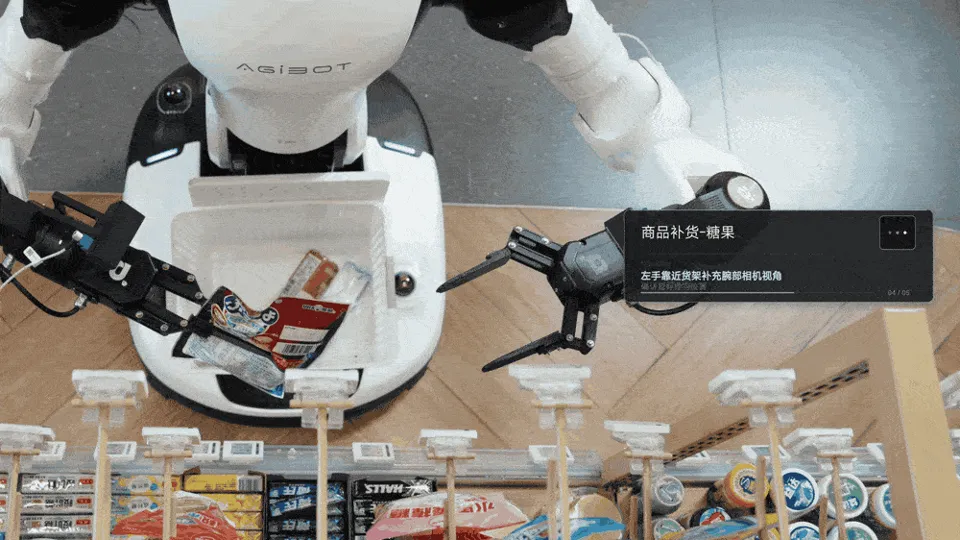
More notably, Robot Jun not only identified the problem and found a solution independently but also quietly accumulated this effective experience for future use.
The mechanism enabling robots to identify issues during work, adjust strategies, and accumulate experience is powered by Genie Master, the latest embodied AI Agent framework released by AgiBot (Zhiyuan).
This marks the fourth installment of AgiBot’s recent "AI WAVE" series of technical releases—this time, AgiBot has brought Physical RSI (Embodied Recursive Self-Improvement) into real-world convenience store operations.
Empowered by Genie Master, AgiBot’s G2 robot has demonstrated the ability to autonomously analyze failure causes, adjust strategies, and consolidate experiences while executing tasks in a real convenience store environment, without relying on human demonstrations or debugging. This achieves "human-in-the-loop-free" continuous self-improvement.
This is the industry's first instance of moving beyond simulation environments and laboratory settings (toy settings) to successfully run and validate Physical RSI in real business scenarios.
How exactly does this autonomous evolution loop in Genie Master work? And what disruptive changes can it bring to the mass deployment of robots?
What is Genie Master?
To understand why this robot can "enlighten itself," we must first look at the underlying Genie Master framework.
Simply put, Genie Master is an embodied AI Agent framework whose core mission is to bridge the reasoning capabilities of high-level Agents with the action execution capabilities of low-level robots.
It enables Agents to smoothly invoke various robot capabilities, understand real physical execution feedback, and continuously organize actions and targeted practice based on task progress.
Once a robot exposes capability gaps during actual work, these issues directly enter the autonomous improvement process.
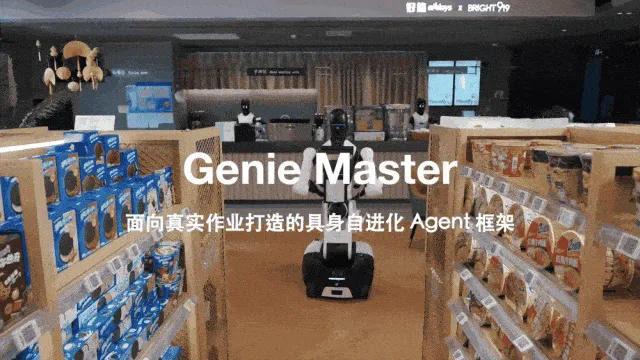
It is evident that Genie Master aims to build a continuous improvement mechanism after robot deployment—this involves both real-time judgment and dynamic adjustments during task execution, as well as post-task experience consolidation and updates to low-level action policies.
AgiBot proposed this framework because it recognized long-standing pain points in industry implementation.
Industry insiders know that when robots enter real commercial scenarios, they inevitably encounter long-tail cases not covered during training.
Execution failures, unstable movements, or excessively long task durations often require engineer intervention for diagnosis, followed by program adjustments, supplementary demonstration data, or model retraining to improve performance.
As scenarios multiply and tasks become more complex, the workload for R&D and maintenance increases accordingly.
If every new requirement waits for manual troubleshooting and debugging from scratch, iteration speed is limited, making large-scale cross-scenario deployment difficult.
In short, for embodied intelligence to be truly utilized at scale, it must shift from "passive fine-tuning" dependent on human demonstrations to a "self-evolving mode" where robots autonomously discover and solve problems.
Genie Master seeks to delegate part of this work to the Agent.
By entrusting problem diagnosis, practice organization, and result evaluation to the Agent, Genie Master supports robots in autonomously acquiring new capabilities, thereby significantly shortening the R&D cycle from "customer proposing a new requirement" to "robot mastering the new skill."
Beyond the hook-stocking example mentioned earlier, in real convenience store tests, robots equipped with Genie Master demonstrated further capabilities in handling complex situations.
According to AgiBot, the Genie Master team has integrated picking, restocking, cleaning, anomaly recovery, and multi-robot collaboration into a unified workflow, exploring closed-loop continuous improvement for robots in real business contexts.
Practicing During Idle Time: Embodied Agent Framework Bridges Brain and Cerebellum
The idea of letting robots evolve themselves through work isn't difficult.
But prior to this, why did this concept remain largely confined to laboratory discussions, with almost no one actually implementing it in real-world business operations?
The reason lies in the fact that whether it is high-level experience consolidation or low-level policy internalization, both must be built upon an extremely rigorous foundation—
Guidance from the high-level reasoning "brain" must be precisely translated into actions; results from the low-level execution "cerebellum" must be fed back to the brain in real time.
To bridge this critical connection, Genie Master introduced one of its key designs:
Embodied Execution Protocol (EEP).

EEP establishes a unified interface between the Agent and the physical world, primarily covering four core interfaces:
- Capability Interface: Allows the Agent to clearly know which robot capabilities are currently available for invocation;
- Guidance Interface: Enables the Agent to pass specific spatial cues, object references, and fine-grained language requirements to the low-level action execution end;
- Feedback Interface: Provides the Agent with real-time information about the actual physical state following robot action execution;
- Continuity Interface: Allows the system to continuously track task progress and dependency division within robot clusters, supporting dynamic scheduling and task resumption after interruptions.
Through the EEP protocol, combined with collaborative designs such as Temporal Alignment, the high-level Agent can dynamically adjust guidance based on execution results at any time; meanwhile, the low-level base Action Policy can precisely execute actions by combining current observations with Agent requirements, returning observations and sub-task states in real time.
In embodied intelligence systems, only by truly integrating reasoning, execution, and feedback into a cohesive unit can self-evolution move beyond being a pipe dream.
EEP serves as the critical interface in this interaction chain, laying the groundwork for subsequent experience accumulation and policy updates.
With this foundation solidified, the robot's daily routine of "self-driven improvement" during deployment begins.
In the normal workflow of a convenience store, when robots encounter tasks that repeatedly fail, execute unstably, or take too long—revealing "capability gaps"—the Agent does not remain passive.
Instead, it proactively utilizes the store's idle time to organize autonomous extra practice sessions for the robots, targeting these weak points.
The Agent takes full charge of what to practice, how to practice, whether the results meet standards after training, and how to recover from anomalies and retry. The real-world deployment environment thus continuously provides practical evidence for the robots regarding "what to practice next" and "what needs improvement."
One Path Accumulates Experience, Another Updates Action Policies
Now that "problem discovery" and "autonomous extra practice" are established in real scenarios, how do robots truly integrate the results of this practice into their own capabilities?
Here, Genie Master adopts a "dual-track" strategy.
One track is called Harness RSI, responsible for accumulating experience; the other is Policy RSI, responsible for updating action policies.
Let's first look at Harness RSI.
Its core logic involves improving subsequent task performance primarily by optimizing prompts, memory, and execution rules, while keeping model weights and existing tool interfaces unchanged.
During daily inference and execution, the robot records both successful and failed examples "as they happen." Subsequently, through asynchronous daily reflection and memory integration, these execution logs are transformed into more effective guidance, completion criteria, anomaly recovery protocols, and collaboration rules. These are incorporated into long-term memory like an "error notebook" and loaded progressively based on task and scenario requirements.
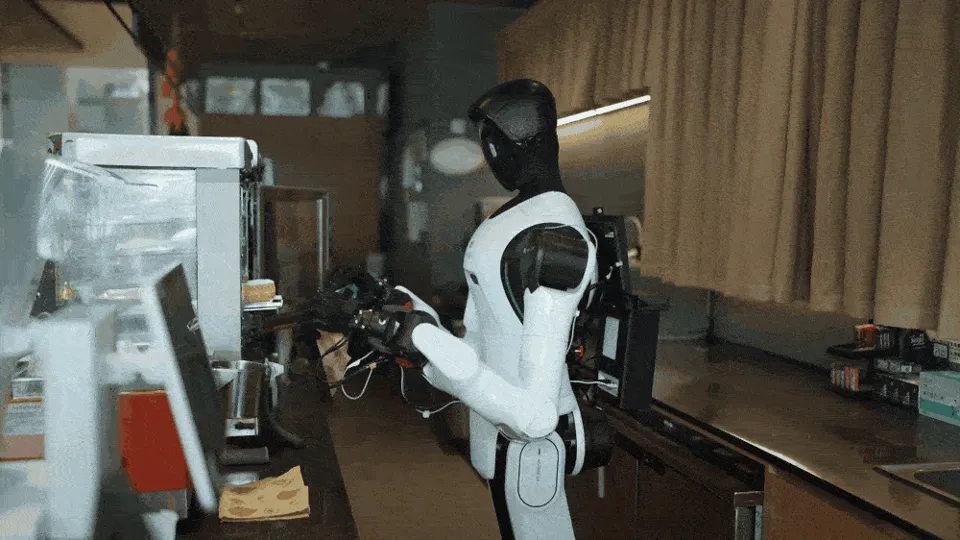
Looking back at the "convenience store shelf stocking" case mentioned at the beginning of the article, this was actually Harness RSI at work.
Initially, the success rate for the small hook task was very low. However, after reviewing failure logs, the Agent diagnosed the root cause: "Insufficient resolution from the head camera view, combined with label obstruction, prevented the robot from accurately identifying the position of small hooks."
Consequently, the Agent encoded a new solution—"first use the left wrist camera to get closer for a better view, confirm the position, then use the right arm to hang the item"—into executable experience. In future similar situations, the system can directly retrieve this experience and handle the task with ease.
Beyond the "error notebook," to meet the stringent requirements of low latency and high stability in real-machine deployments, certain capabilities must become the robot's "muscle memory."
This is where Policy RSI comes into play.
Policy RSI collects and organizes data generated during the robot's autonomous execution, human takeover demonstrations, and anomaly recovery processes. It improves data quality through filtering, weighting, and goal relabeling, then uses supervised learning, imitation learning, or reinforcement learning to directly update the underlying Action Policy models. This ensures improvements are retained within the model parameters.
For example, if a robot performs the "takeout packaging anti-tangling" task in the store, data generated while handling tangled handles, executing retraction, and recovering from anomalies can be filtered and processed for subsequent action policy training. This helps the model improve performance on similar tasks.
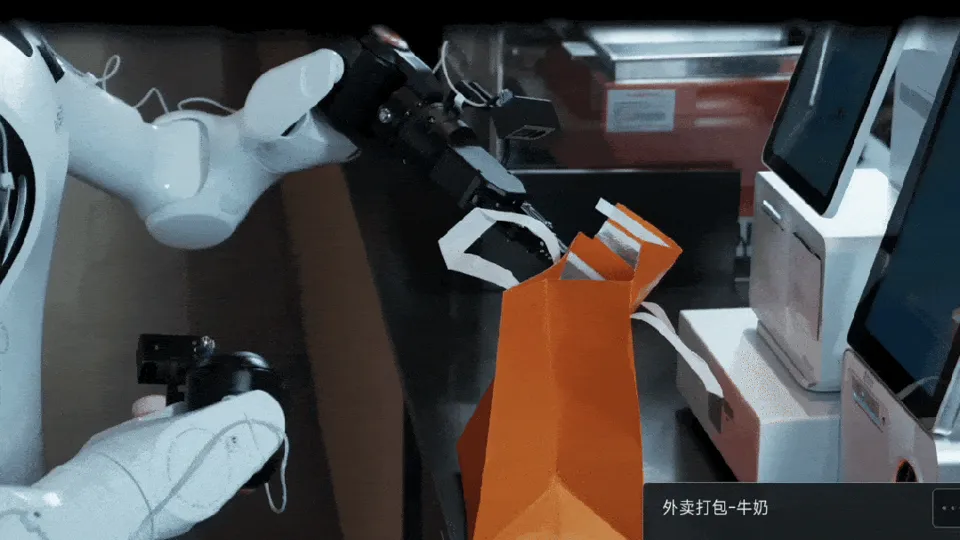
Through Policy RSI, robots absorb insights from each real-world execution experience, achieving more stable execution capabilities and more accurate instruction following.
It should be noted that this does not mean human involvement is entirely eliminated. Policy RSI still utilizes data such as human takeover demonstrations, and updates to action policies still require data processing and model training.
More importantly, these two tracks do not operate in isolation but interlock to form a flywheel that spins faster over time—
Harness RSI accumulates and organizes experience, helping the system analyze failure causes, select practice methods, and improve subsequent execution;
Policy RSI uses processed execution data for action policy training, allowing effective experiences to precipitate into more stable motor capabilities.
The two tracks mutually reinforce each other, forming a closed loop from real business execution, capability gap discovery, and autonomous practice, to experience accumulation and policy updates. AgiBot aims to ensure that every round of accumulated experience helps the system diagnose problems, select practices, and utilize data more effectively.
Allowing the ability to improve capabilities itself to evolve continuously, and achieving greater capability increments with the same investment, is the true power of "Recursive Self-Improvement (RSI)."
From "Fixed at Factory" to "Getting Better with Work"
Stepping out of the convenience store context and looking at the entire embodied AI industry, the direction explored by AgiBot's Genie Master is opening a new door.
First, in terms of R&D efficiency, it completely breaks the shackles of previous robot capabilities being "fixed at factory," shifting to a new paradigm of "continuous growth during deployment."
When new AI solutions can grow into new robot skills on-site, the delivery cycle from customer requirement proposal to robot skill acquisition will be significantly compressed.
Second, in terms of commercial implementation, this also clarifies the economic equation.
As robots become "more capable with more work" in real operations, the same set of capabilities thickens continuously during deployment.
When replicating to more stores and cross-industry scenarios in the future, the marginal costs of subsequent deployment and R&D will continue to decrease.
This continuously declining cost curve is the core prerequisite for large-scale commercial implementation of embodied AI.

Reviewing AgiBot's "AI WAVE" series launches starting October 22, Genie Master serves as the fourth component in this series. It plays a critical bridging role in AgiBot's overall full-stack embodied AI layout—extending and rooting foundational base models and full-stack AI capabilities into real-world commercial deployment states.
Of course, no matter how impressive the technical architecture sounds, final performance must speak for itself.
As the saying goes, you don't know if a horse is strong until you put it to work.
On November 2, AgiBot plans to launch a "24-hour Convenience Store Live Stream" open to public viewing.
At that time, six Jingling G2 robots will go on duty consecutively, undergoing rigorous probation assessments in a real convenience store operation without any script.