Google DeepMind Launches MKA Benchmark for Multimodal Knowledge Agents
Google DeepMind, in partnership with Artificial Analysis, launched the Multimodal Knowledge Agent (MKA) evaluation, a benchmark of 200 private real-world visual tasks spanning 10 industries. Agents must interpret dense visual files such as architectural drawings, engineering schematics and clinical scans, then produce deliverables including slide decks, spreadsheets and reports. Scoring uses expert rubrics split into Climb and Regression criteria, averaging about 70 weighted items per task, with Claude Sonnet 5.5 leading in several domains.
Related Entities
Full Report
Artificial Analysis (@ArtificialAnlys) · 2026-11-10 18
We’ve partnered with Google DeepMind to launch their Multimodal Knowledge Agent (MKA) evaluation, a new benchmark for agentic knowledge work over complex visual files
@GoogleDeepMind’s MKA is a new benchmark requiring agents to review visually complex project files such as schematics and scans, and produce deliverables like slide decks, spreadsheets, reports, and marked-up images
Multimodal Knowledge Agent (MKA) overview:
➤ 200 private real-world visual tasks across 10 industries: Agents work from dense visual project files including architectural drawings, engineering schematics, and clinical scans to produce deliverables including slide decks, spreadsheets, PDFs, Word documents, and marked-up images. Unlike many agentic evaluations, these inputs emphasize realistic visual complexity and domain-specificity, and are genuinely required to complete the task rather than just providing additional context
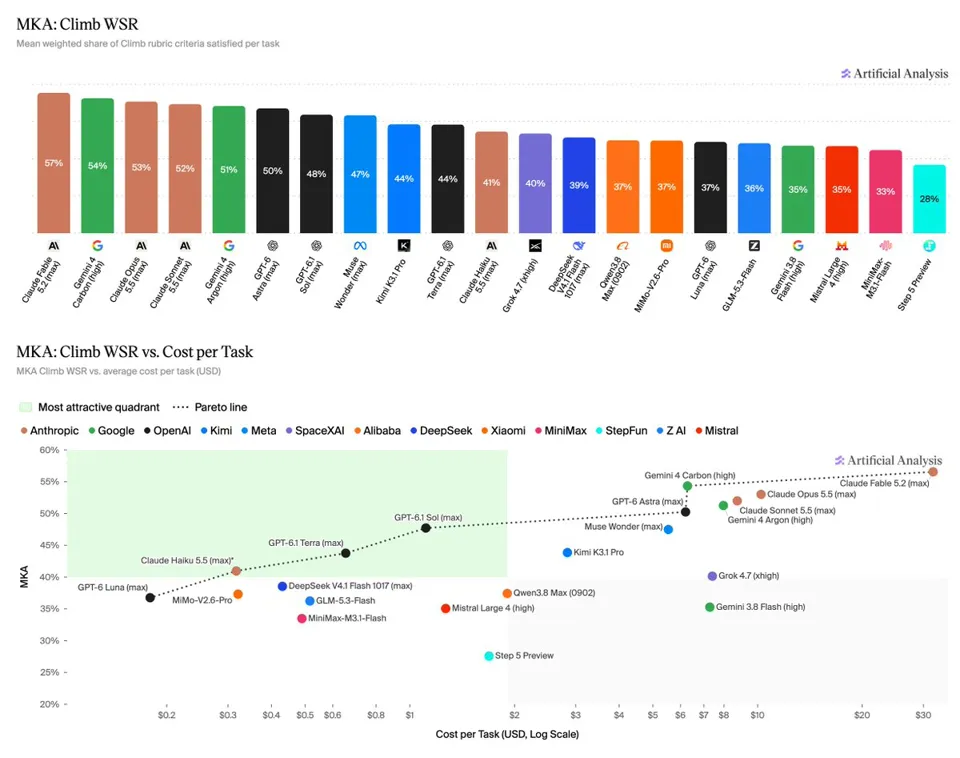
➤ Climb vs. Regression rubric scoring: Each task is graded against expert rubrics, averaging ~70 weighted criteria per task. Criteria are split into ‘Regression’ (baseline checks models should pass) and ‘Climb’ criteria (harder checks designed to separate strong models). The headline score is Climb WSR (Weighted Satisfaction Rate) - the weighted proportion Climb rubric criteria successfully completed
➤ Evaluated in Stirrup with an agentic judge: We run every task in Stirrup, our open source agent harness, with code execution, web search, web fetch, and image-viewing tools (up to 250 turns), and grade submitted deliverables using GPT-6 Luna (medium) as an agentic judge
Key MKA results:
➤ Claude Fable 5.2 leads on multimodal knowledge work: Anthropic’s recently released Claude Fable 5.2 (max) leads the MKA leaderboard with a Climb WSR of 57%, followed by Gemini 4 Carbon (high) at 54% and Claude Opus 5.5 (max) at 53%
➤ Cost per Task spans nearly 30× within 10 points of the top score: Claude Fable 5.2 averages $31.97 per task, over 5× Gemini 4 Carbon (1.11). Below Carbon, all four OpenAI models tested sit on the cost-performance Pareto frontier (GPT-6 Astra, GPT-6.1 Sol, GPT-6.1 Terra, and GPT-6 Luna), with Claude Haiku 5.5 and MiMo-V2.6-Pro making up the rest of the frontier
➤ No single model leads across all 10 industry verticals: Claude Fable 5.2 leads five verticals (Software & Data, Engineering, Logistics & Mapping, Business, and Finance alongside Claude Sonnet 5.5), Claude Opus 5.5 (max) leads Education and Construction, Gemini 4 Argon (high) leads Science, Gemini 4 Carbon (high) leads Healthcare, and Claude Sonnet 5.5 (max) narrowly leads Law & Government
Thank you to the @GoogleDeepMind team for their work building this benchmark and collaborating with us to bring it exclusively to Artificial Analysis!