SpaceX Wins FCC Approval for One Million Orbital Data Center Satellites
The FCC has authorized SpaceX to deploy one million AI computing satellites in orbit as space-based data centers, under a constellation named Starmind. Chairman Brendan Carr framed the approval as extending America's lead in super intelligence, while Amazon, Viasat and the American Astronomical Society opposed the plan over optical astronomy and environmental concerns outside the agency's authority.
Related Entities
Full Report
- The FCC approved SpaceX's proposal to put 1 million satellites into orbit for use as space-based data centers, Chairman Brendan Carr announced on Wednesday.
- SpaceX's proposal was opposed by Amazon, Viasat and the American Astronomical Society.
- Carr said in a post on X that the SpaceX Starmind constellation, and competitors, would "extend America's lead in Super Intelligence."
In this article
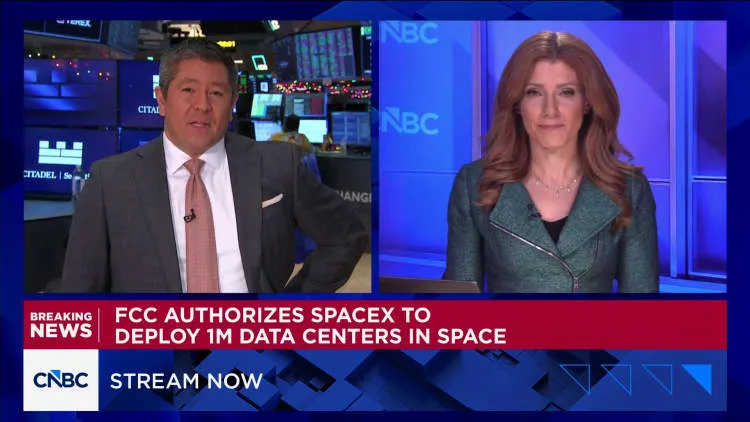
watch nowVIDEO0:4500 authorizes SpaceX to deploy 1 million data centers in spaceSquawk on the Street
The Federal Communications Commission has authorized Elon Musk's SpaceX to put 1 million artificial intelligence computing satellites in orbit, Chairman Brendan Carr announced on Wednesday.
Carr said in a post on X, the social network owned by SpaceX, that the company's Starmind constellation, and "competitor constellations will use solar power to extend America's lead" in AI.
Musk said in a reply, "Much appreciated. This will be a great asset to America and the world."
The FCC, in its authorization filing, noted that SpaceX's application "received a substantial number of comments from the public, including petitions to deny filed by Kuiper Systems LLC (Amazon Leo), Viasat Inc. (Viasat), and the American Astronomical Society (AAS)."
In a March petitionurging the FCC to deny SpaceX's application, Amazon had labeled the company's Starmind project as a "lofty ambition rather than a real plan."
The e-commerce and cloud computing giant is building a competitor to SpaceX's Starlink satellite internet service, and said it would take SpaceX "centuries" to build the constellation, adding that the company provided scant details about how it would "deliver on these grand claims."
The petition resulted in a rebuke from Carr, who said Amazon "should focus on the fact" that it's falling short of its own satellite deployment milestone.
Representatives from Amazon didn't immediately respond to a request for comment on the FCC's approval.
Read more CNBC tech news
- What Jensen Huang’s return means for Nvidia’s Colette Kress
- Anthropic stock falls below $83 IPO price, but analysts are still largely positive
- Nvidia brought Jensen Huang back. But the investigations aren’t over
- Signal joins United Airlines, banks in limiting AI agents over customer risks
- Amazon faces FAA probe after delivery drone strikes Michigan fiber cable, garage
Other companies have also set their sights on orbital data centers. Google last year announced Project Suncatcher, which it describes as a "moonshot to put AI in space," and launched its first chips into space on a SpaceX rocket and Planet Labs satellite in October.
In March, Jeff Bezos" Blue Origin [petitioned](https://fccprod.servicenowservices.com/icfs?id=ibfs_application_summary&number=SAT-LOA-20260310-00118 the FCC to let it launch up to 51,600 satellites as part of a low Earth orbit satellite constellation dubbed ")Project Sunrise." The constellation would work in tandem with Blue Origin's planned TeraWave satellite internet service, announced in January.
Astrophysicist and author Adam Becker was critical of the FCC move in an email to CNBC on Wednesday.
"Any serious attempt at this is going to further pollute the night sky and runs a serious risk of a cascading chain reaction of space junk collisions, which would be a disaster for all of humanity," he wrote. "Musk and Carr are either profoundly stupid themselves, or hoping the rest of us are too stupid to notice this is nonsense."
SpaceX did not respond to a request for comment.
The FCC said in its authorization that it dismissed "comments and concerns raised regarding topics over which the Commission has no authority, including environmental concerns," and concerns about its impact on "optical astronomy."

SpaceX stock chart.
This story is developing. Please check back for updates.