Rohan Paul (@rohanpaul_ai) · 10/19/2026, 17:04:00
Princeton and Google Show Small Models Can Handle Agent Decisions at Lower Cost
A joint Princeton University and Google study demonstrates that small decision models (e.g., 4B parameters) trained on agent states can handle routine tool-selection steps in agentic workflows, reducing costs by 81.1-89.0% and increasing speed by up to 2.5x while maintaining task success rates within 3 percentage points. The approach uses a confidence threshold mechanism to intervene only when highly certain, falling back to large language models otherwise, effectively addressing the inefficiency of frequent LLM calls in long-horizon tasks.
SOURCE COVERAGEFull Original Report
Rohan Paul (@rohanpaul_ai) · 2026-10-19 09
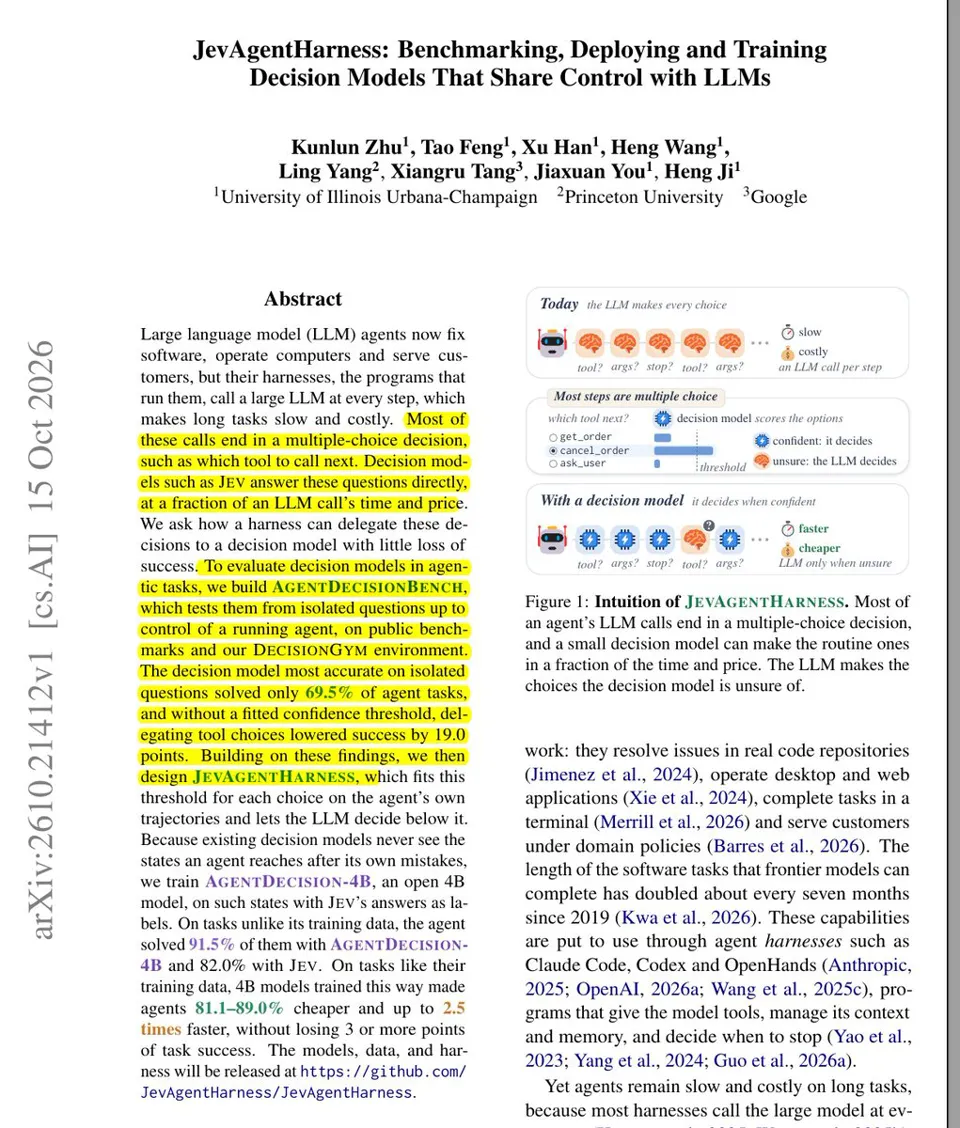
New Princeton Univ + Google paper finds that the decision model most accurate on isolated questions solved only 69.5% of agent tasks, while a 4B model trained on agent states solved 91.5%.
Agent harnesses call a big LLM at every step, which makes long tasks slow and costly. Yet most of those calls just pick from a list, like which tool to use next.
Their harness asks a fast decision model each multiple-choice question and uses its answer only above a confidence threshold fitted on the agent's own runs. They also trained AgentDecision-4B on states the agent actually reaches, including after its own mistakes.
On tasks like their training data, 4B models trained this way made agents 81.1% to 89.0% cheaper and up to 2.5x faster. Success stayed within 3 points, while handing over every tool choice with no threshold lowered success by 19.0 points.
To hand routine agent choices to a small model, train it and set its confidence threshold on your agent's own runs.
– arxiv. org/abs/2610.21412
Title: "JevAgentHarness: Benchmarking, Deploying and Training Decision Models That Share Control with LLMs"