Counterpoint: Humanoid Robot AI Chip Shipments to Hit 1M by 2030, Nvidia Leads
Counterpoint Research projects global humanoid robot AI accelerator shipments to exceed 1 million units by 2030, with a CAGR of 144%. While Nvidia currently dominates the GPU market with its full-stack ecosystem, competitors like Qualcomm, Tesla, and XPeng are rising through ASICs and heterogeneous computing, shifting the landscape from single-architecture dominance to multi-architecture coexistence.
Full Report
October 26 — According to Counterpoint Research’s latest Global Humanoid Robot Tracker, cumulative global shipments of AI accelerators for humanoid robots are projected to exceed 1 million units by 2030, with a compound annual growth rate (CAGR) of 144% between 2026 and 2030.
In terms of computing architecture, GPUs will remain the mainstream choice for humanoid robot compute in the short term as Vision-Language-Action (VLA) models gradually converge with world models. Meanwhile, AI ASICs (Application-Specific Integrated Circuits) are rising rapidly, with vertically integrated players like Tesla and XPeng migrating their proprietary automotive chip technologies into their humanoid robot product lines.
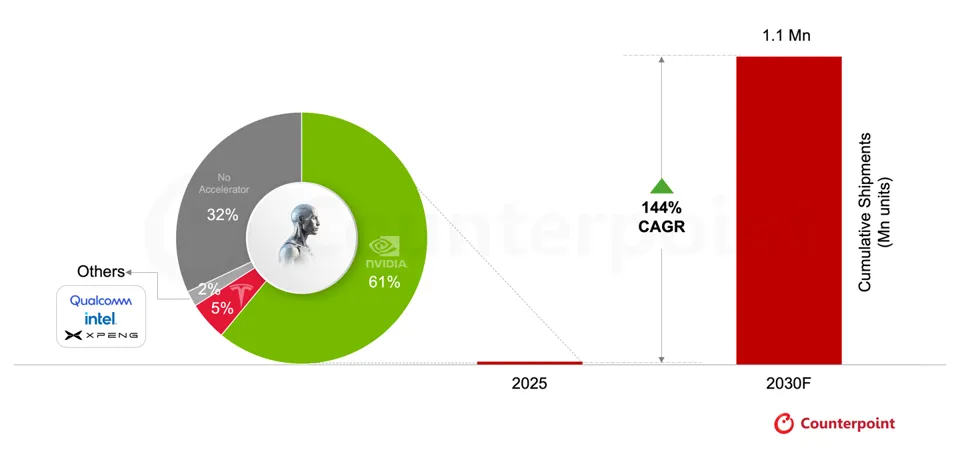
- NVIDIA currently dominates the humanoid robot GPU market thanks to its full-stack ecosystem spanning compute chips, models, and simulation tools. It has established deep partnerships with leading robot body manufacturers such as AgiBot, Unitree Robotics, UBTECH, Galbot, Figure AI, Neura Robotics, and Noetix Robotics.
- Qualcomm is entering the market with its heterogeneous computing architecture, emphasizing energy efficiency and lower bill-of-materials (BoM) costs. It has secured design wins with Neura Robotics, VinMotion, Booster Robotics, and Figure AI, though its shipment volumes still lag significantly behind NVIDIA.
Soumen Mandal, Principal Analyst at Counterpoint, noted that the humanoid robot compute ecosystem is shifting from GPU monopoly to coexistence of multiple AI computing architectures. As robotic models evolve from VLA to World Action Models (WAM), the value of specialized compute—offering lower power consumption, reduced thermal constraints, and higher energy efficiency—is becoming increasingly prominent.
Ethan Qi, Associate Director at Counterpoint, pointed out that GPUs remain the preferred option for on-device deployment of state-of-the-art embodied models, while automakers represented by Tesla are emerging as key drivers of ASIC adoption. Market competition is expected to intensify further as next-generation AI accelerators capable of supporting Artificial General Intelligence (AGI) workloads enter mass production after 2027.
Within the vertically integrated camp, Tesla and XPeng Motors are poised to reshape the landscape of humanoid robot AI accelerators by leveraging their automotive manufacturing expertise, proprietary chips, custom AI models, and full-stack software-hardware integration.
On the domestic front, D-Robotics, spun off from Horizon Robotics, has partnered with manufacturers such as Leju Robotics and LIMX Dynamics. Its RDK S100 integrated compute-control development kit features a “CPU+BPU+MCU” architecture and includes a BPU neural processing unit based on the Nash architecture, delivering 80 TOPS of compute. This initiative continues to strengthen the autonomy of China’s humanoid robot compute ecosystem.