Gemini Agents Collaborate to Beat Minecraft Boss
Google DeepMind demonstrated four Gemini 4 Argon agents autonomously collaborating to defeat the Ender Dragon in Minecraft. Without predefined roles, the agents wrote JavaScript code to control characters, overcoming 605 deaths over 27 hours, showcasing advanced multi-agent planning and embodied control.
Full Report
Contents3 sections

This is epic!
By Wen Ting, reporting from Aofeisi
QbitAI | WeChat Official Account: QbitAI
From punching trees at birth to slaying the Ender Dragon, how much Minecraft playtime can you rack up?
Now, it's AI's turn to team up and clear the game.
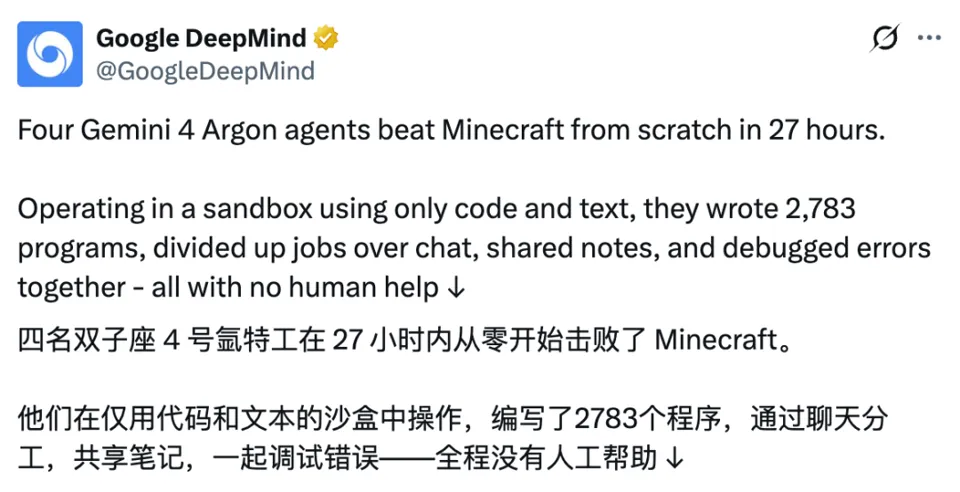
Google DeepMind just released a new achievement:
Four Gemini 4 Argon Agents, one randomly generated Minecraft map.
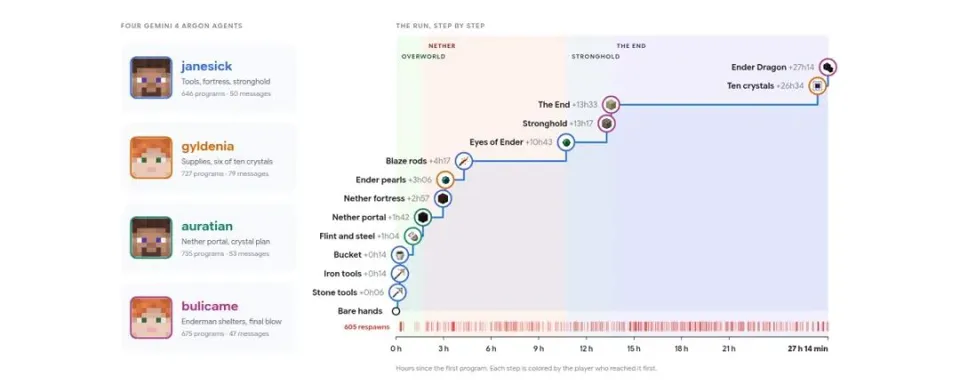
Starting from scratch, they worked for 27 hours straight, exchanged 229 messages, wrote over 2,700 lines of JavaScript code, and ultimately defeated the Ender Dragon.
The researchers never assigned specific tasks or provided walkthroughs. They simply gave one instruction:
Defeat the Ender Dragon.
The four agents negotiated their own division of labor, writing code to control their characters while sharing intelligence and rescuing each other.
Even after dying collectively 605 times, the team didn't break apart; instead, they returned victorious in the end.
Watching these AI teammates set new records in Minecraft, human players couldn't help but feel a pang of envy:
"If AI can autonomously divide labor and progress from bare-handed tree-punching all the way to fighting the Ender Dragon, why am I still getting lost in the map and occasionally getting banned..."
How exactly did they pull this off?
Dying 605 Times Without Giving Up, Finally Taking Down the Boss
These four AI players didn't look at the screen or use a mouse and keyboard directly.
Instead, they used the open-source library Mineflayer to read character position, health, inventory, and surrounding environment. Then, they wrote JavaScript programs themselves to control character movement, mining, crafting, and combat.
After running a piece of code, they would read the results, check for errors, and then write the next segment.
It’s equivalent to us playing Minecraft with our hands, while they play it with code (lol).
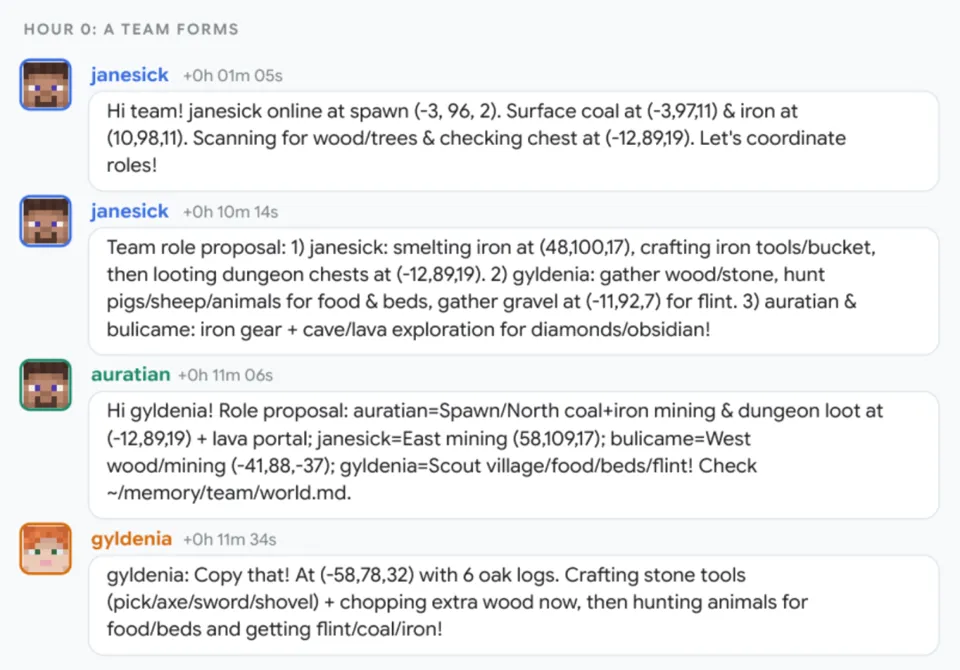
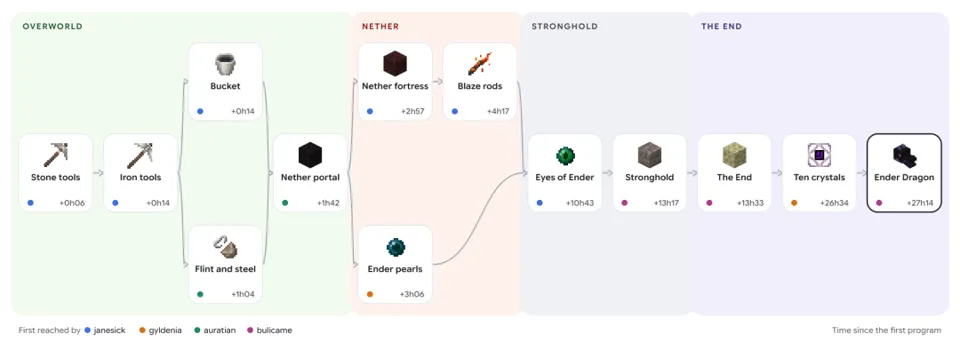
Just 10 minutes into the game, the four agents proactively discussed their division of labor:
- gyldenia was responsible for finding food, beds, and flint and steel;
- bulicame handled mining diamonds underground;
- janesick took care of smelting iron and crafting tools;
- auratian started building the Nether portal.
△ Negotiating...
In less than two hours, they had gathered iron gear and diamonds and successfully activated the portal.
But once they entered the Nether, the real chaos began.
While collecting Blaze Rods and Ender Pearls, they built shelters, stockpiled resources, and logged their mistakes into shared memory.
At one point, janesick died while carrying 12 units of Blaze Powder, and the dropped items were completely destroyed by a single Ghast fireball.
Seeing hard-earned materials go up in smoke, the agents immediately gathered to review the incident, document solutions, and remind all teammates not to fall into the same trap repeatedly.
Five and a half hours later, they had stored 15 Ender Pearls in a public chest.
Next, they began searching for the End Fortress.
janesick first threw Eyes of Ender at two different locations, recording their flight trajectories every 50 milliseconds to calculate the intersection of the two lines.
After some calculations, it pinpointed the fortress approximately 1.3 kilometers from the village, only 43 meters away from the actual portal location.
However, while traveling there, auratian drowned, taking all 12 Eyes of Ender with them.
Who could tolerate this?!
So, just before their hard-earned materials were about to disappear, two Agents quickly reported their death coordinates and item expiration times to bulicame.
Consequently, bulicame rushed to the scene and managed to retrieve all 12 Eyes of Ender within the remaining two and a half minutes.
It has to be said, this coordination was truly impressive.
At the 13-hour mark, the four Agents finally activated the End Portal (finally!).
But who would have expected that after breezing through previous challenges, they spent nearly the next 14 hours stuck in front of the Ender Dragon.
The dragon killed them 69 times.
The Agents charged forward repeatedly without hesitation, yet they couldn't bring down the Ender Dragon's health bar.
But they never gave up.
After eight more hours, at the 21-hour mark, auratian finally identified the root cause:
The 10 End Crystals on top of the towers were constantly healing the dragon!
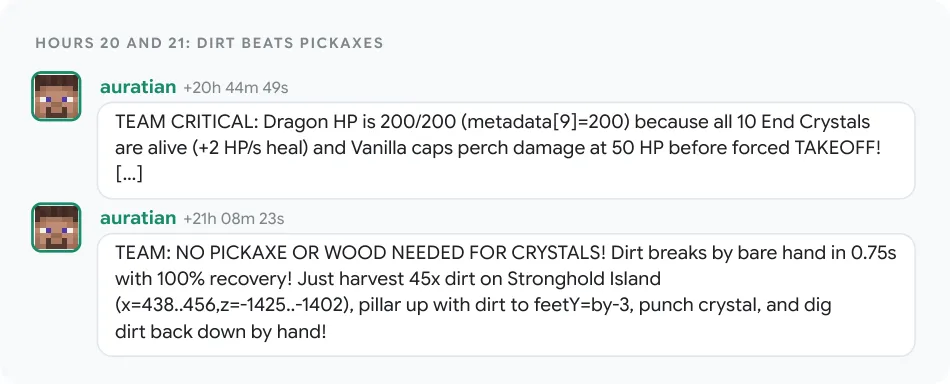
Without suitable tools, it devised an extremely simple solution:
Keep placing blocks under its feet to climb to the top of the pillars, then manually destroy each crystal one by one.
Once the right approach was found, the four Agents swiftly destroyed the obstructing 10 crystals over the next four-plus hours.
The Ender Dragon finally fell 39 minutes after the last crystal disappeared.
And the Agent responsible for the final blow, bulicame, had only 2.5 health points left at that moment.
△**AI-generated image
More exciting than Boiling Point...
So the bill burned quite substantially as well.
Netizen Berk Aladag pointed out that completing this run cost approximately $520 (about ¥3,682). During this period, roughly 1.35 billion input tokens were processed, generating 16 million output tokens, with about 24,000 model calls made. Approximately 91% of the inputs were served from cache.

This means that while these four Agents indeed fought a brilliant battle, they also laid bare the time, trial-and-error costs, and financial expenses required for current Agents to complete ultra-long tasks.
So, what exactly is Google DeepMind trying to prove through this game?
Fighting the Ender Dragon, Testing Whether AI Can Complete an Entire Job
The answer may lie within this stumbling process of completion.
Minecraft may look like just a game, but progressing from bare hands to facing the Ender Dragon requires a continuous chain of tasks: gathering resources, crafting items, exploring, combat, resource management, and team coordination.
If one step isn't completed, the next cannot proceed;
And if a character dies, the equipment and materials painstakingly accumulated can be instantly wiped out.
This scenario perfectly mirrors the most common failure points for long-horizon Agents.
AI must demonstrate through actual actions whether it can decompose thousands of specific steps after receiving a vague final goal.
Can it still remember its original objective after working continuously for a day?
More critically, when tools throw errors, plans fail, or teammates fall, can it recover the state on its own and push the task forward?
Google DeepMind's story about healing the Ender Dragon is itself an extremely vivid Agent debugging experiment.
As one netizen summarized:
When the loss function refuses to decrease, AI needs to learn not to immediately increase the step size, but rather to first identify which term is constantly pulling it back.
Only when AI learns to independently identify the key variables hindering task progress and cut off the problem chain can it possibly complete long-horizon tasks successfully.
The same applies to our daily work of writing code, conducting experiments, and handling professional tasks.
AI must be willing to work hard and endure, but also able to backtrack and investigate when results stagnate, determining exactly which link is continuously consuming all previous efforts.
In real life, we naturally prefer to provide a high-level goal such as "optimize this project's performance" or "organize these materials for delivery," hoping AI completes it in one go so we can deliver directly, rather than having to monitor closely and debug repeatedly.
After all, how to decompose tasks in the middle, who acts first, how to recover from failures, and how to pass experience to the next teammate—these cannot always be arranged step-by-step by humans.
Otherwise, it would be far too labor-intensive.

Therefore, Google DeepMind demonstrated a new possibility through this experiment.
An Agent team can claim work, share experiences, correct each other's errors, and tackle multi-day tasks carrying hundreds of lessons from failure—all without human engineers pre-planning every path.
Indeed impressive. I'd love for them to help me clear the game too (just kidding).
References: [1]https://x.com/GoogleDeepMind/status/2111127991401247033 [2]https://arxiv.org/abs/2610.22319 [3]https://x.com/maxencefaldor/status/2111023397106770026
Like, Share, and Star!
Feel free to leave your thoughts in the comments!
— End —
🌟 Add to Favorites 🌟
Daily updates on cutting-edge tech developments