ZCube Architecture Solves LLM Inference Network Bottlenecks
Zhipu AI, Yuxun Networks, and Tsinghua University introduced ZCube, a networking architecture addressing structural congestion in Prefill-Decode (PD) separated deployments. Benchmarks on GLM-5.1 production environments show that ZCube reduces switch CapEx by 33%, improves average inference throughput by 15%, and lowers TTFT P99 latency by 40.6% without changing GPUs or software stacks.
Related Entities
Full Report
Contents8 sections
Large model inference is redefining AI infrastructure. Networking has evolved from a supporting utility into a critical variable determining the throughput, tail latency, and total cost of ownership (TCO) for MaaS (Model-as-a-Service) systems. To address the increasingly severe structural network congestion in Prefill-Decode (PD) disaggregated deployments, Zhipu AI, Yuxun Network, and Tsinghua University collaborated to propose and deploy the ZCube networking architecture in production environments. The results demonstrate that architectural innovation is the most economical and elegant path to unlocking hardware potential. In benchmark tests within the GLM-5.1 coding production environment, ZCube achieved significant improvements purely through architectural optimization:
- Cost Optimization: With GPUs, software stacks, and applications unchanged, capital expenditure on switches and optical modules decreased by 33%;
- Throughput Improvement: Average GPU inference throughput increased by 15%;
- Latency Reduction: TTFT P99 decreased by 40.6%.
The root cause of congestion lies in the changing traffic patterns of inference workloads. As PD disaggregation becomes mainstream, cross-node KV Cache transmission causes inference traffic to exhibit asymmetric characteristics with dynamically varying sources, destinations, and volume scales. Traditional ROFT (Rail-Optimized Fat-Tree) architectures, with their static topologies and port mappings, are prone to local hotspots, queue buildup, and PFC backpressure, leading to a structural issue where "total bandwidth appears ample, yet frequent local congestion occurs." ZCube’s solution adopts a "dynamic control" approach, utilizing a flat full-mesh topology combined with single/multi-rail hybrid access mechanisms. This globally decouples and discretely routes PD traffic at the structural level, fundamentally reducing the probability of structural congestion and providing a more efficient network foundation for next-generation ultra-large-scale inference clusters.
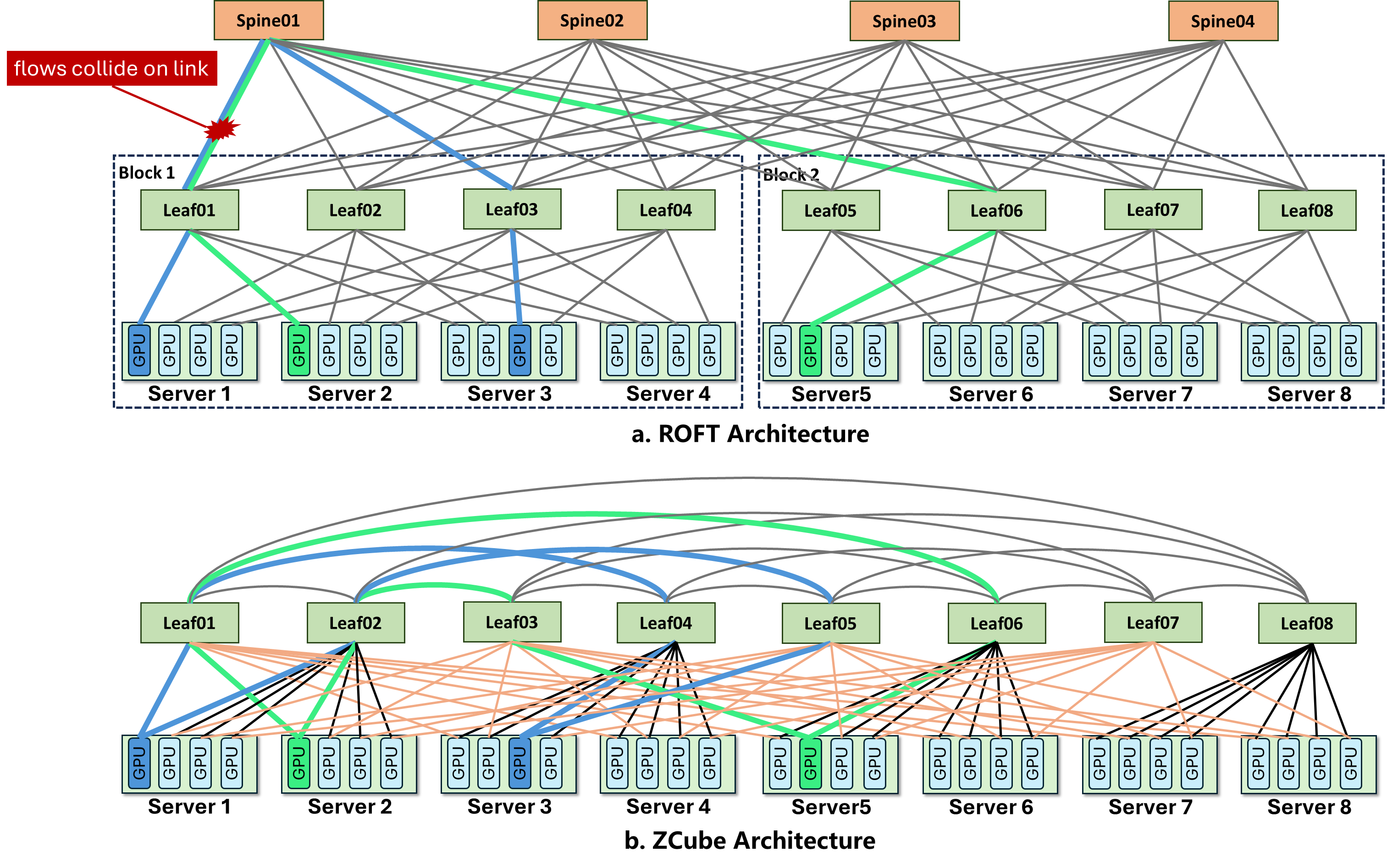
Figure 1: Compared to the ROFT architecture, ZCube effectively avoids structural network congestion.
Networking Impacts Effective Throughput of Inference Systems
When thousands of GPUs in a cluster simultaneously serve online inference requests, every KV Cache transfer and data synchronization passes through the interconnect between GPUs. As long-context inference and PD-disaggregated inference become mainstream, data exchange between Prefill and Decode nodes continues to increase. Consequently, network bandwidth and its effective utilization directly impact cluster throughput and latency. To quantify the impact of networking on inference performance, we conducted a controlled-variable experiment on a 32-GPU inference service: keeping GPU compute power, software stack, model, and application logic constant, we adjusted only the upper limit of NIC available bandwidth and observed changes in overall cluster throughput and Time-to-First-Token (TTFT):
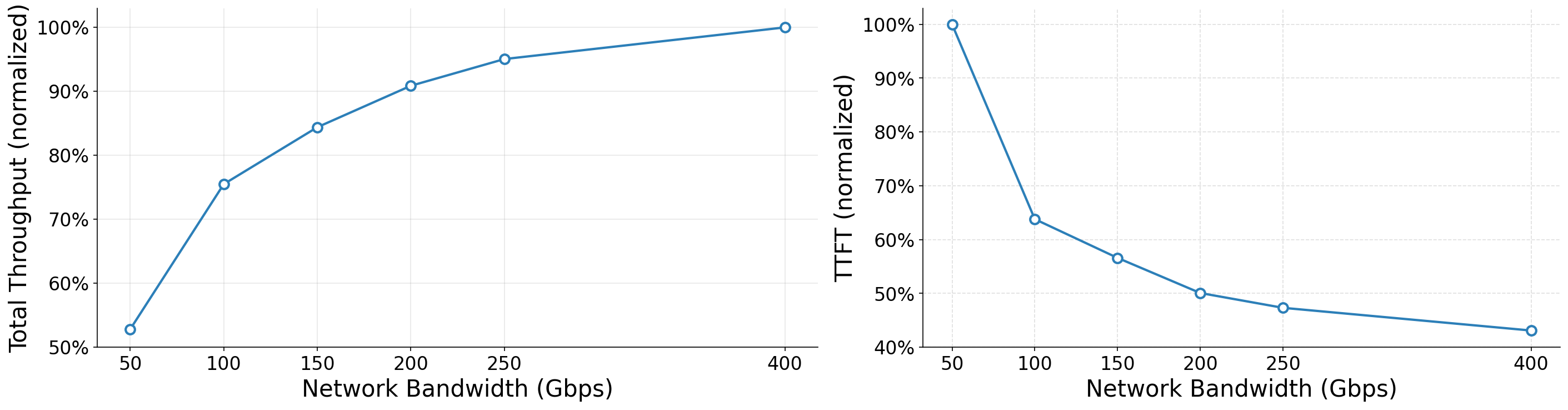
Figure 2: Overall cluster throughput and TTFT versus network bandwidth. For example, increasing network bandwidth from 100Gbps to 200Gbps resulted in approximately 19% improvement in total inference throughput and a 22% reduction in TTFT. This indicates that in large model inference, network bandwidth has become one of the core factors constraining service performance.
1. Inference Network Congestion
Currently, the industry widely adopts Clos architectures (Fat-Tree) for intelligent computing cluster networking. The basic idea is to achieve scale-out through multi-layer switch stacking, but Clos performance heavily relies on ideal load balancing between switches. In reality, due to routing policies and traffic patterns, this ideal state is often difficult to achieve. For instance, in many two-layer Fat-Tree architectures (consisting of Spine and Leaf layers), traffic between Spine switches suffers from severe load imbalance, preventing upper-layer applications from achieving expected network performance. To reduce overhead from cross-layer forwarding, the industry often employs the ROFT (Rail Optimized Fat-Tree) architecture [1]. As shown in Figure 3, ROFT groups all GPUs by index number (rail), connecting GPUs with the same index to the same Leaf switch to reduce some communication costs across Spines.
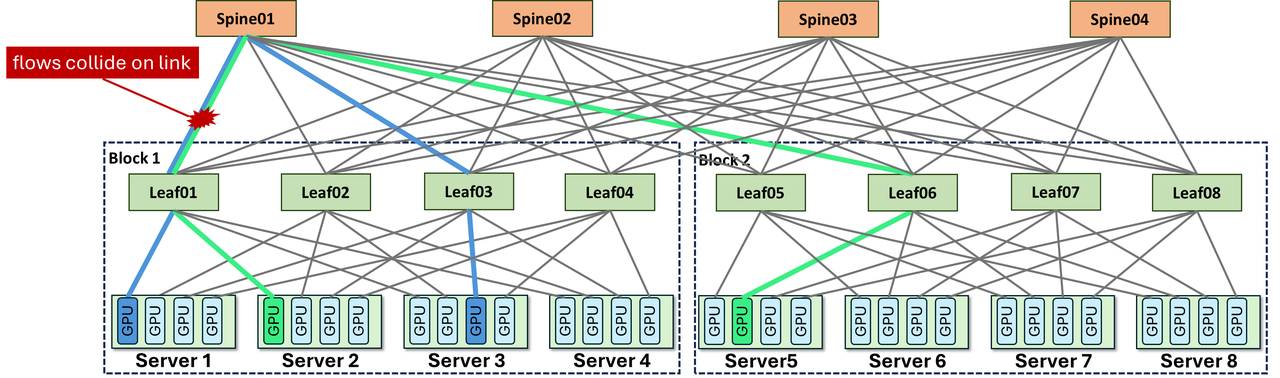
Figure 3: Traffic load imbalance easily occurs between Leaf switches in the ROFT architecture. While ROFT performs well under certain training traffic patterns, we observed a more prominent issue in PD-disaggregated inference scenarios: KV Cache transmission exhibits distinct source-destination asymmetry. Different GPUs and NICs bear vastly different communication loads (as shown in Figure 4), meaning ROFT’s rail mapping no longer naturally equates to load balancing. Instead, it tends to concentrate traffic onto a few Leaf switches and links, causing link congestion and degraded transmission performance. Specifically:
- Certain Leaf switches become load hotspots, increasing the probability of multiple KV Cache transmission flows competing on the same links, resulting in actual transmission rates significantly lower than NIC bandwidth limits;
- Egress queues on certain Leaf switches remain persistently deep, frequently triggering PFC backpressure, as shown in Figure 5;
- Link congestion further amplifies tail latency, impacting TTFT and overall throughput.
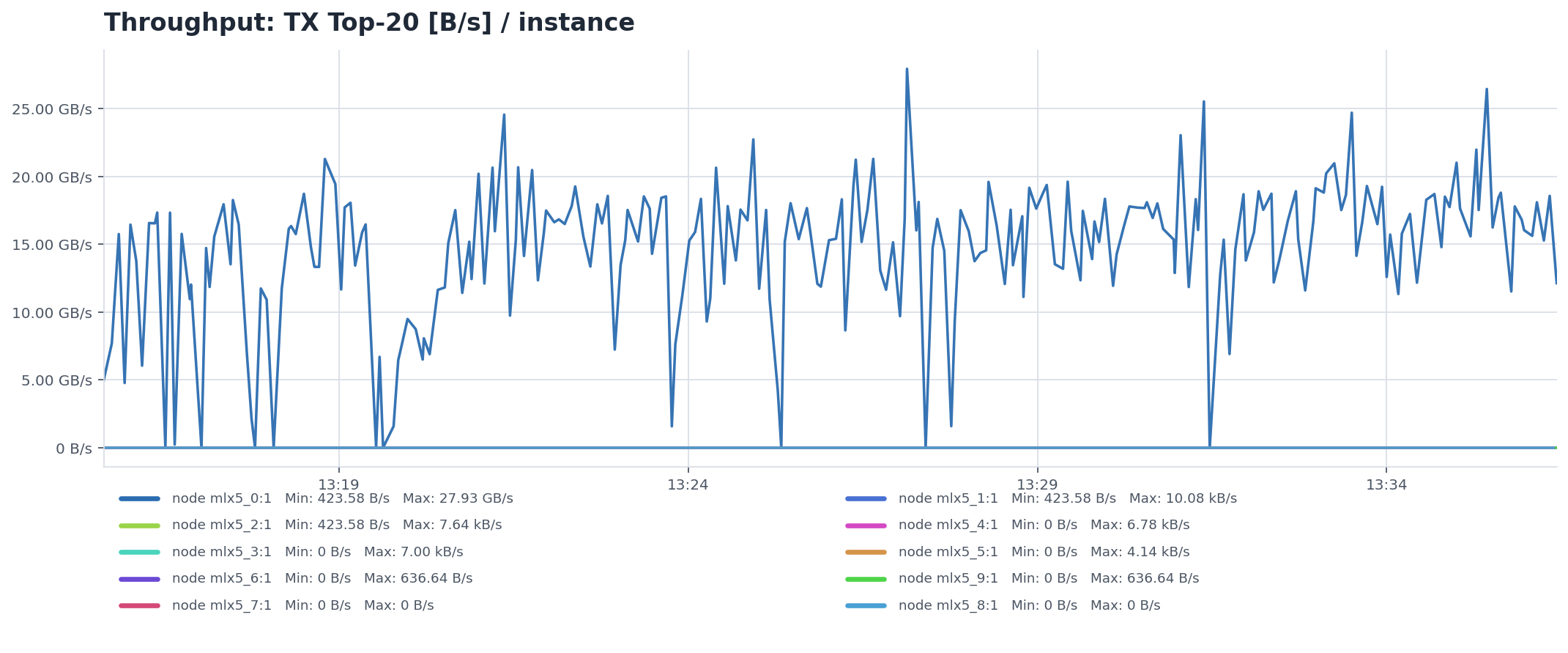
Figure 4: Differences in KV Cache transmission load across different NICs on the same machine.
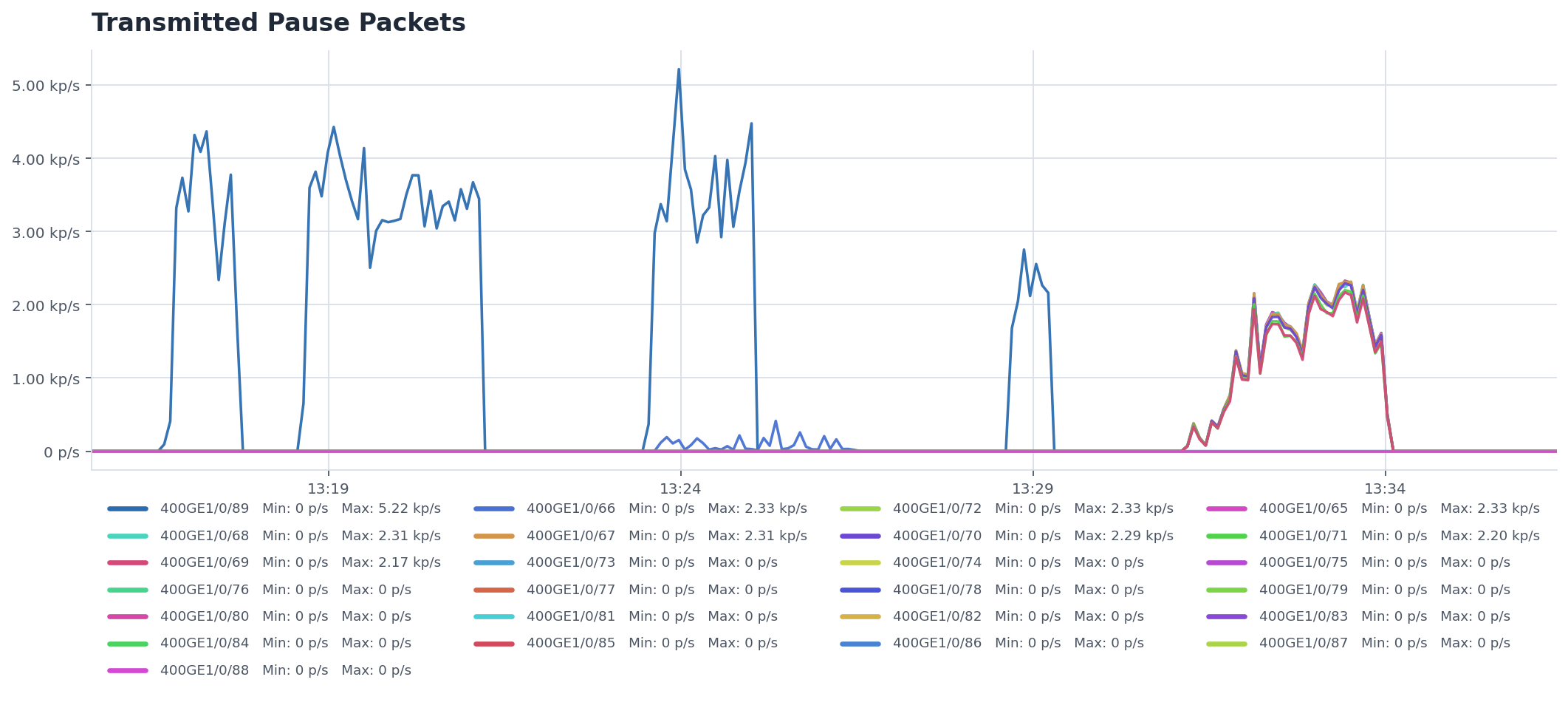
Figure 5: Leaf switch ports frequently triggering PFC Pause. It is important to note that network congestion can be categorized into two types (as shown in Figure 6):
- Unavoidable congestion: For example, when multiple GPUs simultaneously send data to the same destination, contention inevitably occurs on the last-hop link.
- Avoidable congestion: Caused by topology structure, traffic mapping methods, or uneven multi-path load balancing; this is essentially an architectural design issue.
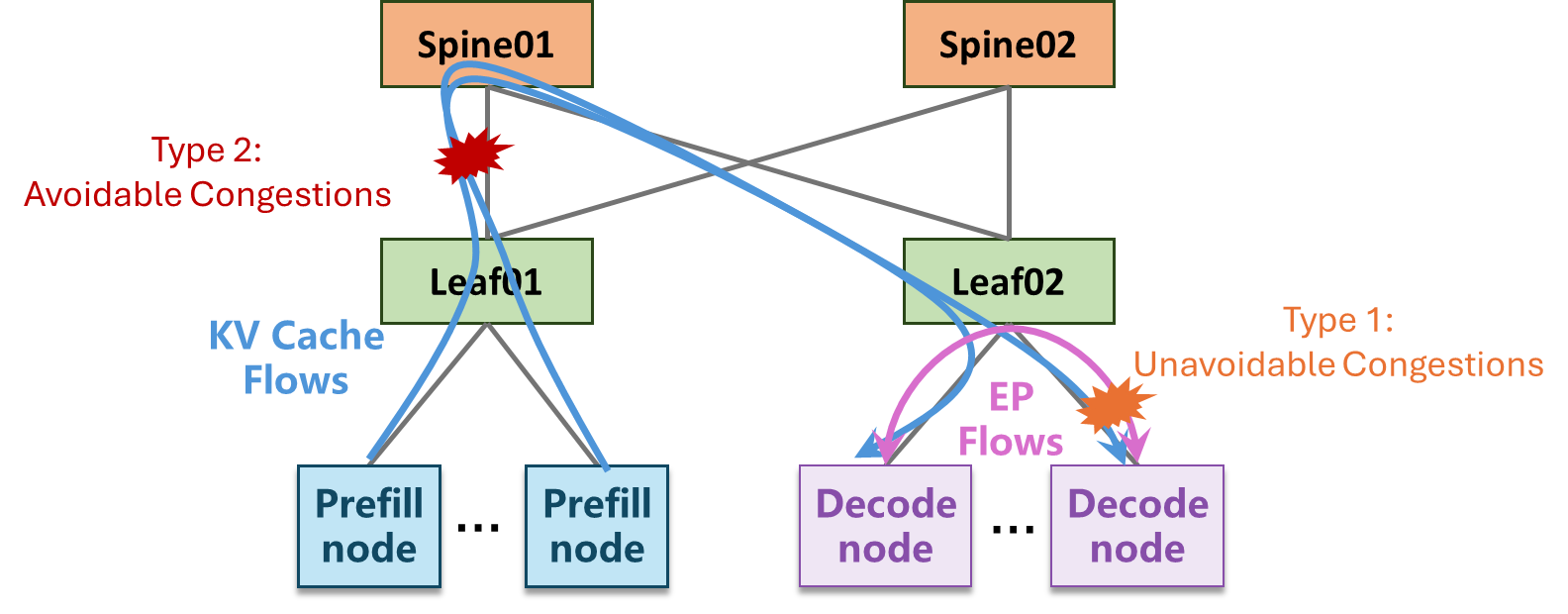
Figure 6: Schematic of the two types of network congestion. For the first type of problem, we typically rely on mechanisms such as congestion control and traffic shaping to mitigate it. However, for the second type, new network transport protocols (such as adaptive routing[2], packet spraying[3,4], MRC[5]) can be implemented. A more effective approach is to innovate at the network architecture level to avoid network conflicts that should not occur in the first place. PD-separated inference is a typical scenario where, if the networking structure cannot adapt to its traffic patterns, the system periodically generates load hotspots and link conflicts. To truly solve the problem, it is necessary to restructure the inference network architecture itself.
2. ZCube Network Architecture
To address the aforementioned issues, we have implemented a novel ZCube networking architecture[6]. This architecture breaks away from the traditional hierarchical stacking of switches in Clos architectures, designing a completely flat method for interconnecting GPU servers. The ZCube routing strategy, adapted to the ZCube architecture, fully leverages the structural characteristics of flat networking to achieve perfect traffic load balancing across all switches in the network, thereby significantly improving the overall network bandwidth of the cluster. This inherent advantage of the ZCube architecture over Clos in terms of load balancing capability allows for significant performance gains in both training clusters and inference clusters. Moreover, this advantage is achieved while reducing the cost of switches and optical modules by one-third compared to Clos. Based on current industry-standard switch and NIC configurations, ZCube can support flat networking at scales of tens of thousands or even hundreds of thousands of GPUs.
2.1 Core ZCube Architecture
As shown in Figure 7, the core ideas of ZCube are:
- Eliminate Spine-layer switches;
- Divide Leaf switches into two equal groups (odd-numbered and even-numbered switches based on their sequence);
- Establish a complete bipartite graph connection between the two groups;
- Connect the two ports of each GPU NIC to the corresponding switches in these two groups using single-rail and multi-rail modes, respectively.
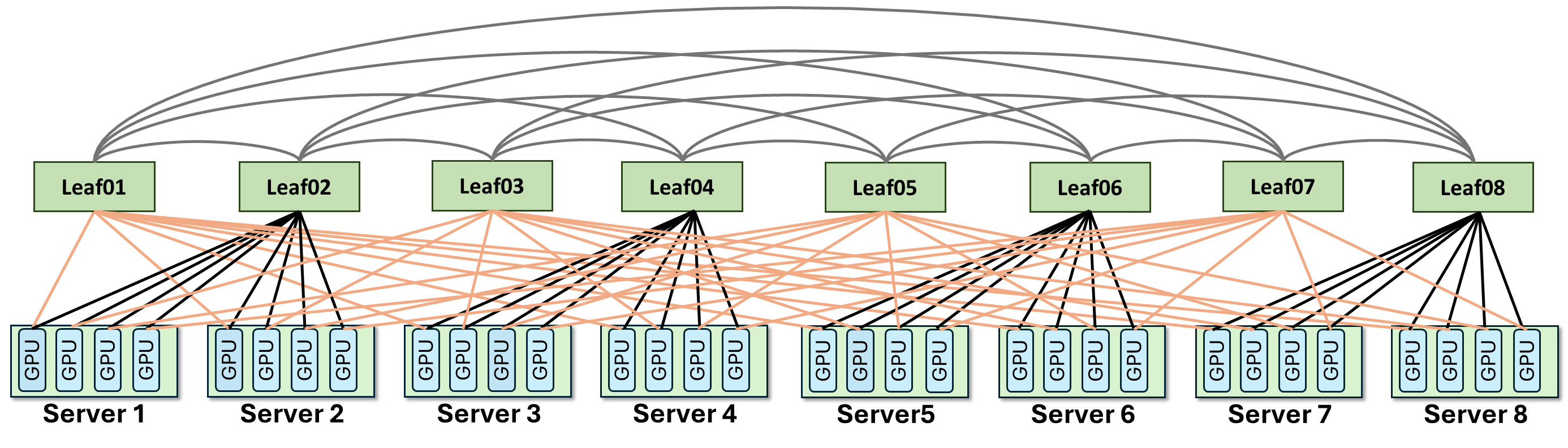
Figure 7: Schematic of the ZCube architecture. Assume each GPU has a dual-port NIC (p=2), with a total of n GPUs (GPU and NIC IDs are identical: 1, 2, …, n). Let k be the number of GPUs connected to a single switch, and let the total number of switches be 2n/k (IDs: 1, 2, …, 2n/k). The first port of GPU i (1<=i<=n) connects to an odd-numbered switch (ID: ((i-1) mod (n/k))*2 + 1); the second port of GPU i connects to an even-numbered switch (ID: ⌈i/k⌉*2). The two groups of switches are interconnected in a complete bipartite graph format, meaning every odd-numbered switch connects to all even-numbered switches. The ZCube networking architecture under a dual-port NIC configuration (p=2, n=32, k=8) is shown in Figure 7.
2.2 Characteristics of the ZCube Architecture
Network Diameter: The network diameter of the ZCube architecture is 2 hops, meaning any two GPUs in the entire network can reach each other via two switches. This falls between single-tier switch networking (1 hop, but limited scale) and two-tier switch networking (3 hops, large scale but high latency).
Load Balancing: First, the ZCube routing strategy ensures that there is only one optimal path between any pair of GPUs, avoiding traffic conflicts that arise during multi-path selection. Second, in the ZCube architecture, one group of switches connects to GPUs in a "single-rail" manner (switches connect to GPUs with consecutive IDs), while the other group connects in a "multi-rail" manner (switches connect to GPUs with the same ID). This unique design enables ZCube to achieve ideal load balancing across all switches in the network, regardless of whether it is handling typical traffic patterns in AI computing training scenarios (such as AllReduce, All2All, etc.) or typical traffic patterns in AI computing inference scenarios (where source-destination mappings are uncertain and loads across different NICs are uneven). This avoids the "second type of network congestion" mentioned earlier at the architectural level. As shown in Figure 8, traffic that would cause conflicts in the ROFT architecture enjoys exclusive use of the entire network path in the ZCube architecture, thereby avoiding congestion.
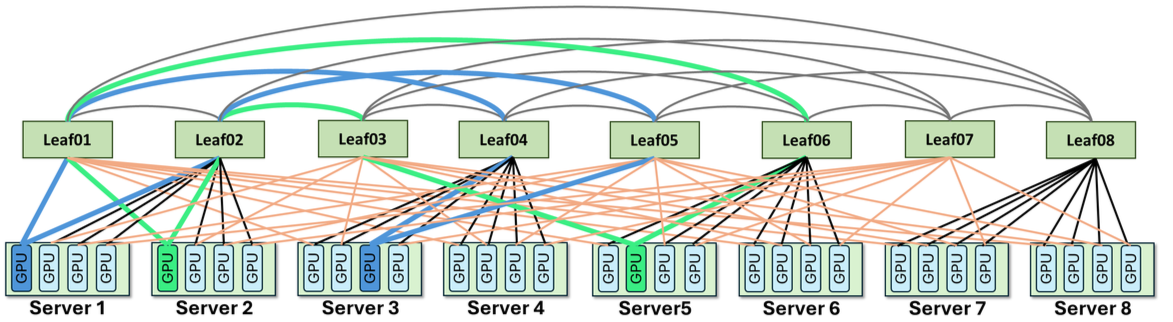
图8:ZCube架构下流量负载均衡示意图扩展性:ZCube架构在保持其良好性能特征的前提下,具有良好的扩展性。比如使用一层容量为51.2T的交换机(128个400Gbps端口),就能构建一个连接16384块400Gbps网卡的ZCube网络。如果使用更高容量的交换机,或者将ZCube网络划分为更多平面,ZCube架构的扩展性会进一步提升,可支持数万甚至数十万块GPU互联。成本:在相同规模下,ZCube 可以比传统 Clos / ROFT 架构减少约三分之一的交换机和光模块成本,比如对于万卡智算集群,ZCube架构可节省网络硬件投资约2.1亿~6.4亿元,上述特性表明ZCube架构付出更低网络成本的同时还可获得更好的负载均衡与性能表现。
2.3 集群实测:在降低网络成本的同时提升推理性能
我们在一个运行GLM-5.1 coding推理服务的千卡集群中,将原本部署的ROFT网络架构升级为ZCube网络架构。由于ZCube网络架构取消了传统Clos架构中的Spine层交换机,原有Clos架构下形成的布线模式、IP编址策略、路由策略以及交换机配置方法,均无法直接复用,需要针对ZCube架构进行重新设计。为了应对这些挑战,驭驯网络团队围绕ZCube架构设计了完整的网络解决方案,开发了ZCube控制器、机房布局设计工具和连线正确性检测程序等自动化工具,实现了机房部署规划、布线正确性校验、配置自动生成与批量下发等能力,有效解决了ZCube部署中的诸多挑战。这是能在极短时间内成功完成大规模生产集群改造的关键因素。在顺利完成网络架构改造后,我们在该集群运行GLM-5.1 coding推理服务来对ZCube架构进行实测。通过对比改造前后集群推理性能,我们发现,ZCube相比ROFT架构,将GPU的平均推理吞吐率提升了15%以上(如图9所示),TTFT的P99分位数下降了40.6%。
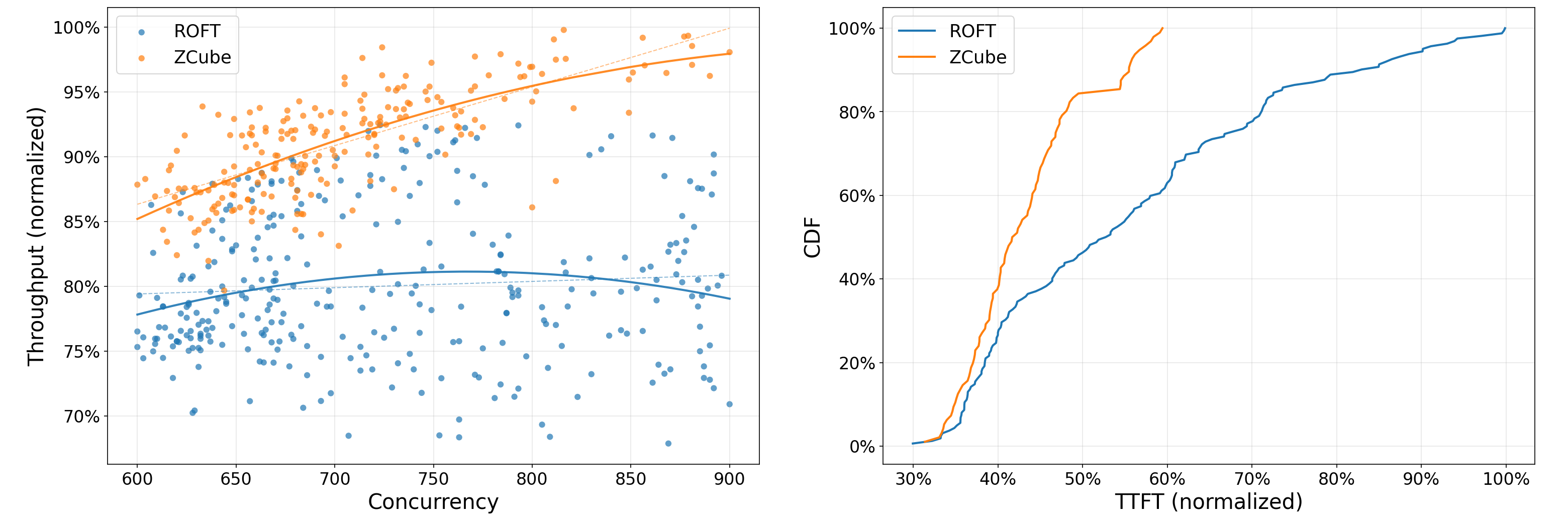
图9:同一集群 ZCube架构 vs ROFT架构吞吐与TTFT对比总结来说,对相同规模和配置的GPU及服务器硬件,在不修改任何应用的前提下,组网架构升级为ZCube之后,我们不但节省了1/3的光模块和交换机硬件,而且集群每秒能多服务15%的推理请求。这在当前推理业务暴增、算力资源紧缺的背景下,显得非常具有实用价值。当前,该ZCube集群已稳定运行两周多,在GLM-5.1 coding推理服务中发挥着重要作用。
3. 结语
大模型推理已从单点优化走向系统协同,网络与推理引擎之间的耦合正在加深,成为推理系统的关键组成部分。ZCube 的落地实践表明,组网架构创新可以直接释放推理系统的有效产能。通过让网络架构更适配 KV Cache 传输和 PD 流量特征,ZCube 从源头降低结构性拥塞形成的概率,在提升吞吐、降低延迟的同时改善集群成本效率。面向下一代大模型基础设施,网络设计将从通用互联走向模型流量驱动的系统协同。长上下文、PD 分离、MoE 和训推一体正在改变集群内部通信模式,要求网络拓扑、通信库与调度策略围绕真实模型流量共同优化。未来,我们将继续面向更大规模推理与训练集群探索新型智算网络架构,让网络从连接 GPU 的底层设施,升级为提升 Token 生产效率、系统稳定性和成本效率的核心能力。
致谢
ZCube发表于网络领域顶会ACM SIGCOMM 2025,被评价为“significantly change the way we think about and understand networking”。这是该技术首次大规模运用于生产推理集群中,感谢驭驯网络团队在本次网络架构升级和优化工作中的专业支持与紧密协作。参考文献:[1] NVIDIA. 2023. SuperPOD: Next Generation Scalable Infrastructure for AI Leadership. https://docs.nvidia.com/https:/docs.nvidia.com/dgx-superpod-reference-architecture-dgx-h100.pdf[2] NVIDIA. 2025. https://developer.nvidia.com/blog/accelerating-ai-storage-by-up-to-48-with-nvidia-spectrum-x-networking-platform-and-partners/ [3] Ultra Ethernet Consortium. Ultra Ethernet specification v1.0.1, 2025.[4] Tommaso Bonato, Abdul Kabbani, Ahmad Ghalayini, Michael Papamichael, Mohammad Dohadwala, Lukas Gianinazzi, Mikhail Khalilov, Elias Achermann, Daniele De Sensi, and Torsten Hoefler. REPS: Recycled entropy packet spraying for adaptive load balancing and failure mitigation, 2026.[5] Araujo, J., Chow, A., Handley, M., Lewis, R., Paasch, C., Padhye, J., ... & Sur, S. (2026). Resilient AI Supercomputer Networking using MRC and SRv6. arXiv preprint arXiv.04333.[6] Yan, Z., Li, D., Chen, L., Xiong, D., Gao, K., Zhang, Y., ... & Lin, H. (2025, September). From ATOP to ZCube: Automated topology optimization pipeline and a highly cost-effective network topology for large model training. In Proceedings of the ACM SIGCOMM 2025 Conference (pp. 861-881).