US Names 33 Alliances for Full-Stack AI Exports
The US Commerce Department designated 33 pre-built industry alliances to export full-stack superintelligence solutions spanning chips, data pipelines, models, security and vertical applications, with on-demand alliance applications opening Nov 30. In parallel, BIS tightened curbs on cross-border advanced AI chip flows and remote compute, adding Indonesia, Malaysia, Singapore, Thailand and Brazil to licensing requirements while rescinding the Biden-era AI diffusion rule. The twin moves use government backing to reshape the global AI supply chain.
Related Entities
Full Report
IT Home News on November 17: The U.S. Department of Commerce announced on November 16 local time that the American SI Exports Program has entered a new phase, designating the first batch of 33 pre-formed industry consortia to provide full-stack Superintelligence (SI) technology export solutions for overseas markets. At the same time, the program will open applications for on-demand consortia on November 30.
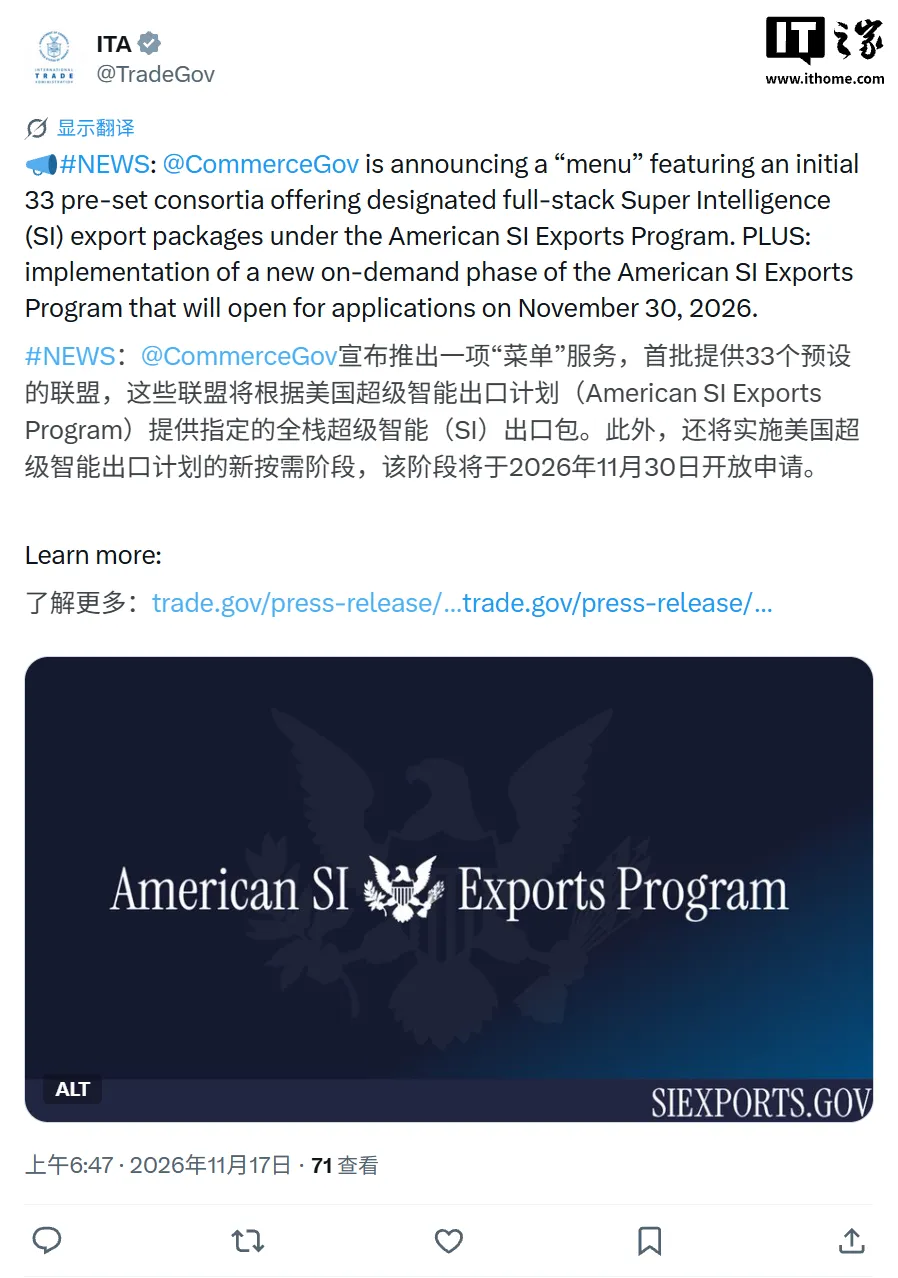
According to the announcement published the same day by the International Trade Administration of the U.S. Department of Commerce, the program is implemented under Executive Order 14320, "Promoting the Export of the American SI Technology Stack," signed by U.S. President Trump, and aims to promote U.S. companies' export of complete superintelligence technology solutions to international markets.
The U.S. Department of Commerce stated that the first batch of pre-built consortia already has the capability to cover the complete superintelligence technology stack and can continuously provide packaged solutions to international markets. IT Home noted that their solutions include five layers: superintelligence-optimized hardware, data pipelines and annotation systems, superintelligence models and systems, security and cybersecurity measures, and superintelligence applications for specific industries.
The U.S. Department of Commerce said that the first batch of approved solutions will be included in a unified export solutions catalog and promoted by the Department of Commerce and interagency partner organizations to overseas government and commercial buyers. Relevant buyers can choose U.S. technology combinations that have undergone U.S. review according to their needs.
Unlike pre-built consortia, on-demand consortia will be formed for specific overseas export opportunities and are not required to provide a complete technology stack, only the technology layers needed for a particular transaction. The U.S. Department of Commerce said that applications for this type of consortium will open on November 30.
In terms of policy support, both types of approved consortia can receive supporting support from the U.S. government, including priority processing of export control license applications, priority connection to federal financing resources, and government-to-government cooperation matchmaking and interagency coordination. The U.S. government will also assist approved consortia in conducting transactions with recognized overseas buyers.
At the same time, the U.S. Department of Commerce is tightening restrictions on the cross-border flow of advanced AI chips and the use of remote computing power. According to a TechCrunch report on November 16, the Bureau of Industry and Security (BIS) of the U.S. Department of Commerce introduced an interim final rule requiring licenses when exporting, re-exporting, or transferring advanced superintelligence chips and related equipment to overseas data centers if the relevant facilities may provide large amounts of computing power to companies in restricted countries.
The rule also brings Indonesia, Malaysia, Singapore, Thailand, and Brazil into the scope of advanced chip export licensing requirements and imposes restrictions on providing computing power through third parties or intermediaries. The rule also revokes the AI diffusion rule introduced by the Biden administration in January 2025.
In addition, The Wall Street Journal reported that the Trump administration is also planning to launch a list of "AI National Champions" companies, with more than 25 companies expected to be selected, possibly including Nvidia, Amazon, Microsoft, OpenAI, and Anthropic. People familiar with the matter said the plan is intended to help U.S. AI companies compete for overseas markets and vie with competitors for international customers.