StarSling Launches Self-Improving CI Platform for Agent-Heavy Repos
YC P25-backed StarSling launched a self-improving CI platform aimed at repositories where AI agents generate code faster than pipelines can verify it. Its agents automatically optimize test pipelines, with Mastra's suite dropping from 29m56s to 5m06s and Better Auth's E2E tests roughly halving, across 3M+ CI jobs run.
Related Entities
Full Report
Contents17 sections
Trusted by AI-first teams
Agents write code faster than CI can check it. These teams made verification keep up.
3M+ CI jobs run
Better AuthMastraBespoke LabsPartclOrgOrgKismet GolfBetter AuthMastraBespoke LabsPartclOrgOrgKismet GolfMastra→
6× Faster test suite
29m 56s → 5m 06s wall p95
“At Mastra we move so fast that the bottleneck becomes reviews and CI. Time spent compounds, and StarSling helps you realize how much time you're losing.”
Mastra case study →Better Auth→
2× Faster E2E
2m 22s → 1m 04s
“We've been using StarSling for Better Auth CI. It's been saving us countless hours, both with fast runners and their agent optimizing our CI.”
Better Auth case study →Partcl→
16× Shorter queue time
9.5 min → 35 s
“Within a day of migrating to StarSling Runners, their agents opened up a PR that literally made our Rust CI tests 2x faster!”
Partcl case study →Real PRs from StarSling agents →
Install with a one-line change
Drop-in replacement for ubuntu-latest.
- 01
Sign up with GitHub
Install in a minute 2. 02
Change one line
Update your workflow file.
Get Started For Free →Your workflow
jobs:
  build:
− Removed: runs-on: ubuntu-latest
- Added:
runs-on: starsling-ubuntu-26.04
    steps:
      - uses: actions/checkout@v4
How StarSling compares
| Capability | StarSling | GitHub-hosted | Blacksmith | Depot |
|---|---|---|---|---|
| GitHub Actions support | Yes | Yes | Yes | Yes |
| AI agent PRs | Yes | No | NoRunner right-sizing PRs | No |
| Adaptive Compute | Yes | No | No | No |
| CI optimization skills | Yes | No | No | No |
| Per-second billing | Yes | No | No | Yes |
Your workflow. A faster runner.
Switch the runner, keep the workflow
Every job, action and build command stays as written. Switch runners to see the line that changes and the median job time on each.
View docs for quick start detailsGet Started For Free →.github/workflows/ci.ymlYAML
name: CI
on: [push, pull_request]

jobs:
  build:
− Removed: runs-on: ubuntu-latest
- Added:
runs-on: starsling-ubuntu-26.04
    steps:
      - uses: actions/checkout@v4
      - run: npm ci
      - run: npm test
TypeScript job, median, standard 4 vCPU runners
GitHub Actions131.5sStarSling61sBenchmark source
LatestIntroducing Adaptive Compute: up to 2.3x faster GitHub Actions →
Adaptive Compute
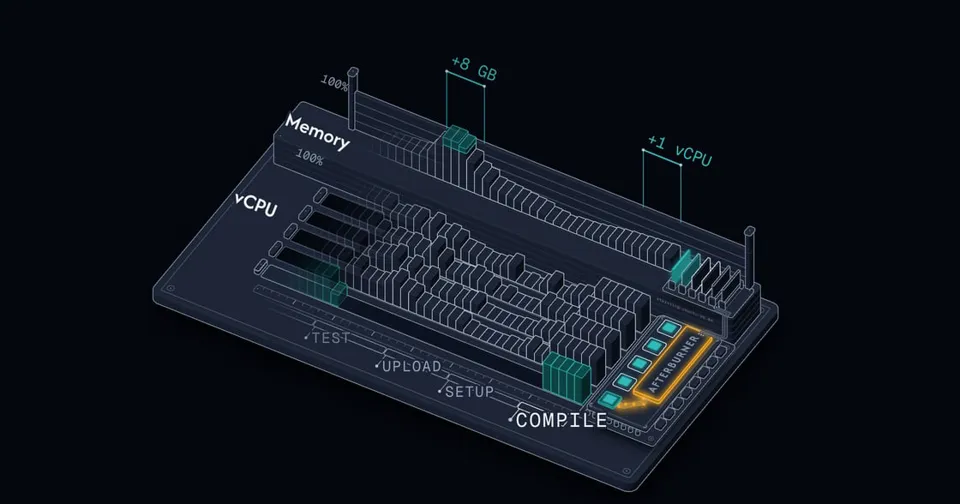
Sandbox Router sends every job to the fastest available sandbox, and Afterburner adds up to 25% more CPU and up to 50% more RAM to a running step at no extra cost. Up to 2.32x faster than GitHub-hosted runners.
 agent skills
Get AI agent optimizations before you change runners
Open source, one install, and they run on your machine: each skill reads your workflows and hands your coding agent the evidence to fix them.
- wall clock
Fix slow GitHub Actions with /ci-speedup
- configuration
Improve your GitHub Actions setup with /ci-score
- attack surface
Close critical attack vectors in GitHub Actions with /ci-secure
- live CI
Diagnose a failed job with /sling
Browse every agent skill→GitHub Actions best practices
Pricing
Free Trial
Free
2,000 free minutes
- • Unlimited concurrency
- • No credit card required
Usage-Based
$0.008/min
33% cheaper than GitHub Actions
- • Billed by the second
- • Queue time never billed
- • Unlimited concurrency
- • 99.99% SLA
Enterprise
Custom
Volume discounts available
- • Custom minute allocation
- • SSO/SAML + dedicated account manager
- • <1hr incident response
- • Custom SLAs
See all CPU and GPU runner rates → · GitHub Actions pricing
Frequently asked questions
Everything you need to evaluate StarSling for your CI.
01What is StarSling?
StarSling is AI-native CI for GitHub Actions: drop-in Ubuntu runners plus agents that open optimization PRs for your workflows. The runners replace ubuntu-latest and ubuntu-24.04 and run up to 33% cheaper than equivalent GitHub-hosted runners. Together with agent PRs, they made GitHub Actions up to 10x faster in public benchmarks, and the agents continuously analyze your workflows to keep the pipeline improving.
02What does Agent-Native CI mean?
Agent-native CI is CI that improves itself. Beyond running your workflows on faster hardware, AI agents continuously analyze your jobs, run logs, and machine telemetry, then open pull requests that optimize your pipeline: caching, parallelization, dependency installs, test sharding, and workflow structure. Traditional CI is static; agent-native CI gets faster the longer you use it. Read more about AI-native CI.
03How do I speed up GitHub Actions builds?
Two things move the needle: faster hardware and removing redundant work. Swap ubuntu-latest for a runner with stronger CPUs, then let AI agents find dead steps, cache fixes, and parallelization opportunities your team hasn't had time to fix (in StarSling's public benchmarks, runners plus agent PRs made CI up to 10x faster). For a deeper guide, read fast GitHub Actions. You can also work through the GitHub Actions CI best practices yourself, without StarSling, or follow Levels of CI for every way to make GitHub Actions cheaper and faster.
04Why are GitHub Actions runs so slow?
Usually the runner. GitHub-hosted ubuntu-latest runs on older shared hardware, so even simple builds spend time waiting on CPU. Switching to faster CPUs (StarSling Runners use 5th Gen AMD EPYC) typically cuts wall-clock time significantly before any workflow optimization.
05Are StarSling Runners a drop-in replacement for ubuntu-latest?
Yes. Change runs-on: ubuntu-latest to runs-on: starsling-ubuntu-26.04 (or ubuntu-24.04 to starsling-ubuntu-24.04) in your GitHub Actions workflow files. No other config changes required. See StarSling vs GitHub Actions and GitHub Actions alternatives.
06Is StarSling a GitHub Actions alternative?
StarSling is not a full replacement for GitHub Actions. It is a GitHub Actions runner alternative for supported Ubuntu/Linux jobs: you keep GitHub Actions workflows and change the runner label. If you are comparing full CI/CD platforms, read GitHub Actions alternatives.
07How much do StarSling Runners cost?
$0.008 per minute for 4 vCPU Linux runners with 16 GB RAM, 33% cheaper than GitHub Actions' $0.012/min. New paid subscriptions are billed by the second, with no one-minute minimum. Queue time is never billed. New accounts get 2,000 free minutes in their first month. See StarSling pricing.
08Can I keep caches and build output between jobs?
Yes. StarSling Disks are persistent directories mounted into StarSling Runners, so dependency stores and build output, such as pnpm's store or Rust's target/, are already in place when the next job starts. In a benchmark on Mastra's 4.5 GiB pnpm store, dependencies were ready in about 25 seconds, 4.5x faster than GitHub's actions/cache. Pull requests from the same repository read the default branch's published disk. Storage is $0.50 per GB-month.
09Does StarSling offer ARM runners?
StarSling Runners are x64 Linux, from 2 to 64 vCPU. Need ARM? Email [email protected].
10Can StarSling cache Docker layers?
Building Docker images in CI? Email [email protected] to talk through caching layers on StarSling Runners.
11Can I run GPU jobs on StarSling?
Yes. StarSling GPU Runners are drop-in GitHub Actions runners backed by a dedicated NVIDIA GPU: RTX PRO 6000 at a normalized $0.06422 per minute, RTX 5090 at $0.03022, and RTX 4090 at $0.02522, with H100 coming soon. Set runs-on: starsling-ubuntu-26.04-gpu and pick a card in the label. The GPU is dedicated to that job for as long as it runs, so nothing reclaims it partway through your suite. Explore StarSling GPU Runners.
12Which GPU should I pick for CI?
RTX PRO 6000 is the default, and it suits large-model and memory-heavy CI workloads. RTX 5090 suits fast inference tests and model evals. RTX 4090 covers everyday GPU tests at the lowest per-minute cost. You choose per job in the runs-on: label, so different jobs in the same workflow can use different cards. Explore StarSling GPU Runners.
13Can StarSling review my pull requests?
Yes. StarSling Review Runners are code review agents you configure and run in your own CI. One workflow file, and every pull request is analyzed as a GitHub Actions job on a StarSling runner using your model key, review skills and scripts from your codebase, and team-defined reviewers. Skills and instructions load from the trusted base branch, so a pull request cannot rewrite its own reviewer. The output is a review comment on the pull request, before a human opens it. Explore StarSling Review Runners.
14How much does a code review cost with Review Runners?
A review is a GitHub Actions job on a StarSling runner in the same account as the rest of your CI. It runs on starsling-review, a 4 vCPU runner with 16 GB of memory. Review Runner time has a normalized rate of $0.004 per minute. New paid subscriptions are billed in whole seconds from job start to finish. Partial seconds round up, with no one-minute minimum. Existing paid subscriptions remain billed in whole minutes with a one-minute minimum until migrated. Queue time is never billed. Concurrency is unlimited. Model tokens are billed by your own provider, on the account you already have. Explore StarSling Review Runners.
15How do StarSling's AI optimizations work?
After installing the StarSling GitHub App, AI agents continuously analyze your workflows, jobs, run logs, and machine telemetry, then open pull requests that optimize your setup: cache fixes, faster install strategies, Docker health checks, test sharding, parallelization, workflow structure, and job ordering. You review and merge. Optimization PRs are on paid plans, off by default for new accounts.
16What's the best GitHub Actions runner for AI-assisted development?
Coding agents (Claude Code, Cursor, Codex) push PR volume up several-fold, which compounds CI cost and queue times fast. The right fit is a runner with unlimited concurrency, continuous AI optimization (so the pipeline gets faster as PR volume grows), and per-minute pricing with no seat fees. StarSling Runners are built for this pattern.
17Do I pay for failed jobs?
Failed jobs are billed for the time they run: whole seconds on new paid subscriptions, with partial seconds rounded up; whole minutes on existing paid subscriptions until migrated. Queue time is never billed. New accounts get 2,000 free minutes in their first month.
18How does StarSling handle security and isolation?
Each job runs in its own single-use, hardware-isolated microVM that's destroyed after the run. That's the same isolation model GitHub-hosted runners use, so there's nothing for a later job or a fork PR to persist on or reach. Secrets pass directly from GitHub to your job and are never stored by StarSling. More details in our docs.
作者发帖说明(HN):
We’re Yonas and Daniel and we’re building StarSling (https://starsling.dev), fast GitHub Actions runners with AI agents that ship PRs to continuously improve your tests and workflows.
Every CI job gets its own ephemeral sandbox on the fastest Zen 5 machines and NVMe Disk with unlimited concurrency so a burst of agent PRs all run at once. We’re different from other runners because ours come with agents that cut down your CI bill over time. PRs are generated through our CI harness, which runs an agent loop that’s tuned to improve your CI speed and reduce cost.
Mastra now merges over 1,800 PRs a month and we got their slowest workflow from 29m 56s on GitHub-hosted runners down to 5m 06s (5.87x) on StarSling. We realized the true value of having an agent loop running on top of fast runners when our agents found an 11-month-old performance bottleneck in better-auth. The fix made one of their test jobs 5.4x faster: https://github.com/better-auth/better-auth/pull/10762.
I previously founded StackShare, which grew to over 1.5M developers. Daniel helped build Netflix's internal developer portal. Last year we started building AI agents for DevOps because shipping code to prod fell way behind agentic coding. We hit the CI bottleneck ourselves as we were building agents. Our own agents shipped so many PRs that at peak our job queues were backed up for hours and our CI bill got close to our inference bill...