Tsinghua Study: LLM Agents Spontaneously Polarize in Networks
A Tsinghua University study published in Nature Communications reveals that thousands of interconnected LLM agents spontaneously develop opinion polarization and homophilic network structures without predefined rules. By comparing five mainstream models like GPT-4o and Llama-3, the research highlights emergent collective behaviors in multi-agent systems, offering new insights into AI group dynamics.
Full Report

What happens when thousands of Large Language Model (LLM) agents are connected to the same network, freely communicating and continuously updating their viewpoints?
The latest research published by a team from Tsinghua University in Nature Communications provides the answer: without any pre-set rules, these agents spontaneously "pick sides." Their viewpoints gradually diverge into two opposing poles, while their connectivity patterns reorganize into a structure where "birds of a feather flock together."
This process is precisely the "emergence" phenomenon that has garnered significant attention in collective intelligence research.
Over the past few years, the capability boundaries of large models have been repeatedly pushed—chatting, coding, reasoning, and decision-making. However, most studies have focused solely on what a "single model" can do.
A more fundamental question has been overlooked: When numerous agents are no longer isolated but are instead connected as "nodes" within a network, interacting with one another and continuously updating their own viewpoints, what will be the behavior of the entire system?
This is no longer a simple summation of individual model capabilities, but rather the core issue of collective intelligence and multi-agent systems: How does the collective behavior of agents emerge? Will it result in viewpoint divergence and polarization similar to that seen in human groups?
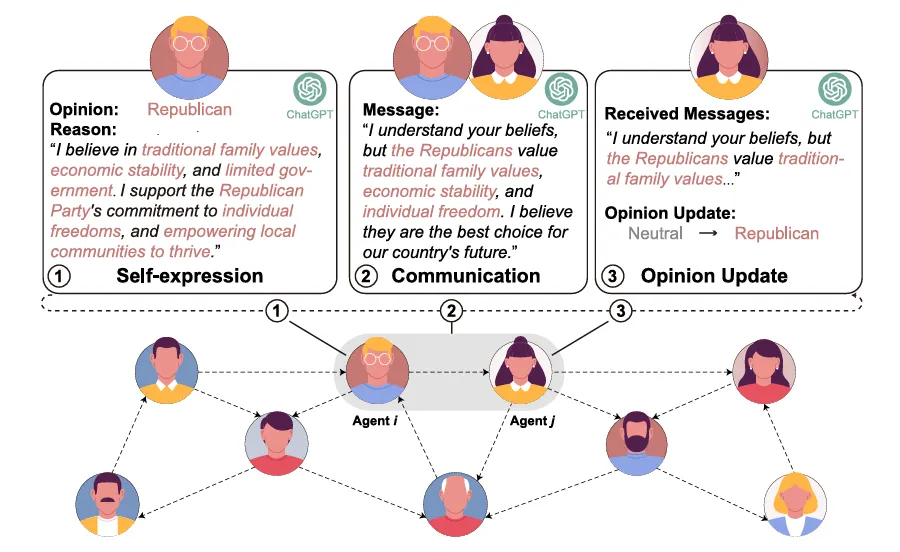
Figure 1: The three-stage operational framework of the agent system—self-expression, information exchange, and viewpoint update. Agents dynamically adjust their connections during interactions.
To address this question, the Tsinghua team collaborated with institutions including the University of Amsterdam, the University of Chicago, and the Santa Fe Institute to construct a networked system comprising 1,000 LLM agents. They systematically compared five mainstream backbone models: GPT-3.5, GPT-4o, ChatGLM, Llama-3, and DeepSeek-V3.
Paper Link: https://www.nature.com/articles/s41467-026-78228-y
Code Link: https://github.com/tsinghua-fib-lab/LLM_for_Polarization
Each agent operates continuously through three stages:
- Self-expression – Generating reasons to support its own viewpoint;
- Information exchange – Autonomously deciding whom to communicate with and what information to transmit;
- Viewpoint update – Updating its own viewpoint based on received information.
The key factor is that agents can dynamically adjust their connections during interactions—establishing links with those who share similar views and distancing themselves from those with opposing views. The system initializes viewpoints using a near-Gaussian distribution and connections using a Watts-Strogatz small-world network. Beyond this, no background context, memory, or behavioral rules are pre-set.
The study focuses on three issues characterized by long-standing viewpoint polarization: partisan stance, gun control, and abortion bans. Viewpoints are measured on a five-point scale: "Left – Leaning Left – Neutral – Leaning Right – Right." Consequently, researchers obtained a real-time trackable agent network, allowing them to observe the complete evolutionary process of viewpoint polarization from inception to formation.
Spontaneous Emergence of Viewpoint Polarization
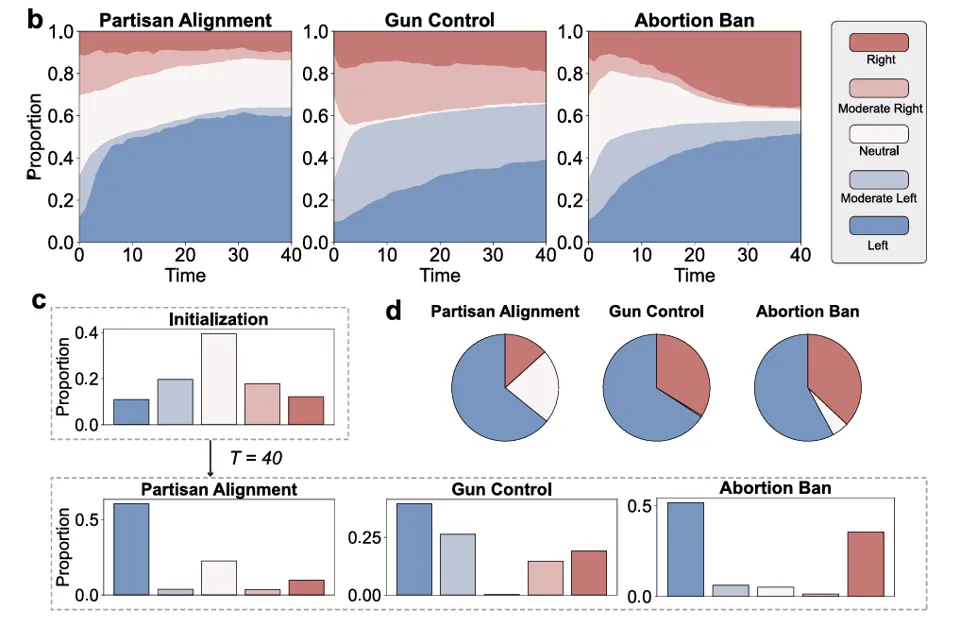
Figure 2: Dynamic evolution of viewpoints across three topics—initially near-Gaussian distributed viewpoints rapidly diverge, with the proportion of neutral viewpoints shrinking significantly from 40%.
The experimental results are quite striking: Within fewer than 10 rounds of interaction, the viewpoint distribution rapidly diverged from its initial near-Gaussian shape.
A consistent pattern emerged across all three topics: The originally high proportion of neutral viewpoints (40%) shrank dramatically, dropping to 22.5%, 0.4%, and 5.1%, respectively. In long-term networked interactions, maintaining a neutral stance became exceptionally difficult. Simultaneously, agents leaving the neutral position spontaneously clustered into two camps, forming distinct bipolar polarization.
More importantly, this phenomenon was stably present across all five backbone models, demonstrating robustness across different architectures.
Large Models Also Exhibit "Inconsistency Between Words and Actions"
Figure 3: Assessment of the self-inconsistency problem (a/b) and the effectiveness of self-regulation strategies (c/d). Self-regulation reduces the self-inconsistency rate by 9.4%–52.2% and restores balance between the left and right camps.
The research team also identified a notable technical issue: LLM agents exhibit "self-inconsistency"—their stated positions, generated rationales, and transmitted messages may contradict one another. For example, an agent claiming to be "neutral" might reveal a clear left-leaning bias when expressing itself.
This inconsistency is not uniformly distributed: right-leaning agents are significantly more likely to switch to left-leaning positions (z=8.27), resulting in polarization outcomes skewed toward the left.
To address this problem, the team drew on Bandura's theory of self-regulation and proposed a self-regulation strategy: having agents check for consistency after generating information, and iteratively regenerating until self-consistency is achieved. Experiments showed that this strategy reduced the self-inconsistency rate by 9.4%–52.2%, restored balance between left and right camps, and brought results closer to real-world distributions.
Homophily in Networks
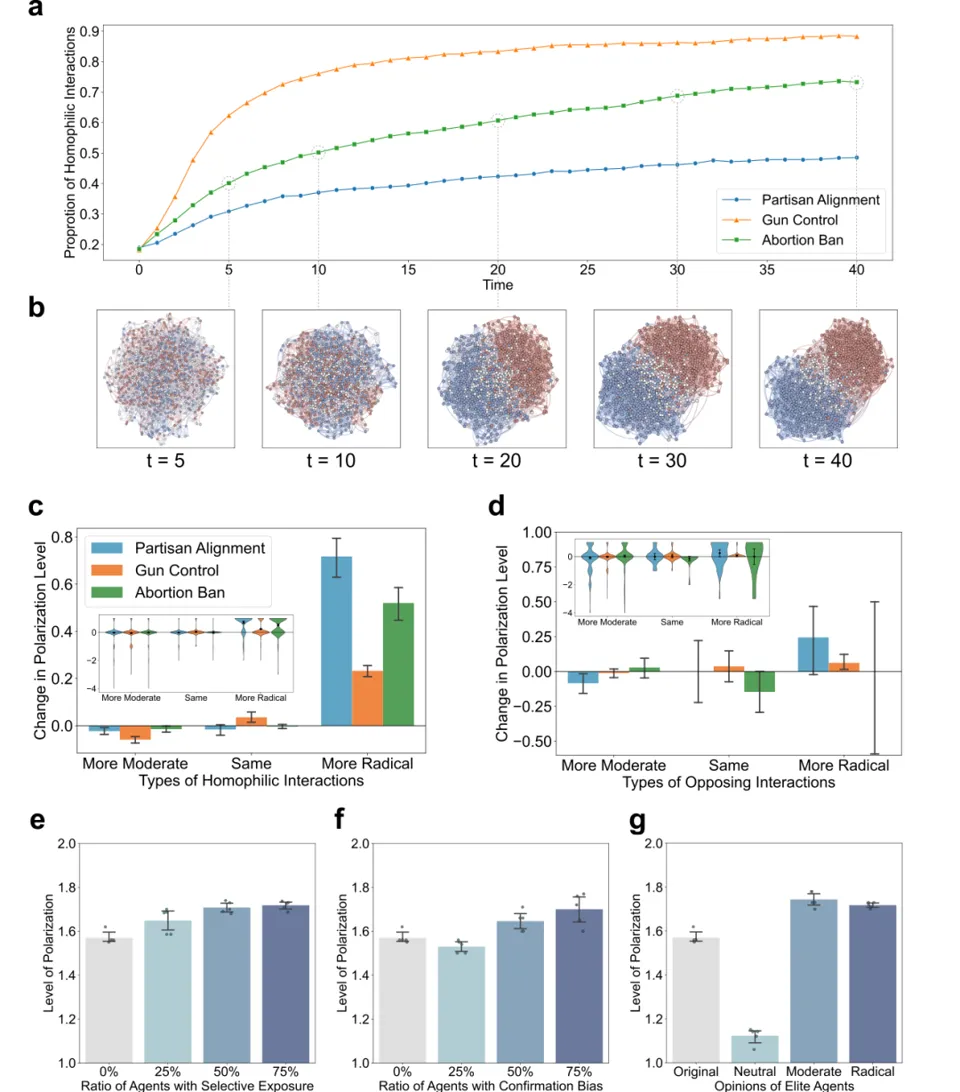
Figure 4: Self-organizing behavior in agent networks—the growth over time of same-camp interaction ratios, the evolution of network homophily clustering, and echo chamber and backfire effects.
Agents with Similar Views Tend to Connect
Specifically, the proportion of interactions between same-camp agents increased by 156.8%–382.7% over time, eventually reaching 48.5%–88.3% of all interactions occurring between those with similar views. Meanwhile, the agent network evolved a scale-free degree distribution, where a few "high-degree" nodes attracted significant attention.
More importantly, this network structure reciprocally shaped collective opinions: exposure to more radical homogeneous agents significantly exacerbated polarization (echo chamber effect); even when a minority of agents encountered opposing views (7.4%–10.2%), it did not necessarily reduce polarization and could instead exacerbate it (backfire effect).
Digital Testbed
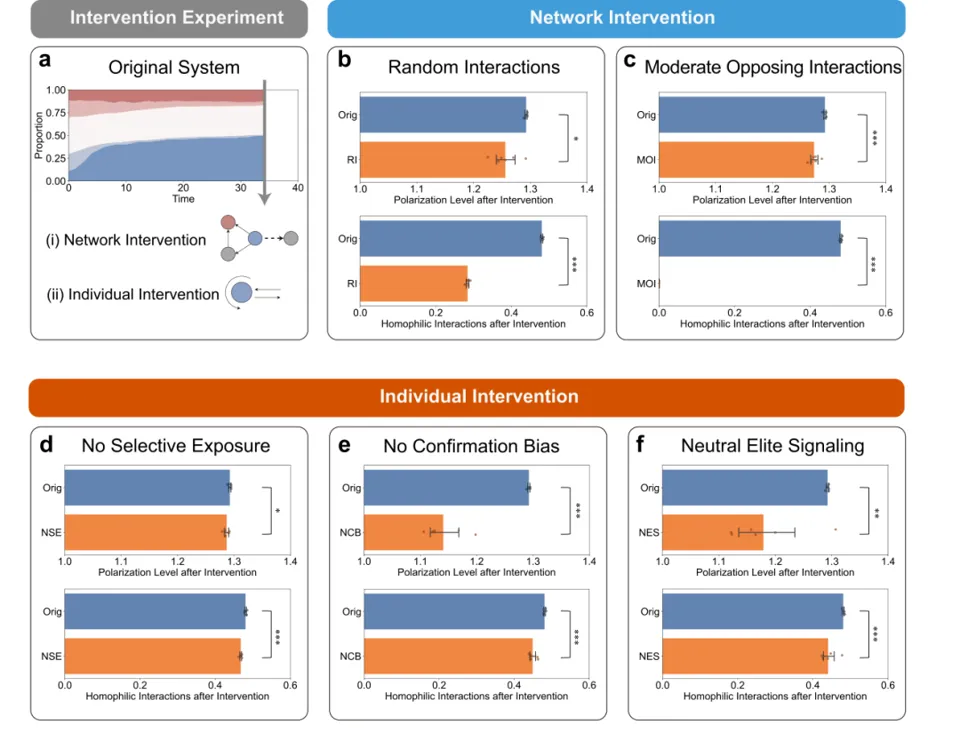
Figure 5: Comparison of the impact of five intervention strategies on polarization levels and homophilous interaction ratios. Individual-level interventions—eliminating confirmation bias (NCB) and neutral elite signaling (NES)—showed the largest reductions.
The value of this work extends beyond merely revealing phenomena. The research team further utilized the system as a "synthetic testbed," testing five categories of intervention strategies on already polarized systems:
- Network level: Random Interaction (RI), Moderate Opposing Interaction (MOI);
- Individual level: Eliminating Selective Exposure (NSE), Eliminating Confirmation Bias (NCB), Neutral Elite Signaling (NES).
Results indicated that in systems where polarization has already occurred and network structures have stabilized, directly adjusting connections has limited effect—for instance, "Moderate Opposing Interaction" yielded only about a 2% change in opinions. In contrast, individual-level strategies guiding agents to process differing viewpoints more openly proved more effective; "Eliminating Confirmation Bias" and "Neutral Elite Signaling" reduced polarization levels by 11.8% and 8.8%, respectively.
The significance of this finding lies in the fact that large-scale, controlled intervention experiments previously difficult to conduct in the real world can now be validated first within safe, reproducible agent networks.
Reliability and Future of Collective Intelligence
This study also raises a serious question: as agents transition from "individuals" to "networks," system reliability no longer depends solely on the capability of individual models but also on connection patterns and information update mechanisms.
Individual-level "correctness" does not guarantee group-level "reliability." Whether opinions drift toward extremes, whether cross-group interactions decrease, and whether similar information is repeatedly reinforced—all these factors must be incorporated into the evaluation of multi-agent systems.
The research team acknowledged the boundaries of their work: simulating human-like patterns does not equate to predicting real-world populations; models, prompts, and simplified representations of opinions still influence results. However, understanding the collective dynamics of networked agents is the first step toward building more reliable multi-agent systems.
References:
https://www.nature.com/articles/s41467-026-78228-y
Chasing ASI Instantly
⭐ Like, Share, and Watch — One Click Triple Combo ⭐
Star us to lock in instant updates from New Intelligence Era!