Shanghai Jiao Tong University's AutoDNA AI-Native Lab Autonomously Runs Molecular Biology Experiments, Published in Nature
A joint team at Shanghai Jiao Tong University has built AutoDNA (Siyuan-1), an AI-native scientific laboratory that autonomously performs molecular biology experiments. A multi-agent architecture decomposes tasks into literature search, protocol design, code generation, hardware execution and iterative optimization, while an 'atomic service' abstraction exposes heterogeneous instruments to the model through natural-language descriptions and unified code interfaces. The system achieves micron-level positioning and microliter-scale liquid handling, and was published in Nature with a homepage feature, including an end-to-end DNA storage workflow demo.
Related Entities
Full Report
IT之家 November 8 news: The IPADS Lab team of Chen Haibo and Wang Zhaoguo from the School of Computer Science at Shanghai Jiao Tong University, in collaboration with the teams of Fan Chunhai and Wang Fei from the School of Chemistry and Chemical Engineering and the Frontiers Science Center for Transformative Molecules, conducted research依托 the DNA Storage Research Center of the Zhangjiang Institute for Advanced Study. The results were published in the journal Nature and received prominent coverage as the lead story on the journal's official homepage.
The research team built AutoDNA (Siyuan-1), an AI-native science laboratory device that enables autonomous molecular biology experimental operations. Through co-design of models, experiments, and instruments, they solved the difficulties faced by existing AI autonomous science laboratories when extending to molecular biology experiments, including the organization of complex workflows, coordination among multiple types of instruments, and the assurance of experimental timing, environmental stability, and operational precision. This enables autonomous experiments to cover complex biomolecular experimental scenarios that require micron-level positioning and microliter-level liquid handling.
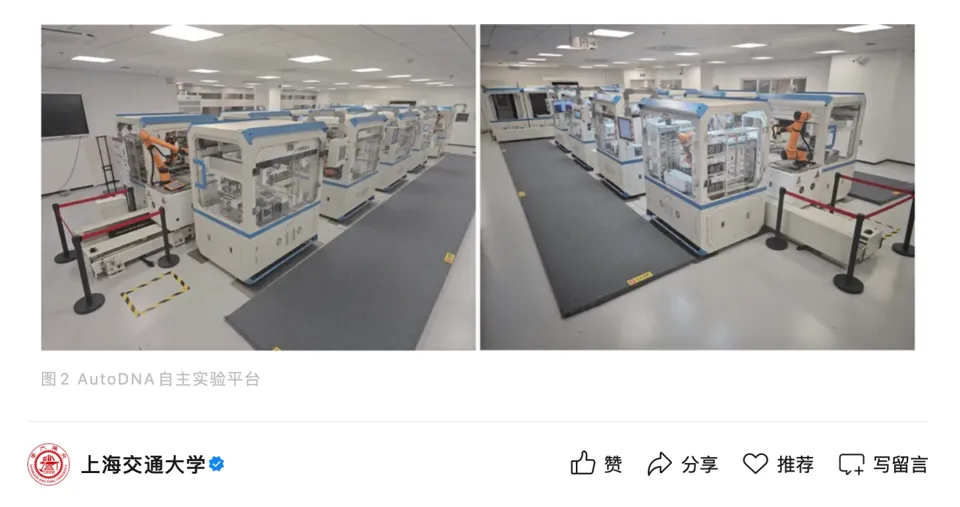
According to the introduction, existing AI autonomous science laboratories are typically pre-configured by experts with instruments, prescribed experimental workflows, and set optimization rules, after which AI is connected to localized steps such as literature retrieval, protocol generation, or data analysis. Although this "bolt-on" architecture can improve the efficiency of individual steps, it struggles to adapt to the characteristics of biomolecular experiments, which involve complex workflows, diverse instrument types, and strict requirements for real-time execution, environmental stability, and operational precision. To address this, AutoDNA adopts an AI-native architecture and solves the above problems through a model-experiment-instrument co-design approach.
- To address the complexity of experimental workflows, AutoDNA combines an understanding of experimental processes suitable for complex biomolecular operations and builds an experiment-oriented multi-agent architecture. The system decomposes complex experimental tasks into steps such as literature retrieval, reagent selection, protocol design, code generation, hardware execution, result analysis, and iterative optimization, and organizes multiple specialized agents to work collaboratively according to experimental progress. This enables the model to connect the entire "design—experiment—optimization" process and continuously iterate and adjust subsequent protocols based on experimental results.
- To address the problem of many instrument types and difficult cross-device collaboration, AutoDNA distills the capabilities of various instruments into "atomic services" suitable for model understanding and invocation, using natural language descriptions and unified code interfaces to tell the model what each device "can do and how to invoke it." This layer of abstraction shields underlying differences among instrument models, enabling the model to combine device capabilities according to experimental needs, generate, check, and correct cross-device control code, and translate experimental designs in the digital world into instrument operations in the physical world.
- To address the strict requirements of experiments for real-time performance, stability, and operational precision, AutoDNA combines high-precision automated hardware with an experimental execution and scheduling system. The hardware provides micron-level positioning and microliter-level liquid handling capabilities, while the system is responsible for program checking, instrument status tracking, and resource scheduling, enabling multiple experimental tasks to run in an orderly manner while satisfying timing and operational constraints. During construction, the platform also integrated a control terminal based on the OpenHarmony operating system and demonstrated application validation in scenarios such as nucleic acid testing, enzymatic DNA synthesis, and cancer detection.
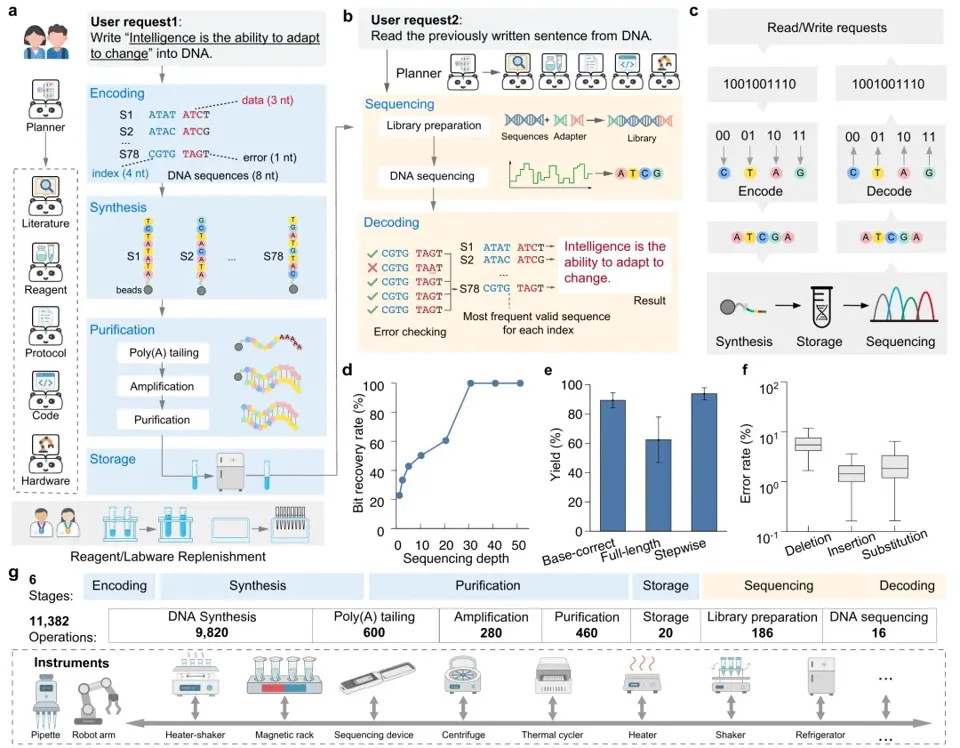
▲ AutoDNA autonomously completes the end-to-end DNA storage process of encoding, writing, preservation, reading, and decoding
IT之家 attaches the paper link:
Advertising statement: External redirect links contained in the article (including but not limited to hyperlinks, QR codes, passwords, and other forms) are used to convey more information and save selection time. The results are for reference only. All articles on IT之家 containing external links include this statement.