Rohan Paul (@rohanpaul_ai) · 10/15/2026, 18:04:14
Survey by MIT and Stanford: Robot Recursive Self-Improvement Lacks Cross-Task Validation
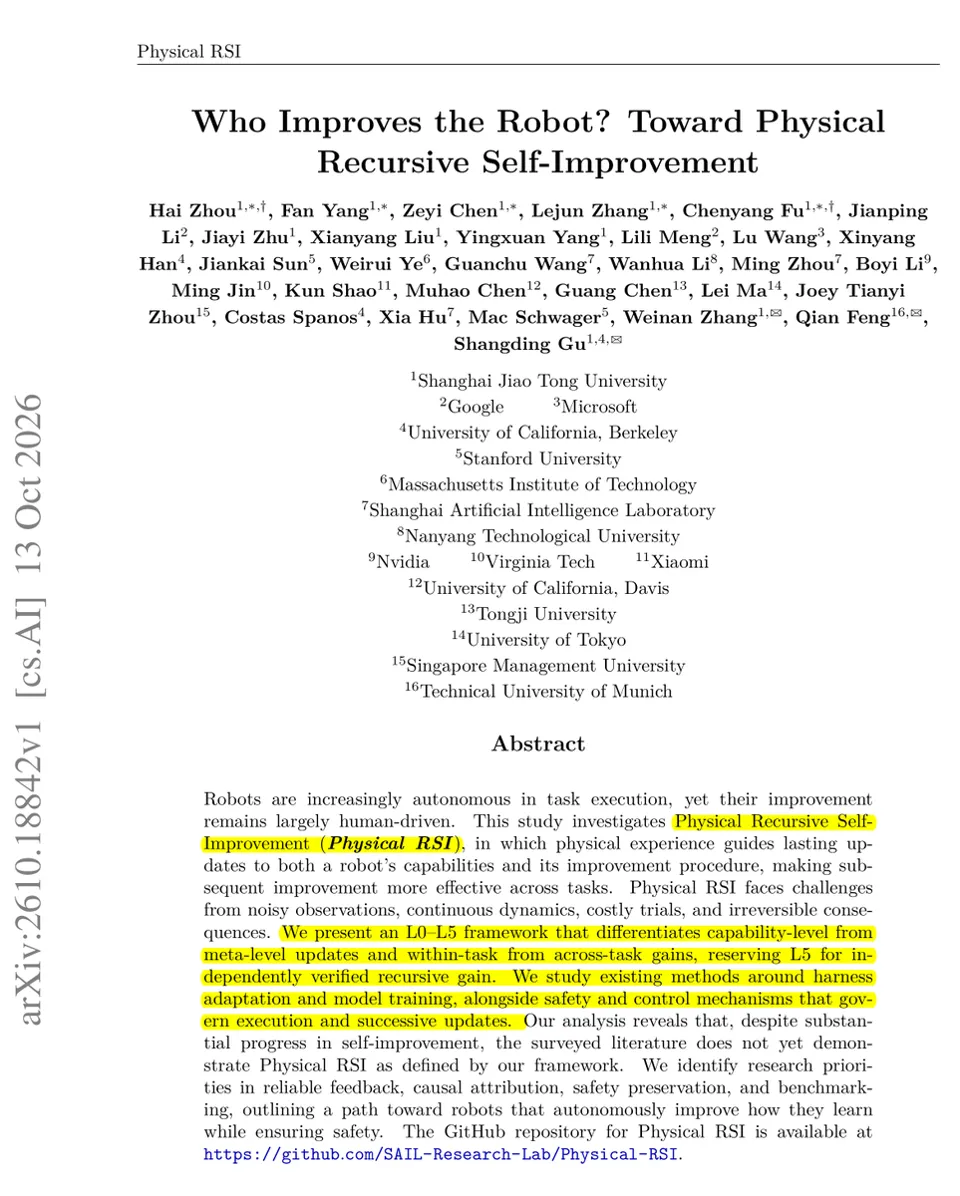
A joint survey paper from MIT, Stanford, Google, and Microsoft reveals critical methodological flaws in current robot 'recursive self-improvement' research. The study found that 5 out of 7 examined evaluation protocols failed to demonstrate gains across different tasks, and no system has yet achieved the independently verified L5 autonomous evolution level. The paper proposes an L0-L5 capability framework, emphasizing that true self-improvement must be validated on tasks requiring distinct skill sequences rather than single-task iterations.
SOURCE COVERAGEFull Original Report
Rohan Paul (@rohanpaul_ai) · 2026-10-15 10
Very insightful survey paper from, written by many of the top labs including MIT, Stanford, Google, Microsoft, for Physical Recursive Self-Improvement
Robots still rely on people to collect data, diagnose failures, and choose which updates to keep. Argues that 5 of 7 robot self-improvement studies they checked never showed gains on a different task.
Self-improvement claims need tests on tasks that require different skill sequences, and finds most reviewed protocols lack them.
Humans still collect their data, diagnose failures, and pick which updates to keep. Real trials are slow, noisy, costly, and sometimes irreversible, so digital self-improvement methods need rethinking.
They define 6 levels, from L0 with no autonomous improvement to L5 with independently verified recursive gain. The middle levels separate updates to skills from updates to the improvement method, on 1 task or across tasks.
Their map of systems from 2022 to 2026 has no confirmed L5 case. Of 7 robot evaluation protocols they examined, 5 did not show improvement across tasks.