Rohan Paul (@rohanpaul_ai) · 2026/10/15 18:04:14
MIT 与斯坦福等联合综述:机器人递归自我改进缺乏跨任务验证,无 L5 案例
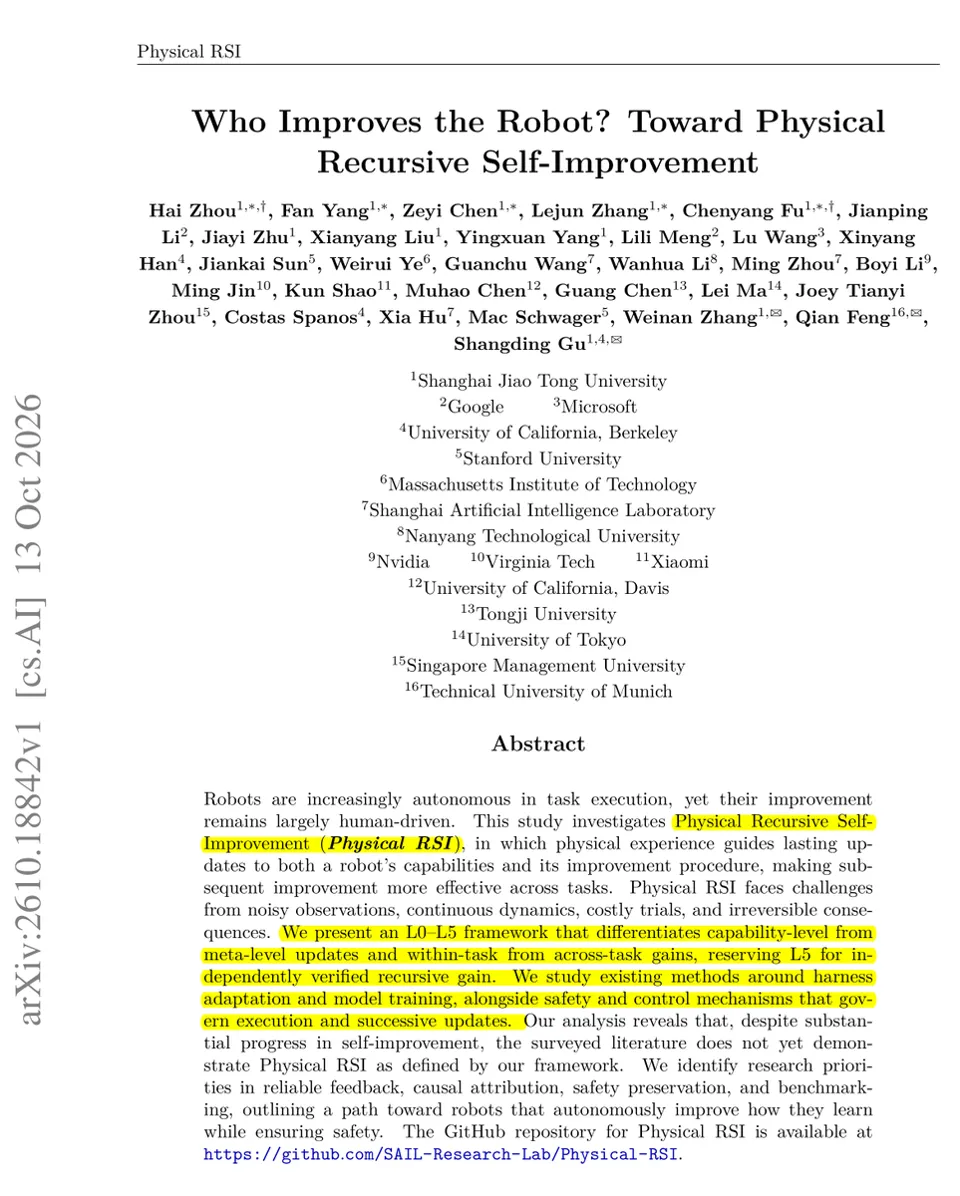
由 MIT、斯坦福、Google 和 Microsoft 等机构联合发布的综述论文指出,当前机器人领域的“递归自我改进”研究存在严重的方法论缺陷。研究发现,在审查的 7 个评估协议中,有 5 个未能证明模型在不同任务间具有泛化增益,且目前尚无任何系统达到独立验证的 L5 级自主进化水平。该论文提出了从 L0 到 L5 的能力分级框架,强调真正的自我改进必须通过需要不同技能序列的任务来验证,而非仅在单一任务上迭代。
报道全文原始报道全文
Rohan Paul (@rohanpaul_ai) · 2026-10-15 10
Very insightful survey paper from, written by many of the top labs including MIT, Stanford, Google, Microsoft, for Physical Recursive Self-Improvement
Robots still rely on people to collect data, diagnose failures, and choose which updates to keep. Argues that 5 of 7 robot self-improvement studies they checked never showed gains on a different task.
Self-improvement claims need tests on tasks that require different skill sequences, and finds most reviewed protocols lack them.
Humans still collect their data, diagnose failures, and pick which updates to keep. Real trials are slow, noisy, costly, and sometimes irreversible, so digital self-improvement methods need rethinking.
They define 6 levels, from L0 with no autonomous improvement to L5 with independently verified recursive gain. The middle levels separate updates to skills from updates to the improvement method, on 1 task or across tasks.
Their map of systems from 2022 to 2026 has no confirmed L5 case. Of 7 robot evaluation protocols they examined, 5 did not show improvement across tasks.