Google Open-Sources EnvHarness for Dynamic Agent Environment Learning
Google researchers have open-sourced EnvHarness, a framework that dynamically reshapes static training environments via pluggable components to address agent learning saturation on fixed benchmarks. Without modifying underlying environments or evaluation systems, it uses EnvRigger to automatically identify agent weaknesses and generate targeted mutations, enabling co-evolution of agents and environments. Experiments show performance gains of approximately 3 percentage points across multiple models on benchmarks like WebArena and SWE-bench.
Full Report
Google Researchers Open-Source EnvHarness, a framework that dynamically adjusts agent training environments based on the agent's weaknesses, without requiring modifications to the agent, environment, or evaluation system. The researchers state that this approach not only improves learning effectiveness and efficiency but also helps agents overcome their own deficiencies.
The researchers note that self-evolving agents typically improve themselves by rewriting prompts and acquiring new skills, but rarely adjust the environments in which they operate. This leads to a critical issue:
An agent continuously improving on a fixed benchmark will eventually stop learning from it. For every learner at every stage of learning, the initial state, rules, and feedback remain identical; therefore, once the agent can solve these tasks, the environment can no longer provide new knowledge.
The researchers explain that generating environments is costly, requires domain-specific pipelines, and often relies on expensive or unreliable verifiers. Even with significant resource investment, the generated environments remain static. To make it easier for engineers to train agents in adaptive environments, they developed EnvHarness.
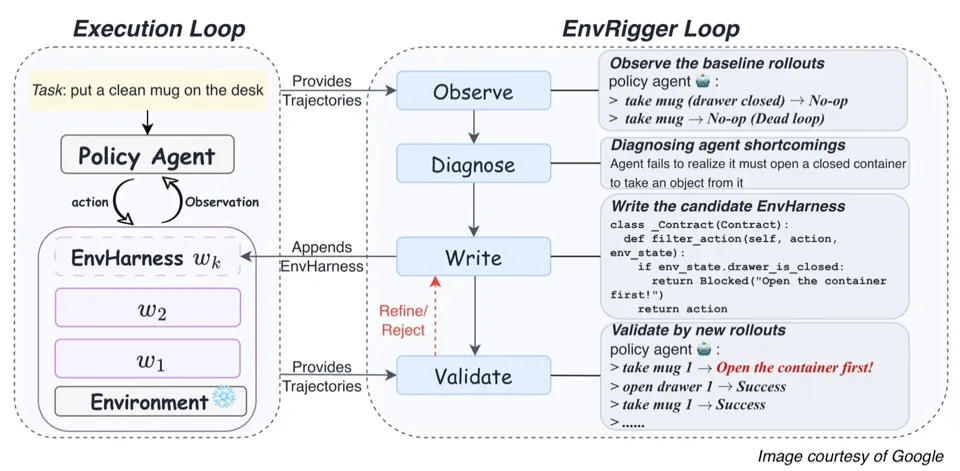
EnvHarness is a programmable wrapper layer composed of pluggable components that encloses static environments, altering only the interface through which agents interact. It reshapes environment behavior by dynamically introducing mutations, without modifying the underlying environment structure or evaluation system.
EnvHarness wraps existing environments using standard reset() and step() interfaces and provides three composable components: setup, for customizing the environment's initial state; rule, for constraining state transitions based on agent actions; and link, for customizing the observations presented to the agent.
The framework also introduces EnvRigger, which automatically determines how to adjust the environment for a specific agent by analyzing agent behavior, identifying recurring weaknesses, generating targeted modification plans, and validating them through new interactions.
Repeatedly running the EnvRigger loop enables continuous co-evolution between the agent and the environment, resulting in compound performance gains that scale effectively with the number of customized tasks.
Google's paper mentions that adding the EnvHarness layer improved agent performance across multiple benchmarks, including WebArena, SWE-bench Verified, and ALFWorld, without modifying core logic. The researchers tested several models, including Gemini 3.1 Flash-Lite, Qwen3.6 27B, Gemini 3.5 Flash, and Claude Sonnet 4.6, all of which showed performance improvements ranging from 2.9 to 3.7 percentage points.
The researchers conclude that EnvHarness delivers sustained performance gains where static environments fall short, achieves cross-domain generalization through domain-agnostic interfaces, and improves efficiency by correcting invalid behaviors.
Asif Razzaq, Founder and CEO of Marketechpost, commented on EnvHarness via LinkedIn:
It wraps existing environments through standard reset/step interfaces, leaving original tasks and manually written validators unchanged. LLM developers only need to write this wrapper logic to address defects discovered in agent trajectories.
Similarly, DevOps engineer Aniket Kumar emphasized that Stage (setup), Contract (rule), and Chain provide a clean abstraction that preserves benchmark validators, avoiding a common pitfall found in other environment scaling methods.
View the original English article: https://www.infoq.com/news/2026/10/envharness-self-evolving-agents/