Duke and Princeton Study Finds Small Parallel Agent Teams Outperform Large Ones
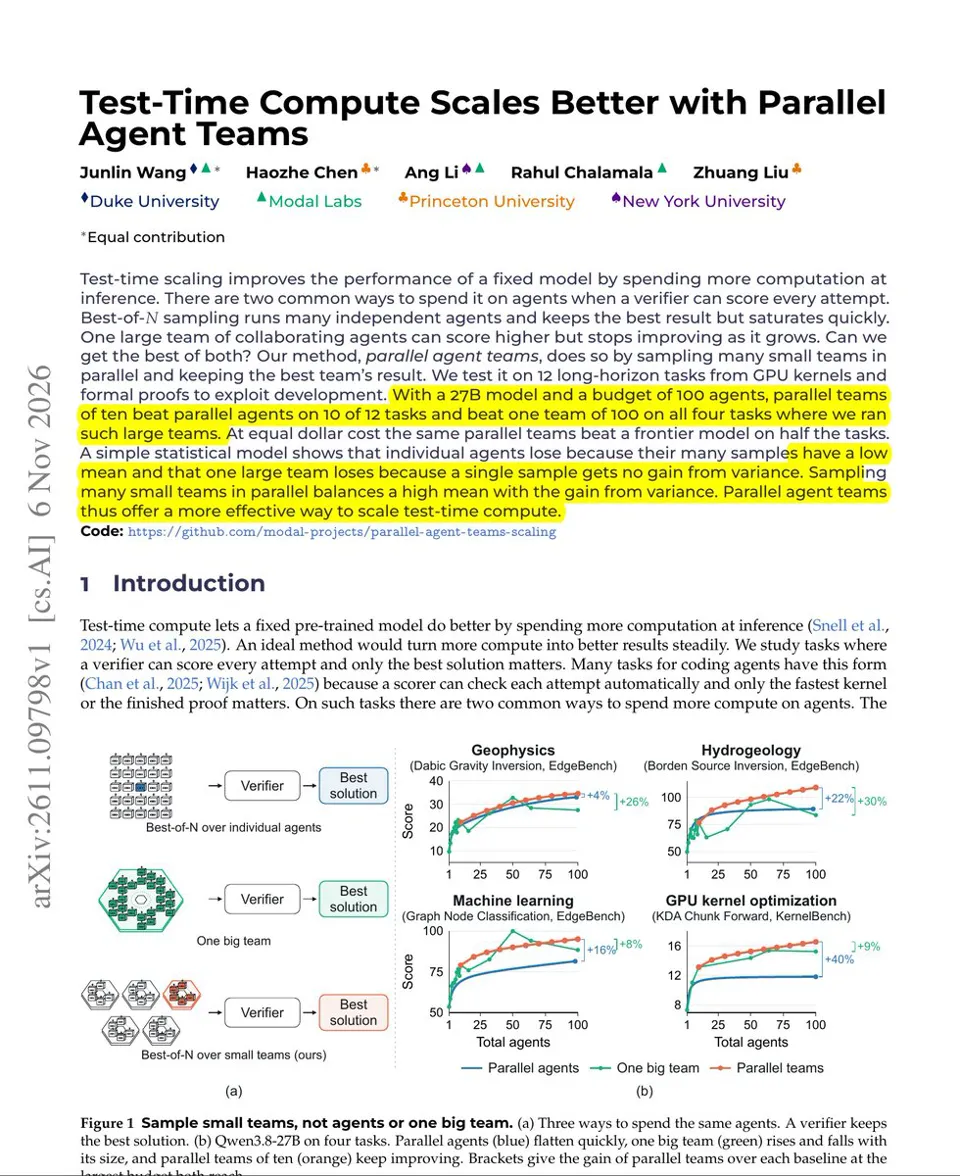
A new Duke and Princeton paper finds that, at equal compute, splitting agents into multiple small parallel teams and keeping the best team's result beats both solo-agent best-of-N and one giant team. With a budget of 100 agents, 10 teams of 10 agents running in parallel and selecting the best team outperformed 100 solo agents and a single 100-agent team. The authors recommend splitting budgets into small note-sharing teams and keeping the best answer when a verifier can score results.
Related Entities
Full Report
Rohan Paul (@rohanpaul_ai) · 2026-11-10 20
New Duke and Princeton paper finds that, at equal compute, many small agent teams in parallel beat both solo-agent best-of-N and one giant team.
With the same budget of 100 AI agents, running 10 small teams of 10 agents in parallel and keeping the best team’s result beat both 100 solo agents and one 100-agent team.
With a verifier, teams usually run many solo agents and keep the best, but gains flatten fast. One large team does better at first, then stops improving as it grows.
They split the agent budget into teams of 10 that share a forum, then keep the best team's result. Teamwork raises each attempt's average, and several teams still give many tries.
If a verifier can score your agents' work, split the budget into several small teams that share notes, and keep the best team's answer.