Google DeepMind Launches Mass Spec Agent Boosting Accuracy to 97%
Google DeepMind, together with analytical chemists, released Mass Spec Skills, a domain-specific skill set for the Google Antigravity platform that combines Gemini's chemical reasoning with mass spectrometry tools and public chemical database queries. Without tooling, frontier models scored below 4% accuracy; with the skill set, even lightweight models reach 97% retrieval identification accuracy and produce auditable evidence chains.
Related Entities
Full Report
IT之家 November 26 news: Google, together with analytical chemists and building on community open-source tools, has created Mass Spec Skills, open on the Google Antigravity platform, which can assist researchers in interpreting tandem mass spectra and organizing chemical evidence. Even with lightweight models, it can achieve frontier-level retrieval and identification accuracy.
A single drop of blood, soil, or plant tissue extract contains a vast number of small molecules, covering nutrients, hormones, drugs and their metabolites, pollutants, and bioactive compounds with medicinal potential. Modern mass spectrometers can detect tens of thousands of molecular signals in a single sample, measure the mass of charged molecules, and in tandem mass spectrometry (MS/MS) mode measure the fragments produced by their fragmentation.
These measurements cannot be directly mapped to molecular structures. Researchers cannot immediately determine which compound a signal corresponds to, nor easily associate it with its biological function and downstream applications.
Currently, mass spectrometry databases on average can annotate only about 5% of measured spectra, and for human samples only about 10%. The remaining large number of unannotated signals are called the "dark matter" of the mass spectrometry field. Many molecules that produce unannotated signals are already included in public chemical databases, but the corresponding spectra have not yet been entered and cannot be directly matched.
Traditional analytical chemists follow a well-established step-by-step workflow to narrow down candidate structures: search spectral libraries, determine molecular formulas, retrieve candidate structures from chemical databases, and compare measured fragment peaks one by one. However, a single study can generate thousands of spectra, and manual analysis simply cannot keep up with the scale of the data.
Mass Spec Skills is a set of domain-specific skills that combines Gemini's chemical reasoning capabilities with mature mass spectrometry tools and public chemical database query capabilities. Antigravity automatically executes the relevant operations, integrates the results, carries out chemical reasoning, and ultimately presents the complete chain of evidence to chemists for review.
The identification efficiency of molecules already recorded in databases will be greatly improved; for undiscovered new molecules, the agent can also narrow down the molecular formula range and identify structural fragments supported by the fragments, providing direction for complete structure elucidation. The entire workflow relies on accurate mass calculations, searches of million-scale compound libraries, and bond cleavage simulations, which cannot be accomplished by language models alone.
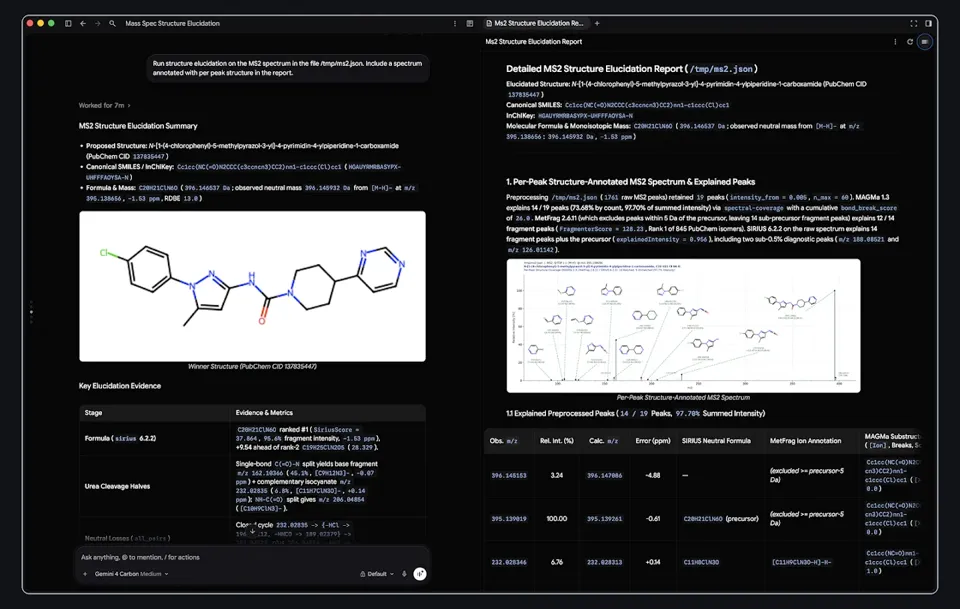
Researchers do not need to configure the underlying tools separately; they only need to describe the task and instrument tolerances in natural language, and the agent will automatically chain the relevant skills together. Starting from a single prompt, it can process unannotated tandem mass spectra all the way to putative chemical structures while generating a complete auditable report. Each stage of the workflow can also be used independently for routine small tasks such as spectral denoising, peak annotation, and isomer comparison.
Under test conditions with no network access and no additional skills, the identification accuracy of Gemini 3.8 Flash, Gemini 4 Argon, and Gemini 4 Carbon was all below 4%, proving that they cannot reliably infer molecular structures from peak lists alone. With only limited network access, frontier models missed one-quarter to one-third of spectra, and lightweight models missed more than three-quarters.
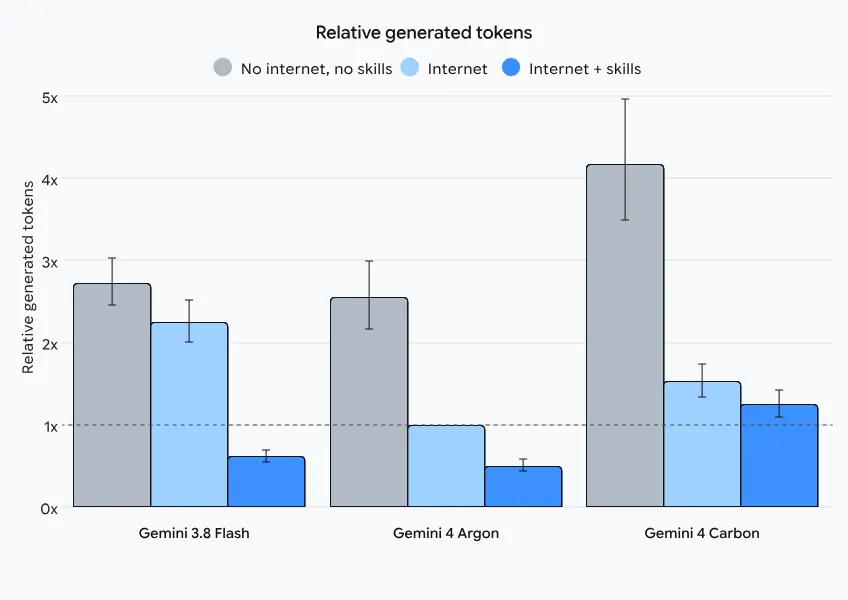
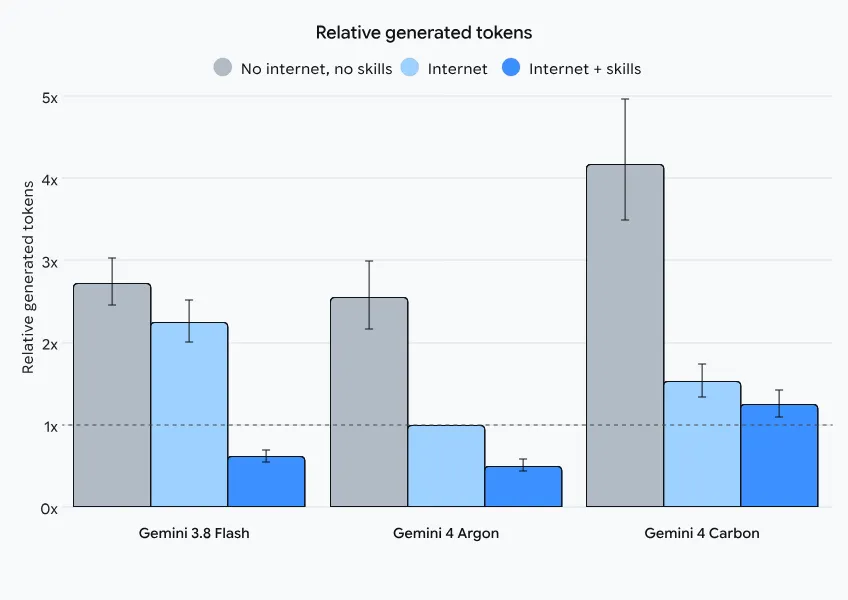
After integrating Mass Spec Skills, the molecular identification and validation accuracy of all three models reached about 97%, with the lightweight model matching the accuracy of the two frontier models. At the same time, the number of generated tokens consumed per interaction dropped significantly: Flash by nearly 4x, Argon by half, and Carbon by nearly one-fifth.
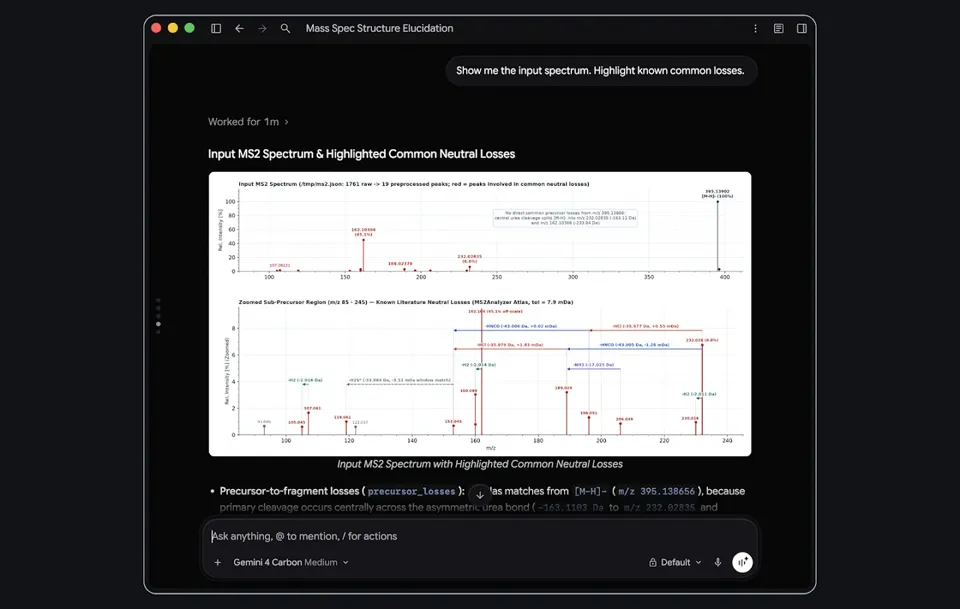
The tool cannot distinguish enantiomers or some highly structurally similar isomers based on LC-MS/MS spectra alone; such objects require additional measurements such as chromatographic retention time, ion mobility, and nuclear magnetic resonance. For entirely new molecules not recorded in any database, Antigravity also cannot independently retrieve and confirm their structures, but it can output predicted molecular formulas, peak annotations, and detailed annotation tables, providing chemists with a reliable starting point for analysis.
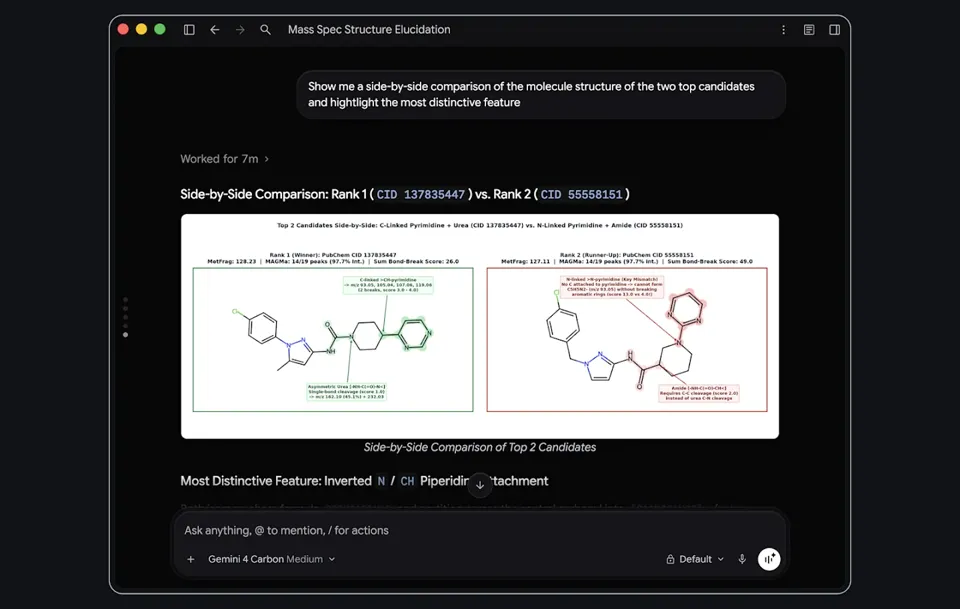
Currently, Mass Spec Skills is available on Google Antigravity. Users can download the Antigravity app and install the Mass Spec plug-in to use it; enterprise users can log in to enterprise accounts with Google Cloud credentials to try it. Google is also offering 10,000 researchers six months of free access to the highest usage tier (rolled out gradually, subject to qualification review). The application channel is now open.
IT之家 attaches the reference address
Advertising statement: External redirect links contained in the article (including but not limited to hyperlinks, QR codes, passcodes, etc.) are used to convey more information and save selection time. The results are for reference only. All articles on IT之家 containing external links include this statement.