Intology Launches Locus: Autonomous Research Agent Outperforms GPT-6 and Claude 5.5 in Molecular Design
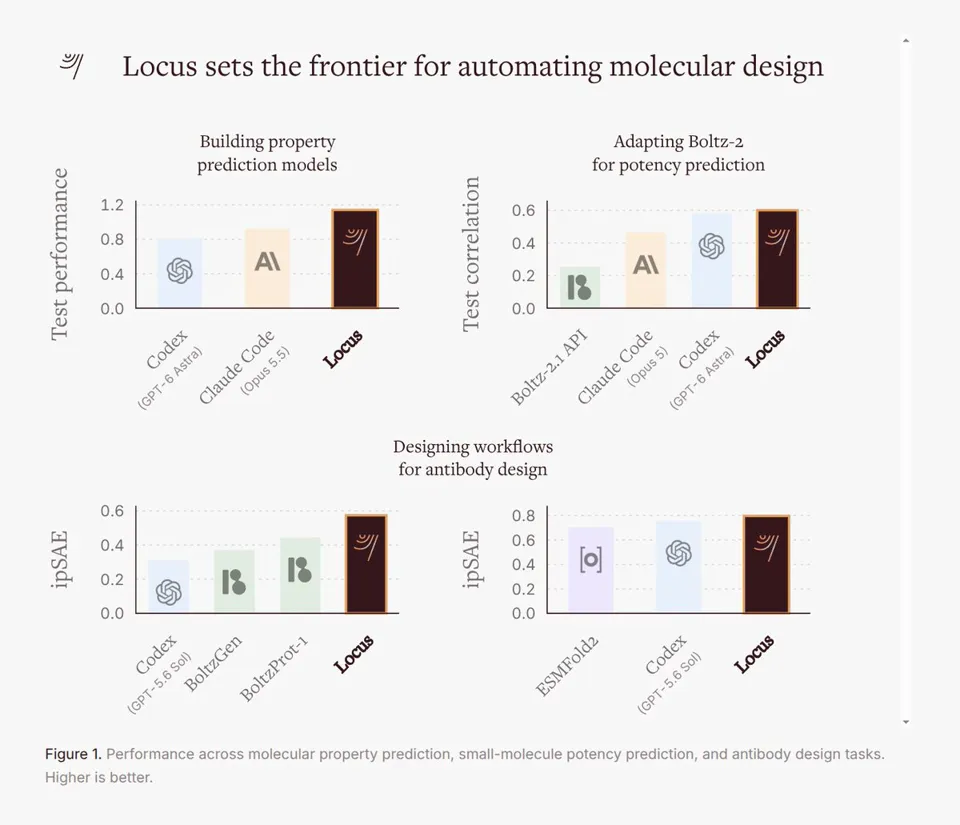
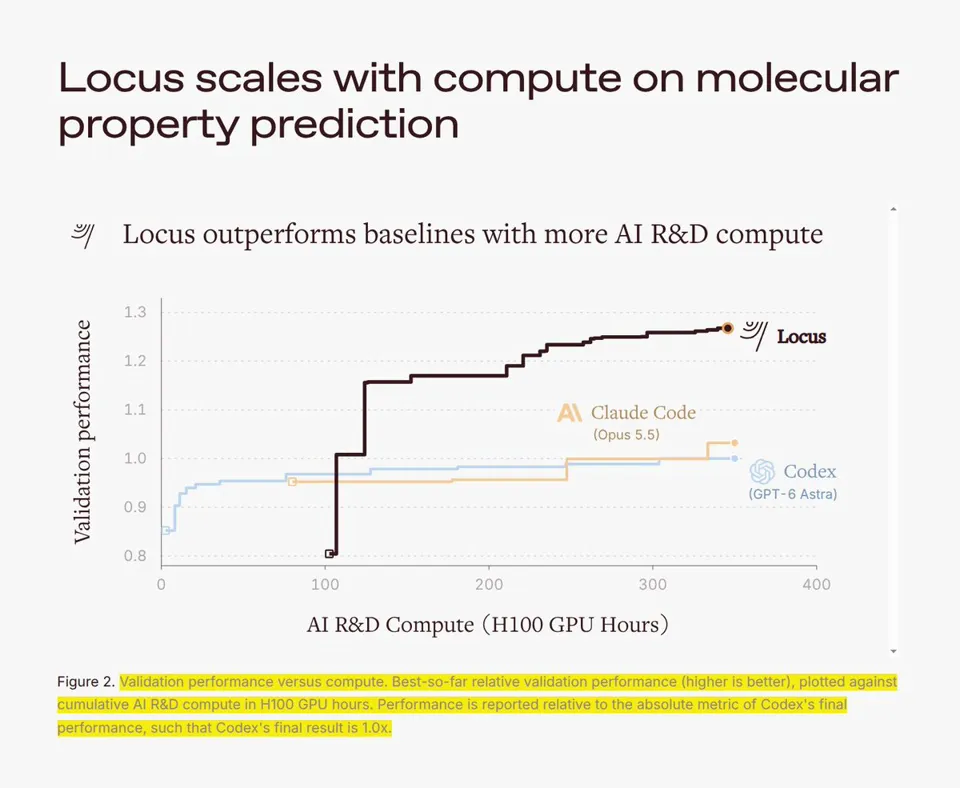
Intology has introduced Locus, an automated research system capable of autonomously proposing experiments, running parallel batches on GPUs, and iterating on successful models. In molecular prediction and design tasks, Locus outperformed agents built on GPT-6 Astra and Claude Opus 5.5, demonstrating superior generalization and sample efficiency in proprietary data scenarios.
Full Report
Rohan Paul (@rohanpaul_ai) · 2026-11-03 17
An AI system just designed better molecular models than the specialist tools built by the labs that own those models.
@intology’s Locus does a machine-learning researcher’s job:
proposes experiments, runs many batches of them in parallel on GPUs keeps what works and repeats, now applied to drug and antibody design.
Locus beat GPT-6 Astra and Claude Opus 5.5 agents on molecular prediction
↳ 引用 @intology (Intology): Locus sets the frontier for automating molecular design
Our automated research system Locus develops scientific AI models that outperform SOTA expert solutions
Unlocking the potential of scientific AI requires leveraging proprietary data. Locus achieves this autonomously 🧵👇
--
We test Locus across a number of tasks related to molecular scoring and design: training molecular property prediction models for a proprietary task, fine-tuning Boltz-2 to predict small-molecule potency, and building antibody design workflows around BoltzGen, Boltz-2, ESMC, and ESMFold2.
Each of these settings are real-world AI for science use cases, where tasks are often out-of-distribution for existing foundation models and limited in data, while featuring expensive and noisy evaluators. Compared to state-of-the-art baselines and LLM agents set to optimize these tasks, Locus achieves higher performance. Additionally, Locus generalizes better despite limited data, finds more sample efficient solutions, and explores a higher diversity of solutions.