The Decoder · 10/11/2026, 17:49:59
Jevons Paradox in AI: Falling Token Prices Drive Surging Compute Demand for Nvidia
Data reveals a textbook Jevons paradox in the AI market: while unit token prices drop, H100 GPU rental costs remain steady or rise. Cheaper inference unlocks agents and automation, driving total volume growth faster than price declines, thus sustaining strong compute demand. This trend validates Nvidia's business model but suggests current compute needs may be artificially inflated by the high token consumption of agentic systems.
SOURCE COVERAGEFull Original Report

Oct 11, 2026
Jevons' paradox is Jensen's best friend. Data from Ornn, Silicon Data, and Bloomberg (as of August 2026) shows what a16z calls a textbook Jevons paradox in the AI market. Token prices keep dropping, but H100 GPU rental prices hold steady or climb. Cheaper tokens unlock AI agents, automation, and new applications, so volume grows faster than per-unit costs fall. How much demand comes from humans versus the systems themselves isn't clear, since agentic AI burns through tokens at a staggering rate. Compute demand could be artificially inflated, and even modest human usage growth could trigger outsized hardware needs.
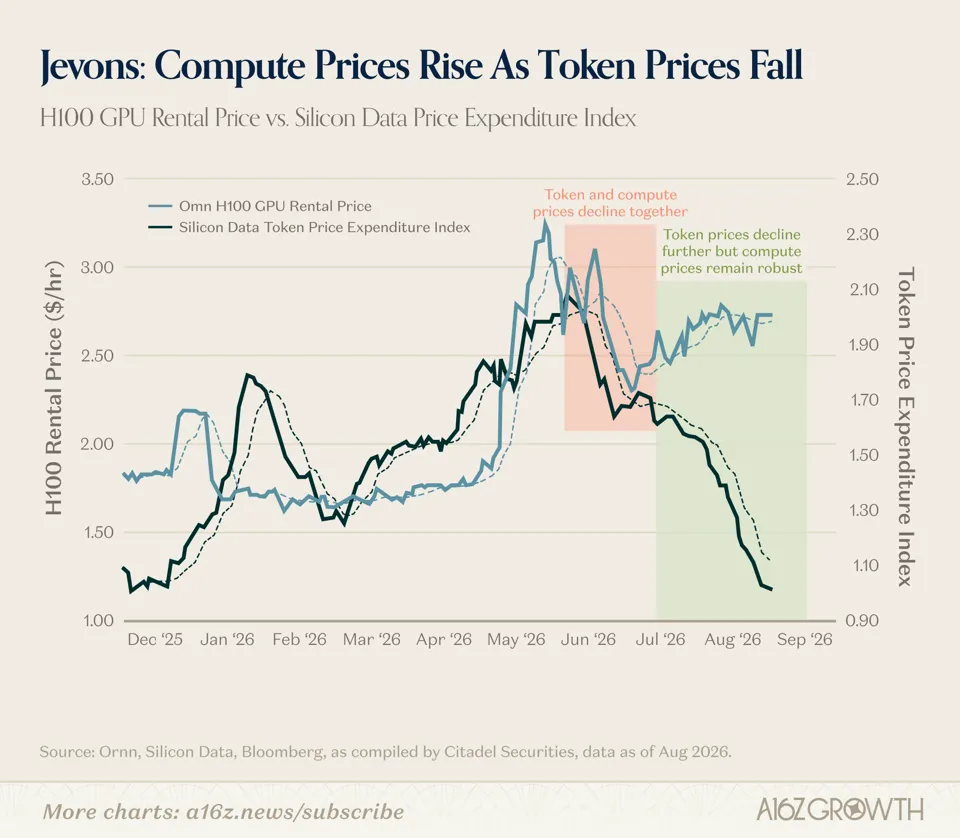
The whole system rests on one assumption: AI usage has to grow fast enough to offset falling token prices. As long as it does, hardware stays scarce and expensive. If demand flattens, the chain from chip makers and memory suppliers to energy providers and cloud companies takes a hit. Markets could spiral from there, and how sensitive they already are became clear when US stocks dropped on reports that OpenAI's annualized revenue might be lower than previously reported.