Subvocal Launches Silent Speech Input Glasses for 200+ WPM Typing
Hardware startup Subvocal has launched silent speech input glasses that use facial muscle electrical signals (EMG) to convert subvocalizations into text at over 200 words per minute. The device addresses privacy and noise concerns in public settings, enabling users to interact with AI agents and coding tools silently.
Full Report
Contents5 sections
Talk without talking.
Input text at the speed of speech, silently and invisibly.
Saying “I think it’s time I looked for another job” is easy in private. In a crowded train, those words may be overheard.
Voice flows perfectly,
until it’s awkward.
Some words aren’t for everyone.
On the train. In a quiet room. Around people you don’t know.
Speak silently
at the speed of speech.
Write at the speed of speech, without speaking out loud. Subvocal decodes almost-invisible subtle, silent mouthing into text at 200+ WPM.
Messages, notes, a conversation with AI. The words go where you need them. The room stays quiet.
Your words flow at 200+ words per minute.
Silent input No words spoken aloud
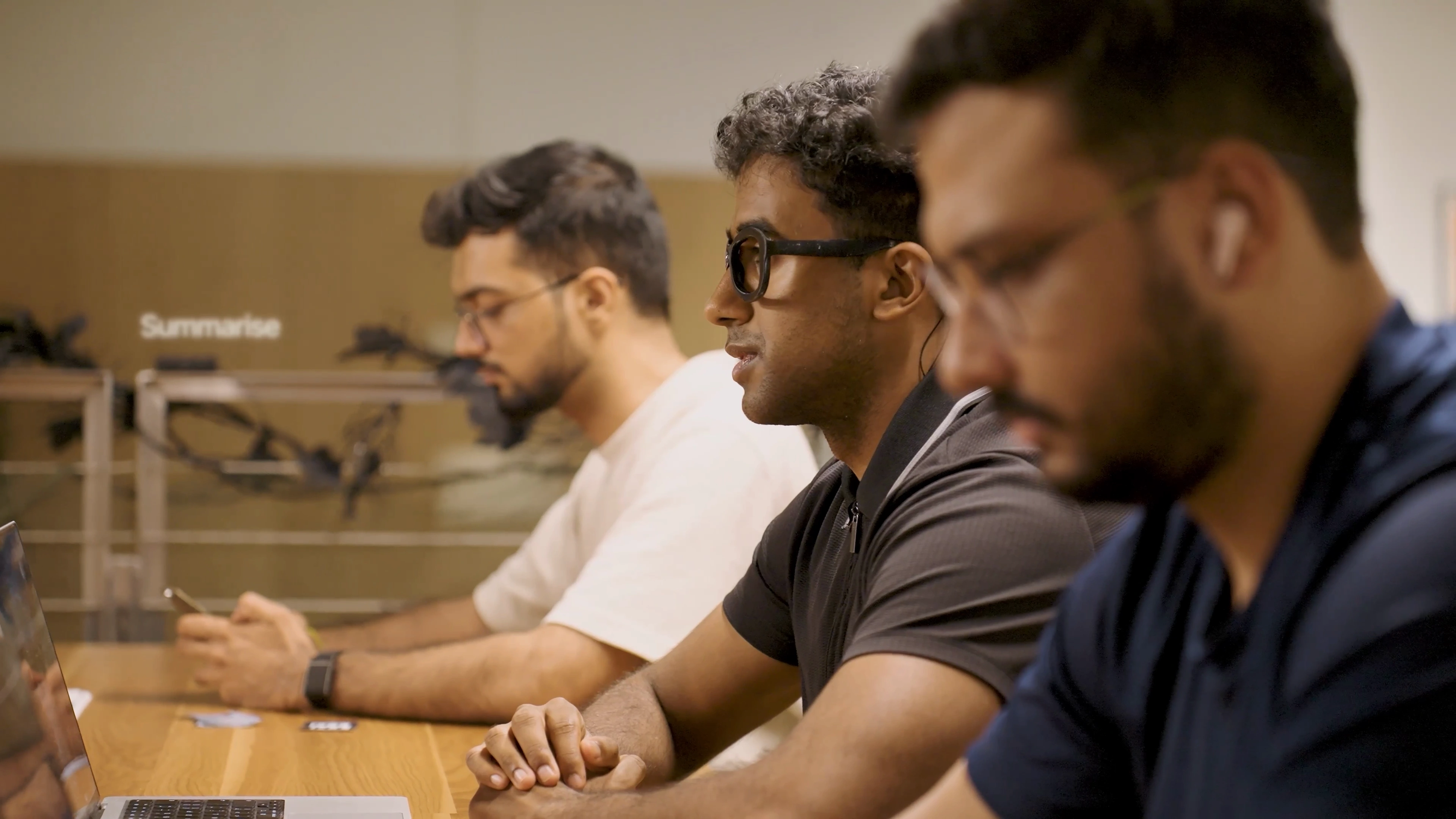
Next to your coworkers
Control your coding agents without annoying your coworker.
Dictate straight to your computer with coworkers beside you. Your words become text, without a word spoken aloud.
Claude Code
Add Google OAuth to the login flow. When the user clicks the login button...
Talk your thoughts out
Good questions.
How much do I have to move my mouth? Subvocal uses deliberate silent articulation. You mouth words as subtly as you want, without producing audible speech. Up close, someone may notice slight movement, but at normal conversational distance it’s designed to be be invisible.
Does Subvocal use or need cameras? No. Subvocal does not use or require cameras for silent speech input. There’s no video or camera-based lip reading, and you don’t need to turn on your computer’s webcam.
Can Subvocal read my thoughts? No. Subvocal does not read arbitrary or involuntary thoughts. It only decodes words you intentionally articulate. If you aren’t deliberately trying to say something through Subvocal, there is nothing for it to transcribe.
Does background noise affect it? Unlike normal voice dictation, Subvocal does not depend on hearing your voice, so surrounding conversations, traffic, music, and other environmental noise don’t create the same problem. That’s a big part of why we’re building it for offices, cafes, travel, and other places where speaking aloud isn’t practical.
How accurate is it? The current prototypes already decode open-ended silent speech in real time, and accuracy continues to improve as we collect more data and train larger models. Like any input method, it can occasionally get something wrong, so the product is designed to use context and easy corrections rather than pretending errors never happen.
Do I have to train it to recognize me? There will be a short personal calibration process when you first set up Subvocal. Our goal is to make that calibration increasingly lightweight as the underlying model improves, while still adapting to the way you personally articulate speech.
Can I use it in the apps I already use? That’s the idea. Subvocal is being built as an input method, not as a separate destination app. You should be able to use it for things like ChatGPT, Claude, Cursor, Slack, email, documents, messaging, and anywhere else you’d normally type.
Is Subvocal always listening or recording me? No. Silent-speech input is intentional. Subvocal is designed around you choosing when you want to articulate something, rather than continuously turning everything you do into text. We’re also designing the system with privacy in mind because the things people type into their computers are often highly personal or confidential.
作者发帖说明(HN):
Hi HN, we're Aarush and Arnav from The Subvocal Company (YC F26). We’re building smart glasses that let you talk to your computer without talking out loud. You can mouth words silently and discreetly and the glasses decode them to text at the speed of speech.
Here's a video of Dave from YC trying it out: https://www.youtube.com/watch?v=9QdX1eObVYI
Arnav and I were studying CS at Georgia Tech at the beginning of the year, with no experience in silent speech or sensing. We were both AI-native builders and power users of Wispr Flow. What bugged us was not being able to use these tools in the library (or an office) or in public. At Stanford’s TreeHacks in February, we decided to build the most technically ridiculous thing we could think of. We’d read about AlterEgo, a silent speech system out of MIT’s Media Lab, and wanted to recreate it in 36 hours. We built a crude prototype, sticking EMG electrodes onto my face:
https://drive.google.com/file/d/1mwhv5HZMz3UTevdrgwS5O7g2jWV...
We got it to kind of work at a letter level in a very janky way. It wasn’t good enough to win the hackathon, but convinced us to go all in. The first time I typed a sentence without anyone noticing, I felt the magic of the technology.
We quickly realized EMG (reading muscle electrical signals) wouldn’t work:
-
Signal changes due to sweat
-
Electrical interference
-
Pl...