DeepMind Turns Chip Simulation Waveforms into Queryable SQL for AI Agents
Google DeepMind and Columbia University propose BTTF, which compresses 10 GB+ chip simulation waveform dumps into a compact SQLite database that a team of agents can query. On 150 expert-labeled verification questions, the Gemini 2.5 Pro-based system answered 95.33% correctly, and splitting work across specialized agents scored 17.3% higher on a quality audit than a single agent at 1.96x latency. The broader lesson: put huge logs and traces into a queryable database instead of pushing them into the prompt.
Related Entities
Full Report
Rohan Paul (@rohanpaul_ai) · 2026-11-15 23
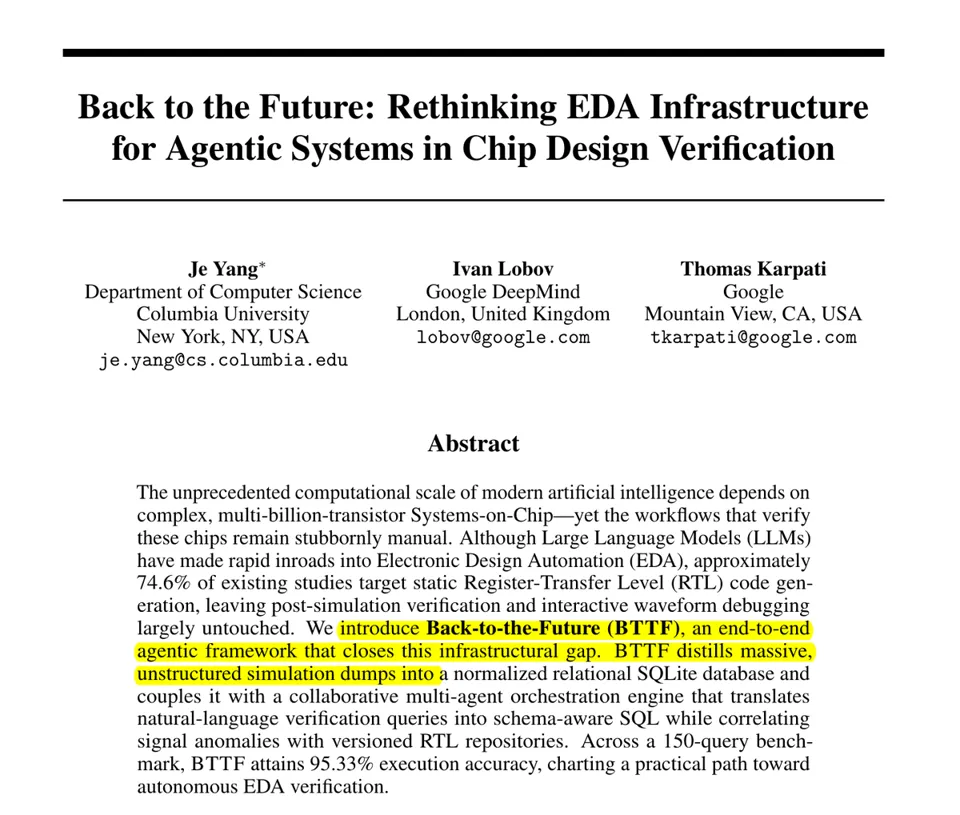
Google DeepMind and Columbia Univ paper argues that AI agents can debug chip simulations once the huge waveform files become a SQL database they can query.
Chip simulations record every signal change, and these dumps can exceed 10 GB of text that engineers still scan by hand. No LLM context can hold that, and the files offer no way for an agent to search them.
They built Back-to-the-Future (BTTF), which converts the dumps into a compact SQLite database. A team of agents then turns plain-English questions into SQL, checks design rules, and audits each answer.
On 150 expert-labeled verification questions, it answered 95.33% correctly using Gemini 2.5 Pro. Splitting the work across specialized agents scored 17.3% higher on a quality audit than 1 agent alone, at 1.96x the latency.
If your agents struggle with huge logs or traces, put the data in a queryable database instead of pushing it into the prompt.