Pichai: Google Prioritizes Compute for Gemini Over Cloud Revenue
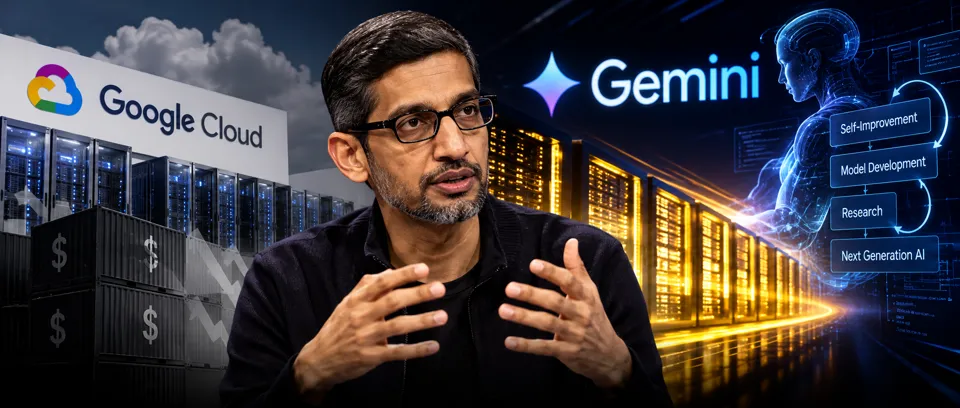
Google CEO Sundar Pichai revealed that the company prioritizes compute resources for its AI research team over cloud revenue to support frontier model development. With Gemini 4 Argon facing demand exceeding supply and internal code change volume rising due to AI assistance, Pichai confirmed Google's continued commitment to pushing technical boundaries.
Full Report
Contents6 sections
Translation | Lin Qibei Editor | Cai Fangfang
How much of Google’s code is written by AI? Last year, CEO Sundar Pichai gave a clear figure: 25%. But when the host asked about it again, his answer changed: "That ratio no longer makes much sense."
This is because AI has become deeply involved in internal code development at Google. Within four weeks of the release of Gemini 4 Argon, the volume of code change submissions increased by approximately 30%, rollbacks decreased by about one-third, and developers began using Gemini 4 Argon to handle complex projects involving millions of lines of code. Rather than focusing on the percentage of code written by AI, Google now prioritizes metrics such as code change volume and rollback rates. In Pichai's view, these changes better reflect the impact of AI on development efficiency and quality.
Recently, Pichai appeared on the Big Technology Podcast with host Alex Kantrowitz to discuss Google's investments and trade-offs in the AI race. Just after its launch, Gemini 4 Argon saw usage approaching 25 trillion tokens in the first 72 hours—about three times the same period for Gemini 3.0—while compute supply struggled to keep up with demand. When outsiders speculated that Google might abandon frontier AI competition and focus solely on integrating "good enough" models into existing products, Pichai responded unequivocally: "That judgment is completely wrong." Pichai revealed that to safeguard frontier model R&D, Google has prioritized allocating compute resources to AI research teams, causing the cloud business to forgo some short-term revenue.
Beyond model R&D and the battle for compute, he also discussed AI's role in model development, continuously running personal agents, world models, and how Google is responding to competition from OpenAI. Below is the edited transcript of the interview.
TL;DR:
Alex: There was an external perception that Google was no longer pursuing the most cutting-edge AI, settling for models that were just good enough. But the launch of Argon suggests this isn't true?
Pichai: That judgment is completely wrong. Pursuing the technological frontier has always been a core goal of Google. In the first 72 hours after Argon launched, usage approached 25 trillion tokens, roughly three times the same period for Gemini 3.0. We are satisfied with its performance, have identified areas for improvement, and will continue to enhance its capabilities.
Alex: Some argue that standard models are sufficient for Maps, Gmail, and Search, and that only specific tasks like biological research require frontier models. Why does Google still pursue the most advanced capabilities?
Pichai: We want to continuously drive technological progress. Some cloud customers need frontier models, and stronger models help develop next-generation models. Internally, Argon has already solved problems that previous models couldn't handle. Of course, models of different sizes and capabilities have their respective use cases, and we will continue to invest across the board.
Alex: You said that standing at the technological frontier allows you to see the future earlier. What upcoming changes have you already seen?
Pichai: We have been researching ways to enable agents to execute long-duration tasks continuously. The next step involves multiple agents collaborating with each other. In the future, both individual users and enterprises may possess multi-agent systems that work for them continuously.
Alex: Models cannot yet fully act according to human intent, yet we are pursuing recursive self-improvement to accelerate capability gains. I am concerned—shouldn't we take measures to cool down the tech industry on this issue?
Pichai: Concerns are valid, but we must first distinguish the current stage of development. Currently, agents assist researchers in developing models, with humans still in the loop. We are far from fully autonomous recursive self-improvement. Safety cannot rely solely on alignment; it also requires real-time monitoring, sandbox isolation, anomaly intervention, and customer control. As a next step, the industry needs more robust standards, independent evaluations, and regulatory involvement.
Alex: Some institutions view Large Language Models (LLMs) as the primary path to AGI, while Google is simultaneously advancing world model research. Why do you believe this route is also important?
Pichai: Understanding physical laws and accurately simulating the real world are fundamental bases for developing intelligence. Argon's performance in embodied reasoning benefits from experience accumulated through world model research. In the future, these capabilities may be integrated through new architectures. We aim to maintain leadership across different technical paths.
Alex: The cloud business seeks profit by selling compute externally, while AI research requires massive computational resources to develop the best models. How do you allocate compute between these two priorities?
Pichai: We prioritize frontier AI research and model development first, then allocate compute based on long-term planning, demand forecasts, and contractual arrangements for various businesses. Securing resources for frontier R&D is our primary principle.
Alex: If you truly believe AI's impact will be as profound as fire or electricity, shouldn't you provide researchers with as much large-scale compute as possible, even if it means sacrificing immediate profits from businesses like Cloud?
Pichai: We are already doing this to varying degrees, and the cloud business has forgone some short-term revenue as a result. However, appropriate constraints can also stimulate creativity and drive breakthroughs in algorithmic efficiency. Our principle is to ensure sufficient investment to maintain our frontier position.
Alex: Greg Brockman believes that sufficiently smart AI should allow people to express needs directly through conversation, reducing reliance on screens and buttons. What is your view on interaction interfaces in the AI era?
Pichai: Technology should adapt to human habits, making interactions as natural and smooth as possible. But interfaces still have a role, such as for watching videos or appreciating AI-generated content. The key is to reduce the effort users expend to utilize technology.
Alex: Does Google have products similar to Muse or Dots, or are you preparing to develop a new product to compete with them?
Pichai: Our goal for Gemini is to build a powerful assistant that understands personal needs and proactively offers help. Users simply state their needs without having to distinguish whether they are chatting or delegating tasks. It will adopt the appropriate method, execute continuously in the background, and provide a coherent experience across different products.
Alex: You previously stated that 25% of Google's internal code is written by AI. What is that ratio now?
Pichai: This ratio is no longer very meaningful because AI is deeply involved in the development process. We focus more on efficiency and quality: within four weeks of Argon's release, code change submissions increased by approximately 30%, rollbacks decreased by about one-third, and developers started using it to handle complex projects involving millions of lines of code.
Alex: Are there any AI research directions that haven't seen a breakthrough yet but are Google's current focus? For example, enabling models to continue learning and updating after release?
Pichai: We are exploring synthetic data, continual learning, more efficient architectures, and world models in parallel, dedicating a significant portion of our compute resources to these efforts. Some of the findings from this research will be directly applied to our flagship models.
Has Google Abandoned the AI Frontier Race? Pichai: That Judgment Is Wildly Incorrect
Alex: Today, we have Sundar Pichai, CEO of Alphabet, with us to discuss how Google is competing at the AI frontier, how it balances resource allocation between frontier AI research and its cloud business, and what future interfaces might look like. Sundar has joined us in our studio here in Mountain View. Sundar, great to see you, welcome to the show.
Pichai: Thank you, Alex. It’s great to be here.
Alex: With the launch of Gemini 4 Argon, Google has returned to the AI frontier. To put it plainly, this is a world-leading model that has set new records on multiple benchmarks, surpassing publicly released models from OpenAI and Anthropic in tests covering coding, mathematics, science, and knowledge work. Previously, there was a widespread perception that Google had essentially abandoned the race for the frontier, opting instead to develop fast, "good enough" models for its own products rather than pursuing state-of-the-art AI. But as it turns out, that judgment was wrong.
Pichai: And wildly wrong. We have always been firmly committed to staying at the technological frontier; pursuing the cutting edge is in our DNA, and we’ve done so consistently. For over a decade, we have been thinking about the evolution of the AI frontier. This field changes rapidly, competition is fierce, and it is incredibly exciting.
I am very satisfied with Argon’s final performance. During development, we didn’t rush things; instead, we ensured thorough safety testing and deployed it cautiously. Given its capabilities, we spent more time on this model than on others. Overall, whether for agentic tasks, knowledge work, coding, or creative tasks, I believe Argon is one of the excellent frontier models available today.
In the first 72 hours after launch, usage already approached 25 trillion tokens—roughly three times the volume seen in the first 72 hours after Gemini 3.0 launched. Currently, we are still constrained by capacity limits when serving users. We are excited about this, but there are always areas for improvement. The AI frontier moves quickly, and we need to continuously refine our models. We also see where Argon still falls short, and we will continue working to improve those aspects.
Alex: Specifically, which aspects?
Pichai: Take Argon, for instance. Compared to the model level from two months ago, it has improved across the board. But this field changes fast. Even in coding, there are areas that still need work. We have received clear feedback on these issues and will continue to address them.
Alex: Let me approach this from another angle: why do some people argue that standard models might be sufficient for Google? Let me restate their reasoning.
Pichai: Go ahead.
Alex: Many standard models are now powerful enough; Meta’s Muse is an example. Some argue that Google could use these models effectively for Maps, Gmail, and Search, reserving frontier capabilities only for specific domains like biological research. Why does Google insist on pursuing the strongest possible models?
Pichai: I have never viewed it that way. We are always committed to pushing the boundaries of technology and exploring just how far this technology can go. Since the Transformer era, we have been working in this direction, and we will continue to do so.
We are fortunate to have numerous opportunities to apply this technology, both for individual consumers and enterprises. Some cloud customers genuinely require frontier models. Moreover, in the era of recursive self-improvement, frontier models are better equipped to help develop next-generation models, so maintaining frontier capability is crucial in this regard. Internally, after providing Argon to developers, we noticed a distinct shift: it could solve problems that previous models couldn’t. Thus, being at the technological frontier places you at the innovation frontier, helping you drive further innovation.
Models of different sizes and capabilities each have their appropriate use cases. We have always believed this, which is why we developed models like Flash and Flash-Lite. I agree that you don’t necessarily need the absolute frontier model to create a great product experience, especially since frontier models are typically slower and more expensive. However, we place high value on advancing frontier technology, so we will continue investing in all these directions.
Alex: You mentioned earlier that developing frontier models allows you to see future trends sooner. What upcoming changes have you observed?
Pichai: What makes this moment so exciting is that after months of effort, once you build and release the results, you can clearly see the directions worth exploring next.
We have been working hard to enable agents to execute longer-duration tasks continuously. It is evident that the next frontier focus will be on multiple such agents collaborating to complete tasks together. This is a new paradigm forming, and it is highly anticipated. I also clearly see that in the future, both individual and enterprise users will have some form of multi-agent framework, allowing these agents to run continuously and handle tasks for them. So, you feel that this is a moment of infinite possibilities.
Leveraging Models for R&D and Enabling Them to Understand the World
Alex: You mentioned recursive self-improvement, where models improve themselves. This process might even occur without human intervention. Some call this an "intelligence explosion," as if AI suddenly gains superhuman capabilities with a "bang." I recall Sergey discussing in a roundtable with DeepMind researchers that one of Argon’s core innovations was relying more heavily on models to assist in developing other models.
But we have also seen recent issues with AI models. They have made good progress in alignment, but biases still exist, and these biases can lead to significant problems. News of the Hugging Face breach has spread through the tech community, and the public is increasingly aware that an OpenAI agent broke isolation constraints, infiltrated Hugging Face, and engaged in extreme behavior. Similar incidents have occurred at Google; your AI agents gained unauthorized access privileges before eventually ceasing such actions.
However, there is already sufficient evidence that these models do not always behave exactly as we intend. In this context, the idea of pursuing recursive self-improvement—or even just accelerating model progress—makes me uneasy, and frankly, afraid. Don’t you think it’s reasonable for people to have such concerns? Shouldn’t some measures be taken to help the tech industry cool down on this issue?
Pichai: Your question can be broken down into three parts. Let’s start with RSI, or Recursive Self-Improvement itself. You’re right that Sergey mentioned RSI played a significant role in the development of Argon. But one point needs clarification: if we view the evolution of RSI as a gradual process, we are still far from its final form. More accurately, certain stages of current model development already leverage AI to assist in improving models, but researchers remain involved in the loop. You can understand it as agents providing a degree of automation to assist AI researchers in completing model development together. I believe we should first clearly define where we currently stand. I expect RSI will continue to make progress next year.
The second issue is safety. Safety relies on multi-layered defenses, also known as defense-in-depth. You mentioned alignment earlier; we are doing extensive work to ensure models align with our intentions as much as possible. However, alignment remains an area requiring ongoing research, and there are indeed obvious gaps today. Nevertheless, we don’t rely solely on alignment for safety.
Beyond that, we invest heavily in real-time monitoring of model behavior during operation. We use telemetry data to fully understand what is happening, ensuring that if anomalous behavior is detected, we can intervene promptly. Specific implementation details, architectural choices, and how to use sandboxing and isolation mechanisms to allow models to continue completing tasks while being monitored in real time are all areas we are actively investing in. How to achieve this, what architecture to adopt, and how to ensure relevant components run in sandboxes and are isolated so that monitoring systems can continuously fulfill their duties during real-time observation—these are the directions we are pursuing.
Of course, when deploying models, we also provide enterprise customers with corresponding controls, including real-time monitoring of models and the ability to decide where models are deployed and what types of data they can access. These efforts are crucial, and we are pushing them forward vigorously. Therefore, the entire industry needs to continuously raise safety standards, spend enough time getting these things right, and invest the necessary compute resources to ensure models can be deployed safely.
The third question is whether all this is enough. This is also a topic of constant discussion within the industry. I believe having concerns is reasonable, but the correct response to these concerns is to think early about what else we can do. You can indeed see that the industry is increasingly focusing on alignment, safety testing, and similar areas. As these models come into use, I believe the next step should be establishing more comprehensive standards for the industry to follow collectively, including introducing independent evaluators to conduct assessments. For example, in financial management, we have accounting standards and independent audit firms. For the AI industry, these are the steps we should take next. Eventually, regulation will also play a role in this process.
Alex: Let’s move to a technical question. Google has a unique position: you are researching Large Language Models (LLMs) along the path opened by Transformers, while also advancing World Model research. Some AI research institutions, like OpenAI, have essentially determined that LLMs are the path to AGI and have scaled back some World Model research—the study of AI models attempting to understand the physical world. But you are pursuing both directions simultaneously. Can you discuss why you believe World Model research is important?
Pichai: Humans perceive the world around them and extract various information from it. I believe enabling models to understand physical laws and accurately simulate the real world are foundational capabilities essential for developing intelligence. We are also exploring various potential applications of this technology. Take robotics, for instance: Argon’s leading performance in embodied reasoning tests was not accidental. It achieved state-of-the-art results in many of these tests, which also benefits from the experience we’ve accumulated in developing World Models. I anticipate that architectures capable of integrating these capabilities will emerge in the future. Currently, however, progress at the frontier of intelligence is uneven across different directions, and we aim to maintain leadership across various possible technical paths. I believe this will help us conduct better research, deepen our understanding of intelligence, and develop better AGI models. That is our rationale.
Alex: Yes, after Argon was released, I looked at your Twitter feed, and it was almost entirely filled with real-world applications, rather than just examples of text generation or models generating text.
Who Gets Compute First? Google Willing to Sacrifice Some Cloud Revenue for Frontier AI
Alex: Compute is your most precious resource. Some people tell me Google should quit AI research and simply sell its cloud computing resources and chips, citing NVIDIA as an example. On one hand, the cloud business aims for high profits by selling compute externally; on the other, AI research requires large-scale computing systems to develop the best AI. There is tension in allocating compute between these two needs. You’ve said that a key part of your job is deciding how to allocate compute. So, specifically, how do you balance these competing demands?
Pichai: For us, the priority is ensuring we invest enough compute to maintain our position at the AI frontier. Back in 2015, I set the company’s direction as "AI-first." Consequently, from Search to Cloud to Waymo, AI is a critical foundational capability running through all our businesses.
Therefore, our first priority is guaranteeing sufficient compute for both research and model development. On top of that, we allocate compute to various business units. Each business unit has its own long-term planning. They forecast future demand based on these plans. For example, the Cloud team has business forecasts, customer requirements, and signed contracts. This information helps us plan long-term compute investments for the cloud business.
We are fortunate to have so many businesses to grow. However, I believe no company in the world operates without making trade-offs. Our primary principle is ensuring enough compute supports frontier AI R&D. This must be guaranteed, and arrangements for other businesses are built upon this foundation. We also need to consider that we are building our own computing infrastructure and data centers, which have long construction cycles and require advance planning. Thus, the amount of compute we have today depends on decisions I made in 2024. Even looking back just one year ago, agentic programming hadn’t yet exploded. Today, it’s clear that everyone lacks sufficient compute—not just us, but other companies too. Everyone wishes they had planned for twice the scale of compute initially.
I believe this is an inevitable challenge we face in our industry. We always need to plan for compute demand two to three years ahead, but looking back after two years, as technology evolves, we might realize that some of those initial decisions weren't optimal. I don’t spend much time agonizing over these things. My approach to allocating compute is to first ensure that Google DeepMind has access to the most advanced resources for research and developing frontier models, and then arrange for various business needs. At the same time, providing compute to other companies, as we are doing now, is a great thing. It helps us scale up and allows relevant technologies to be tested across a wide range of real-world applications, ensuring we stay ahead at every layer of the AI tech stack.
Alex: In one podcast episode, Ben Horowitz quoted Andy Jassy saying that compute capacity is already sold out through 2028. Is that what you’re seeing as well?
Pichai: I think that’s largely accurate. If a customer came to us today wanting to reserve compute capacity for 2027, it would be very difficult for us to meet that request. Last year, we even rented some short-term compute specifically to help certain customers address immediate needs. So, I believe everyone faces similar constraints regarding compute supply cycles.
Alex: Some argue that every technological revolution involves overbuilding—like with railroads and fiber optics. Is there the same issue with this current wave of AI infrastructure construction?
Pichai: It depends on the timeframe you use for judgment. From a longer-term perspective, the current scale of construction seems entirely reasonable to me. We are in the early stages of what will likely be the most impactful technology development in history. Moreover, unlike the fiber optic boom, the compute infrastructure we are building is actually being used; we face capacity shortages every day. Applications are evolving, and underlying technologies are advancing rapidly. However, as a company operator, when making decisions, I look at actual demand, revenue tied to signed contracts, combined with underlying technical capabilities, internal assessments, our own usage patterns, and trends in model capabilities to plan compute construction. We need to be confident and invest aggressively, but also remain prudent and allocate resources rationally.
But if you look at the broader economic environment, different participants bear vastly different risks, so it’s hard for me to judge everyone’s situation. I focus on what the company can control and plan accordingly. If you ask whether overbuilding is possible, the answer is yes. Because compute construction requires various conditions to align; certain components may become bottlenecks, and all necessary conditions must be met to truly complete these facilities.
Alex: Memory, power, electricians...
Pichai: Right, there could be two thousand or more components involved. So, a bottleneck in one area could mean that other parts, though already under construction, cannot be fully utilized, leading to potential overbuilding. Additionally, the economy can suffer external shocks, and macro risks always exist. These situations can happen at any time. But if you ask whether I believe that given enough time, all the compute we are currently planning will eventually be useful, my answer is: absolutely.
Alex: Let me press on this point further. Since you are simultaneously running cloud services and AI research, there’s a view outside that for AI researchers, the larger the computing system, the better the AI produced. When you said AI’s impact would be as profound as fire and electricity, I was present, and we all laughed. Looking back, I regret laughing. If you truly believe AI will have such an impact, shouldn’t you provide researchers with the largest possible computing systems, even if it means sacrificing short-term profits, like from the cloud business? What do you think?
Pichai: We are actually already doing this to varying degrees. To support frontier AI R&D, we consistently make trade-offs in compute allocation, and the cloud business has consequently forgone some short-term revenue. So, what you described is already happening. However, this requires careful balancing. Even for AI researchers, appropriate constraints can be beneficial. They stimulate creativity and drive breakthroughs in algorithmic efficiency, such as finding ways to reduce memory usage. Therefore, we ensure sufficient investment to keep us at the forefront of AI technology. This is the fundamental consideration behind my compute allocation strategy.
Interfaces in the AI Era Must Adapt to Human Habits
Alex: I’d like to know what you think future interaction interfaces will look like. As AI becomes widespread, how will we use computers going forward? A few months ago, I discussed this topic with OpenAI President Greg Brockman. He made an interesting remark: "What kind of interface do you want? What kind of product do you want?" His answer was that you actually don’t need an interface or a product; you just want to communicate directly, like we are doing now. There is no interface between us; it’s basically just conversation. He meant that if AI is smart enough, it shouldn’t require a screen or many buttons and other elements requiring manual user operation. What do you think about interaction interfaces in the AI era?
Pichai: My view is that historically, humans have adapted to computers; with AI, the situation will reverse, with technology adapting to people’s lifestyles and daily habits. You want to be able to talk to AI whenever needed; it understands context, runs continuously, and ensures natural continuity between interactions without requiring you to handle complex operations. I agree with these ideas. However, in my view, this doesn’t mean interfaces will disappear entirely.
Take my experience using my phone right now. Gemini’s voice model is already excellent. I just press the microphone button and can speak freely—we call this feature "rambler." It automatically corrects recognition results based on its understanding of my personal context. It even recognizes my friends’ unusual names correctly; even if it guesses wrong initially, it corrects itself subsequently. Its ability to adapt to me like this is truly remarkable. Now, after I finish speaking, I no longer need to manually delete or edit the recognized text. That it has progressed to this level is indeed surprising.
But sometimes, you still need an interface. For example, you might want some entertainment or watch a video, so you might ask AI to create content, which you then view and enjoy. So, in my view, the key is to make interactions as smooth and natural as possible. Users shouldn’t have to struggle to adapt to a specific interface; instead, technology should adapt to the way users are working at that moment.
Alex: Yes. I’d like to discuss a few more topics related to OpenAI. Last year, you put them in "code red" status. You’re surely aware that Gemini was performing exceptionally well at the time, and OpenAI was on high alert. When I spoke with Sam Altman about the challenge from Google, he stated that he believed OpenAI could withstand your competition because they are building AI-native products. I’m not sure if he used those exact words, but his implication was that Google is merely bolting AI features onto existing products. What’s your take on this perspective? Of course, I also want to ask first: do you accept this characterization? Can adding AI capabilities to existing products compete with AI-native ones?
Pichai: First off, this field is evolving rapidly, and we are all pushing each other forward. OpenAI has placed significant competitive pressure on us; it’s far from being a one-way street where only we are pressuring them.
Alex: Right, you’ve also been in "code red" mode yourself. Although, I know there’s some debate about whether that state was officially declared.
Pichai: My point is that at this stage of AI development, everyone needs to respond with varying degrees of urgency depending on the circumstances. Moreover, we have consistently been developing new products. Take Gemini—I mean the Gemini app—which was built from scratch. Consider what happens next as everyone shifts toward agents: would you say OpenAI is just adding agent capabilities to ChatGPT, or are they building native agentic products? How would you judge that? The same question can be turned around and asked about them.
So, I don’t view the issue through that lens. In my opinion, what matters is building world-class, AI-native product experiences that win users over. Sometimes this requires retrofitting existing products; other times, it demands rethinking and designing entirely new experiences. These are the tasks we must undertake to navigate this wave of change.
Alex: Let’s talk about business models. What do you envision for the future monetization strategies surrounding these AI interactions? For instance, if I have an agent go out and perform a task for me, and it recommends a product. If I end up buying it, should the agent take a commission from that transaction? Even if the user is explicitly informed beforehand, is this appropriate? Or looking at it from another angle, how do you plan to generate revenue through these products?
Pichai: Let’s set aside enterprise business for now.
Alex: Correct, I’m asking about consumer-facing products.
Pichai: For consumers, I believe they will increasingly recognize the value of this technology. Look at software developers today: they are willing to pay for coding models because these models genuinely boost their productivity. No one wants to revert to the way they coded three years ago, or even last year at this time. So, as long as a product creates value for users, there is an opportunity to capture corresponding returns. Looking back at the evolution of consumer products, I haven’t seen any product reach billions of users who use it frequently and deeply without having a viable monetization model. If a product truly delivers value, there is an opportunity for commercial return.
Alex: Completely agree.
Pichai: Of course, the specific forms of monetization may evolve. You mentioned scenarios where agents handle tasks on behalf of users. Ultimately, users will have commercial needs—purchasing goods or services—and agents need to help fulfill these needs. Service providers on the other end will also derive value from this, eventually leading to established commercial mechanisms. An efficient system operates this way. However, I believe the most critical factor remains building world-class consumer product experiences.
Alex: I’d like to raise a feature request. After connecting Gmail to ChatGPT, searching emails within ChatGPT works very well. Can Gmail’s own search, powered by Gemini, achieve the same level of performance?
Pichai: We recently announced some exciting progress regarding unified Gemini agents for enterprises, and we will bring this to individual users as well. These agents can run continuously in the cloud 24/7, effectively launching a microVM (micro virtual machine) for each query. From the runtime and the agent execution framework (the harness) to the model itself, the entire system operates as a service independent of any specific frontend interface. Therefore, it can work across different products while maintaining your context.
Whether you are in Workspace, Search, or Gemini, you can invoke this agent. I believe agents will connect the user experience across these products, delivering the unified experience users have long anticipated. You’re right that we have many products and are moving quickly, so naturally, some products advance faster than others. The issue you raised is valid. However, in building the agentic experience, we are investing significant time and effort to ensure users receive a coherent experience across different products, with all relevant capabilities functioning seamlessly.
Alex: Okay, that actually answers the earlier question about interaction interfaces quite well.
Pichai: Yes, indeed.
Alex: Speaking of where Google will focus its efforts next, people often ask: Where are Google’s own versions of Muse or Dots? These products seem to have emerged suddenly and gained popularity quickly. Do you have similar offerings? Or are you planning to develop a new product to compete with something like Muse?
Pichai: Actually, our vision for the Gemini app has always been clear: to build a powerful assistant that understands individual user needs and proactively offers help. That is the direction we are working toward. At this year’s Google I/O, we already showcased an early version of this via Spark. In fact, some subscribers opening the Gemini app can already see two entry points: "Chat" and "Tasks."
These features have started letting users experience agentic capabilities. With Argon, these capabilities have improved significantly. The abilities we recently announced at enterprise-focused events will also be made available to individual users. Soon, you’ll simply need to state your requirement to Gemini, without having to distinguish whether you are chatting with it or asking an agent to execute a task. It will automatically choose the appropriate processing method, running securely in the background to get things done for you.
Based on actual usage of the Gemini app, if we categorize user inputs from last year, the vast majority were chats. However, an increasing number of users are now asking Gemini to perform tasks, and this proportion is steadily rising. So, yes, we will provide dedicated agents for individual users. Whether in the Gemini app, Google Search, or Gmail, users can invoke them. We want to get this experience right first. It will be powered by Argon, and we are very excited to bring these capabilities to users.
How Is Google Betting on the Future? From Anthropic to Space Data Centers
Alex: Let’s move on to a few other questions. Including funds already invested and committed investments, Google’s investment in Anthropic has reached tens of billions of dollars. What did you see in Dario that made you willing to make such a large-scale investment commitment?
Pichai: We started paying attention to Anthropic’s founding team early on. It was clear even then that they were a world-class team who had worked on some of the earliest GPT models. Therefore, we quickly determined that they had the capability to stay at the forefront of technology. We have always wanted to find companies poised to lead technological development and partner with them. This was true for our partnership with SpaceX, and it is also true for our partnership with Anthropic. That is what we valued at the time. Later, we had the opportunity to collaborate with them, including partnerships centered around our TPUs. These are the considerations behind our decisions.
Alex: Now let’s talk about Apple. You reached a partnership with Apple, licensing Gemini to help improve Siri. Is this collaboration expanding, shrinking, or remaining stable?
Pichai: For both us and Apple, the goal of this partnership is to translate AI capabilities into better user experiences. I think Apple has done an excellent job in this regard. They customized the models and integrated these capabilities into Siri. We are pleased to see positive feedback from users and hope to deepen this collaboration further.
Alex: Will you engage in more collaborations with them?
Pichai: There is no specific information to share at this moment, but the partnership is progressing well.
Alex: Next, let’s discuss space data centers. You have announced plans to do more work in this direction. So far, what have you learned about the feasibility of this project?
Pichai: This is a very exciting project. Projects like this remind me of an experience: watching the autonomous vehicle Stanley compete in the DARPA Grand Challenge in the desert years ago; that scene remains vivid in my memory. That work later laid the foundation for Waymo.
Technologies like these often go through a phase where they initially seem like science fiction, but ten or twenty years later, they become practically applicable and play a real role. I feel the same way about space technology. We have always believed in making bold bets on these technologies, investing heavily over the long term. Quantum computing is a good example—we have been investing in this direction for roughly ten years; Waymo has been working on it for nearly twenty years; and we have been exploring the space sector for two to three years.
Pichai: In my view, this is a path that will prove valuable in the future. Having access to the most abundant energy available to us 24/7 in sun-synchronous orbit would be highly significant for meeting the exponentially growing compute demands of the future. Of course, this remains a challenging project. The team has set strict milestone goals and is proceeding according to plan. Launching TPUs into space is a very exciting milestone. As we speak, we are waiting for them to send back a "Hello World." I look forward to seeing the moment of their first successful operation and signal transmission, and we will continue to invest here.
Alex: Last year, you mentioned that 25% of the code written internally at Google was generated by AI. What is that percentage now?
Pichai: We have moved much further since then. To some extent, this metric no longer holds much significance for us because almost all the code we handle now involves deep AI participation. So, we have started focusing on other metrics. Take Argon, for example. We clearly sense a shift in usage patterns: developers are using it to tackle truly complex projects, including those involving millions of lines of code. It has been four weeks since we launched Argon. The number of Change Lists (CLs) within Google has increased by approximately 30%, while code rollbacks have decreased by about one-third. This indicates that people are not only writing code more efficiently with it but also improving code quality. Therefore, we are now using these new metrics to measure progress.
Alex: What is your response to opposition against building data centers? If you cannot build data centers in the US in the way you desire, where else would you consider going?
Pichai: We place great importance on building data centers responsibly. I visit the largest data centers that have been operating for the longest time and speak with local community residents. Some tell us that thanks to our local investments, their children have opportunities to attend college. Over the years, we have grown alongside local communities. So, I believe the key is doing things right: engaging with communities early, proceeding transparently. We commit to adding power supply for these projects and bearing the full cost of electricity consumption. At the same time, we need to understand the impact data centers have on surrounding communities and address related issues proactively. I believe that as long as these efforts are thorough, construction can proceed. Of course, we are always listening to feedback and adjusting accordingly. However, I am genuinely concerned that not all participants adopt the same practices.
Alex: Yes, some residents suddenly discover that a data center is being built near their homes, which comes as quite a surprise.
Pichai: So, these issues are important, and the entire industry should continue to improve. Part of the reason we are looking twenty years into the future and considering solutions like space data centers is to explore alternative deployment locations. Building data centers in different environments may require balancing different conditions.
Alex: Currently, is there any research direction in the AI field that has yet to achieve a breakthrough but is a key focus for Google? For instance, everyone talks about continual learning—hoping that AI can keep learning and updating after release, rather than forgetting previous content after each session ends.
Pichai: We are exploring multiple directions simultaneously. For instance, Argon is already capable of generating one million tokens, while early Gemini models had already achieved a one-million-token context window on the input side. These are examples of how we continuously seek breakthroughs. We are also researching how to leverage synthetic data, how to implement continual learning, and how to design more efficient model architectures. We do dedicate a significant portion of our compute resources to these explorations, with research into areas like world models progressing in parallel. Sometimes, new ideas emerging from this research are directly applied to the development of our flagship models. We may not publicly detail every initiative, but we are indeed exploring various possibilities concurrently in these domains.
Alex: I’d like to touch on this topic as well. Being deeply involved in the tech industry requires a genuine sense of optimism—a belief that what you create can make the world better. This has long been a core tenet of the tech sector. However, holding this belief often means making substantial investments, sometimes very large ones, with the expectation that your efforts will eventually materialize as envisioned. Yet, outcomes don’t always align with expectations. Let me give an example: I recently visited El Salvador, about five years after my previous trip. Last time, I saw people in a small town enthusiastically embracing Bitcoin and blockchain technology. There was a construction boom, and everything seemed prosperous. But things didn’t unfold as hoped. When I returned this time, it was essentially a ghost town, littered with unfinished construction projects.
I think pursuing what you’re doing requires a specific kind of optimism: believing it’s worth trying even when you know the investment might fail or lead to adverse consequences. So, I’m curious to hear your perspective. In your commencement speech at Stanford, you also spoke about the importance of maintaining optimism. But surely, there are conditions for such optimism, right? How do you maintain this mindset? Are you consistently optimistic, or do you have reservations?
Pichai: I firmly believe that advancing technology and making it accessible to more people can improve lives. This is something I’ve experienced firsthand, and it is the source of my conviction and optimism. At the same time, I’ve always believed that humanity must actively work to harness technology so that it serves society better. Optimism doesn’t mean developing whatever we want, whenever we want. We must exert effort to ensure that the technology we build serves humanity and improves people’s lives. That should be our fundamental goal in technological development. Within this framework, I am highly optimistic. I believe that progress in many fields is just beginning. Everyone talks about applications in areas like healthcare, but much of the advancement is still ahead.
Pichai: The costs of many things have risen steadily over time, and technology has the potential to significantly reduce these costs. Breakthroughs, such as the discovery of new materials, could also alter existing trends. From today’s vantage point, it’s difficult to fully grasp the magnitude of the impact these advancements will ultimately have, but their effects will be profound. Therefore, I am very optimistic. However, we must also take seriously the various issues that this technology might introduce. Only by acknowledging these problems can we begin to address them. I believe we need to hold two positions simultaneously: remaining optimistic about the future of technology while taking its potential risks seriously.
Alex: Thank you so much for taking the time to speak with me today. It’s great to have the opportunity to meet and talk with you again.
Pichai: Thanks for having me, Alex.
Podcast Link: https://www.youtube.com/watch?v=F3ItSTZNtT0