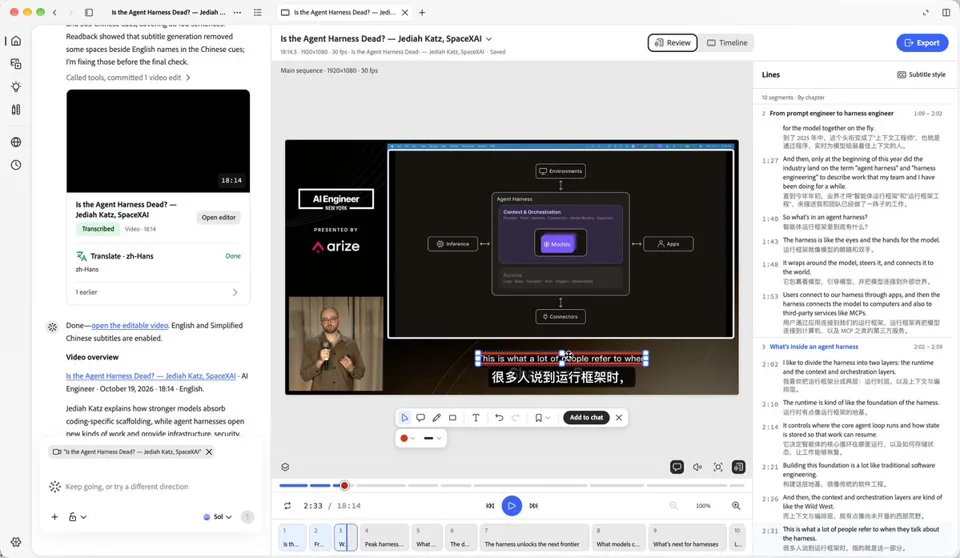
Opus 5.5 Enables AI Agents to Automate Video Editing
Following the release of Anthropic's Opus 5.5, AI agents can now autonomously perform complex video editing tasks with significant efficiency gains. The model achieves 'code-based editing' by generating HTML/CSS/JS, drastically reducing reliance on external skills and specialized editors, signaling a shift towards automation in video production.
Full Report
Contents8 sections
Baoyu (@dotey) · 2026-10-28 03
Since the release of Opus 5.5, AI Agents editing videos have already reached a level capable of replacing junior editors. This is comparable to the moment when Claude Code was first released—models could genuinely autonomously complete complex programming tasks. But this is just the beginning; consider how short it has been since Claude Code launched.
Back then, Anthropic focused on training for Coding, never expecting it to solve so many problems. Now, even video editing can be done using HTML and JavaScript to cut videos and generate animations.
Before Opus 5.5, I was already developing Skills and tools for editing. However, after the model's release, I found that most of those Skills were no longer necessary.
I conducted my own experiments: for the same video, without using any Skills and only providing ASR (Automatic Speech Recognition) and TTS (Text-to-Speech) tools, Opus 5.5 performed better than when Skills were used. This aligns closely with the experiences shared in the tweets.
Additionally, Sabba offered advice that mirrors what I’ve been doing recently. He suggested: "Don't reinvent the timeline interface of professional editing software—it’s too difficult to build. Focus on getting the rough cut right, then easily hand it off to existing professional software."
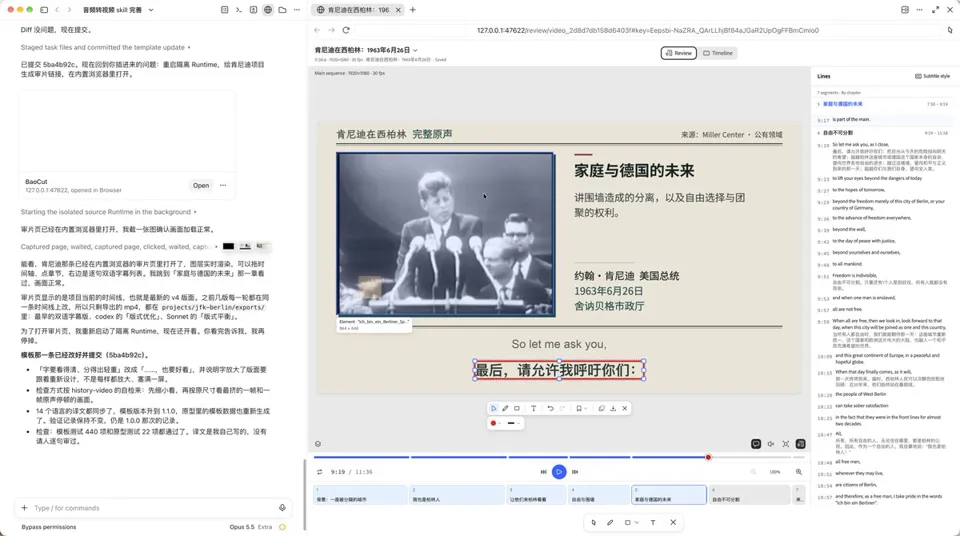
Recently, I also moved BaoCut’s timeline editor to the background. It was overly complex; by default, users should only need a simple video preview player.
If you use an Agent to generate or edit videos, the simpler the editor, the better. As long as it allows marking points and makes it easy for the Agent to know where changes are needed, that’s sufficient.
This is similar to Tibo’s experience modifying Codex. Codex didn’t need a VSCode-style code editor, and similarly, video editing Agents don’t need a full-fledged video editor.
The two retweeted posts share extensive experience regarding AI Agent video editing. Those interested should take a look.
Here is a summary of the two referenced tweets:
Alex Cooper manages an editing team producing a high volume of ads daily, focusing on how to use these tools. Sabba Keynejad is the co-founder of VEED, an online video editing tool, discussing how the market will change.
1. Video Editing Is Following the Path of Programming
Both believe that AI agent-based editing is already viable, and currently represents its worst state. A senior editor on Alex’s team stated that at equivalent quality levels, his daily output is now five times higher than before.
Sabba predicts that within one year, the cost of basic editing will drop from several dollars to several cents. Sabba also draws parallels to programming: senior engineers initially resisted AI-generated code due to concerns about quality and maintainability, but eventually accepted it. He believes the best editors will be the harshest critics, but they will ultimately convert.
2. Video Is Being Solved as a Code Problem
Sabba explains why this shift is happening now: Anthropic bet on programming. Because models can write code, they can "write" videos using HTML/CSS, SVG, browser rendering, and OpenCV. Previously, a suite of tools existed specifically to patch LLMs with editing capabilities; after Opus 5.5’s release, many of those workarounds became obsolete. He admits that current outputs still look more like web pages than traditional videos.
Alex’s experience aligns with this point: he tried various solutions and found that performing everything directly within Claude—without installing MCP servers or plugins—yielded the best results. As general-purpose model capabilities improve, the intermediate tool layer gets absorbed. This phenomenon has already occurred once in the domain of programming.
3. The Core Asset Is the Skill; Alex Provides a Replicable Approach
This is the most practically valuable part of the two posts:
- Break down Skills by style: Create separate Skills for mashups, UGC (User Generated Content mimicking casual selfie-vlog styles), and AI animation. Avoid monolithic "all-in-one" editing Skills. This ensures the context loaded each time is relevant to the specific task.
- Starting Point: Provide Claude with 4–5 reference works and ask it to summarize them into a Skill.
- Training: Have the Skill re-edit the last 25 ads edited by a senior editor. Place these in Artifacts for the senior editor to critique line-by-line. Iterate until the Skill understands what constitutes good editing.
- Record Tacit Knowledge: Have top editors record their screens while editing, narrating via Google Meet or Loom why they made specific cuts, chose certain rhythms, or selected particular B-roll shots. These rationales provide the crucial context missing from Skills.
- Only the strongest editors should train the Skills.
The result is that most videos pass review on the first or second version, occasionally requiring a third. This methodology applies equally to writing, design, and customer service scripts: start with reference samples, batch-recreate historical work, gather expert feedback line-by-line, and record the experts’ reasoning during judgment calls.
4. Human Value Shifts from Operation to Taste
Alex believes technical trends are unstoppable, but taste remains highly valuable because training AI and providing feedback to it relies on taste. Editors with strong taste will become more valuable; those without will find it increasingly difficult.
Sabba approaches the same issue from another angle: achieving 80–90% correctness in rough cuts is already impressive. To reach excellence requires iterative refinement. How creators provide feedback and imbue videos with their personal style is where the true value of these tools lies.
5. Division of Labor for Adoption: Leaders Build Frameworks, Top Talent Trains AI
Alex states that whoever drives AI adoption in the team should step back once the initial framework is built. He notes he isn’t the best editor on the team; his job is to create an environment where the best editors can train the Skills.
In my view, this simultaneously resolves the resistance Sabba mentioned: the senior editors most likely to oppose AI become the ones teaching it. Additionally, he advises allocating dedicated time for senior editors. There will be an initial dip in efficiency; without reserved time, the resulting Skills will be mediocre, saving little time overall.
6. Divergence Between the Two, and the Stances Behind It
Alex completes the entire workflow within Claude conversations. Sabba argues that video involves timelines and spatial positioning on screen, which chat alone cannot handle; more complex interfaces are required.
Sabba also contends that brand consistency and repeatability remain unsolved. For example, Casey Neistat’s (a YouTube creator with a distinct style) videos are instantly recognizable, and brands need to maintain such consistency across hundreds of videos. However, Alex’s approach of "breaking down Skills by style + feedback loops" essentially solves repeatability on the user side.
There are two sources for this divergence. Alex deals with ads, which are short, formulaic, and high-volume—ideal for AI delegation. Sabba sells tools, and superior interfaces are his business model.
7. Bottlenecks Will Shift
Sabba predicts that once editing becomes nearly effortless, the number of creators will explode, making shooting and recording the new primary bottlenecks. Alex mentions that things he expected to take 3–6 months to achieve are already possible today.
8. Judgment for Tool Builders
Sabba believes this market will not be winner-take-all, much like how Cursor targets large enterprises while Lovable serves non-technical users.
Basic editing capabilities cannot sustain a long-term advantage, as Anthropic, Google, and OpenAI will eventually enter the space; differentiation must rely on deeper workflows, vertical use cases, and a robust mobile experience.
He also advises against reinventing the timeline interface of professional video editing software, noting that it is extremely difficult to build well. Instead, focus on excelling at rough cuts and ensure seamless handoff to existing professional tools.
↳ Quote @sab8a (Sabba Keynejad): My thoughts on the agentic video editing wave:
There won't be one winner in agentic video editing. Speed, use case and workflow will always matter. Just as Cursor moves upmarket while Lovable caters to non-technical users, specialised video tools will continue to serve different audiences, even as general-purpose agents improve.
Every major AI leap unlocks new product categories. Since GPT-3.5, we've seen coding, 3D and presentations. Opus 5.5 and Google's vision-language models are now unlocking agentic video editing. The edits still look more like websites than videos, but this is the worst they'll ever be.
Editing costs will collapse, and the number of creators will explode. Basic edits could go from dollars to cents within a year, with huge speed improvements. Frontier models will still command a premium. As editing becomes effortless, recording content might be the biggest bottleneck.
The best editors might be the biggest critics of agentic editing. Just as experienced engineers initially resisted AI-generated code over quality and maintainability, I think professional editors will eventually come around as the tools improve.
The real magic is in iteration. Getting 80–90% of an edit right on the first attempt is great, but making it excellent requires much more iteration. The way creators give feedback, refine edits and make videos feel distinctly theirs is where these tools will become truly magical
Anthropic's focus on coding enabled agents to build videos using HTML/CSS, SVG, browser rendering and OpenCV. Packages like Hyperframes, Rebooshed and VEED's OpenEdit gave LLMs editing capabilities they previously lacked. Opus 5.5 now makes many of those use cases redundant.
Chat alone won't be enough for video editing. Chat will be central, but video operates across time and X, Y and Z coordinates. More sophisticated UI will be needed to make great edits.
Brand consistency and repeatability remain unsolved. A Casey Neistat video feels distinctly his because of intentional creative decisions. Creators and brands need that same predictability across hundreds of edits. Even vibe coding hasn't solved this well (yet).
Basic editing won't be a long-term moat. Anthropic, Google and OpenAI will eventually offer it. Deeper workflows, specialised use cases and excellent mobile experiences will drive differentiation.
- Don't reinvent professional editing tools. Building non-linear timelines is incredibly hard. Agentic video tools should focus on creating great first cuts and making it easy to hand them off to existing professional editing tools.
Overall, the next six months will be noisy!
But video editing has never been winner-take-all.
And I do NOT think that will change.
Hope this helps.