Rohan Paul (@rohanpaul_ai) · 10/14/2026, 23:42:36
OpenAI's Internal Model Generates 722 Math Papers, Sparking Cryptographer Fears for Public Key Encryption
OpenAI's internal model generated 722 mathematical manuscripts, prompting leading cryptographers to reassess the potential threat AI poses to modern public key encryption. Johns Hopkins professor Matthew Green estimates a 15% probability that AI could erode confidence in current elliptic curve algorithms (like X25519), which underpin most internet security, by challenging the assumption that private keys cannot be derived from public ones.
SOURCE COVERAGEFull Original Report
Rohan Paul (@rohanpaul_ai) · 2026-10-14 15
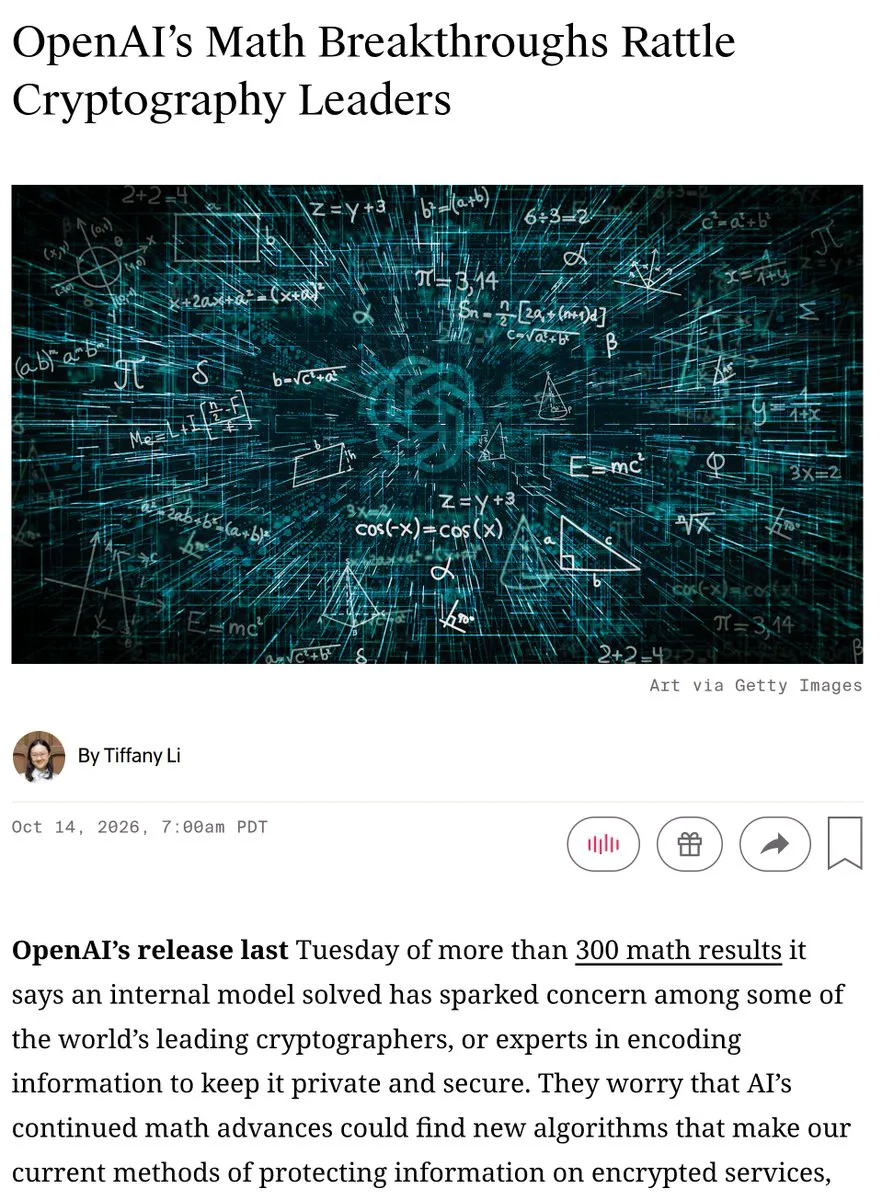
OpenAI’s internal model produced 722 math manuscripts, and leading cryptographers now worry public key encryption could be next.
~ The information published this piece.
Internet encryption rests on a bet that nobody can work backward from a public key to a private key, and that bet was never proven.
Matthew Green, a professor of computer science at Johns Hopkins gives 15% odds that AI erodes confidence in today’s public key encryption.
Most of the internet, from payments to WhatsApp, leans on a handful of elliptic curve algorithms, and X25519 alone secures most connections. A break in just 2 of them would hit a huge share of encrypted traffic, and the fallback options are less studied and possibly weaker.