AMD Closes $8.2B World Labs Deal, Appoints Fei-Fei Li Chief Scientist
AMD completed its acquisition of World Labs, the spatial intelligence startup co-founded by Fei-Fei Li, on November 13, issuing about 14.98 million shares in an all-stock deal valued at roughly $8.2 billion and closing in just 46 days, making it AMD's second-largest acquisition ever. Fei-Fei Li becomes Executive Vice President and Chief Scientist reporting directly to Lisa Su, with the World Labs team folded into AMD to bolster its 3D world model and physical AI capabilities.
Related Entities
Full Report
Contents3 sections
$8.2 Billion in Stock, a 46-Day Lightning Close
By Cressy | From Silicon Valley QuantumBit | WeChat Official Account QbitAI
This really is a meeting of titans!
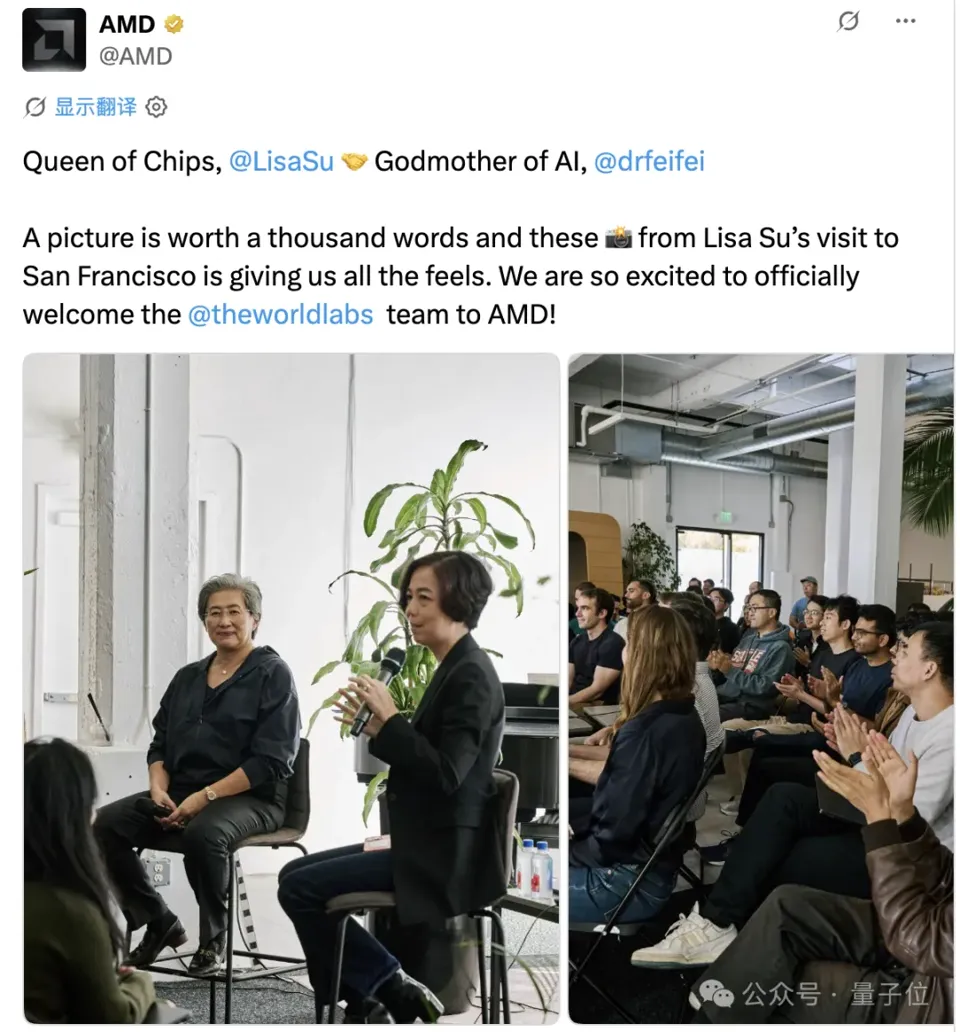
In a San Francisco office, "Semiconductor Queen" Lisa Su and "Godmother of AI" Fei-Fei Li sit side by side on tall stools, facing a room full of applauding World Labs employees.
On November 16 local time, AMD officially announced the completion of its acquisition of World Labs, the spatial intelligence company co-founded by Fei-Fei Li, which is now fully absorbed into AMD.
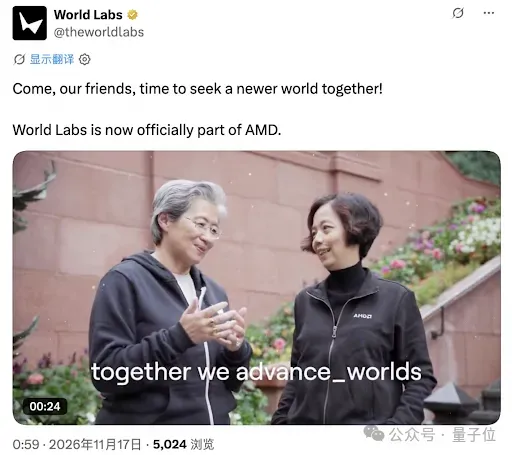
In the official announcement video, Lisa Su, wearing a black hoodie, gestures and laughs as she speaks, while Fei-Fei Li beside her has already put on a black jacket with the AMD logo printed on the left chest.
Below the celebration video, white subtitles even changed AMD's long-standing slogan to "together we advance_worlds".
To secure this team, founded just two years ago, AMD offered an all-stock consideration of approximately $8.2 billion.
With the closing complete, Fei-Fei Li officially takes on the role of AMD Executive Vice President and Chief Scientist, reporting directly to Lisa Su.
From signing the acquisition agreement on September 28 to completing the full closing on November 13, the deal took only 46 days from start to finish.
14.98 Million Shares Secured, AMD's Second-Largest Merger Closes
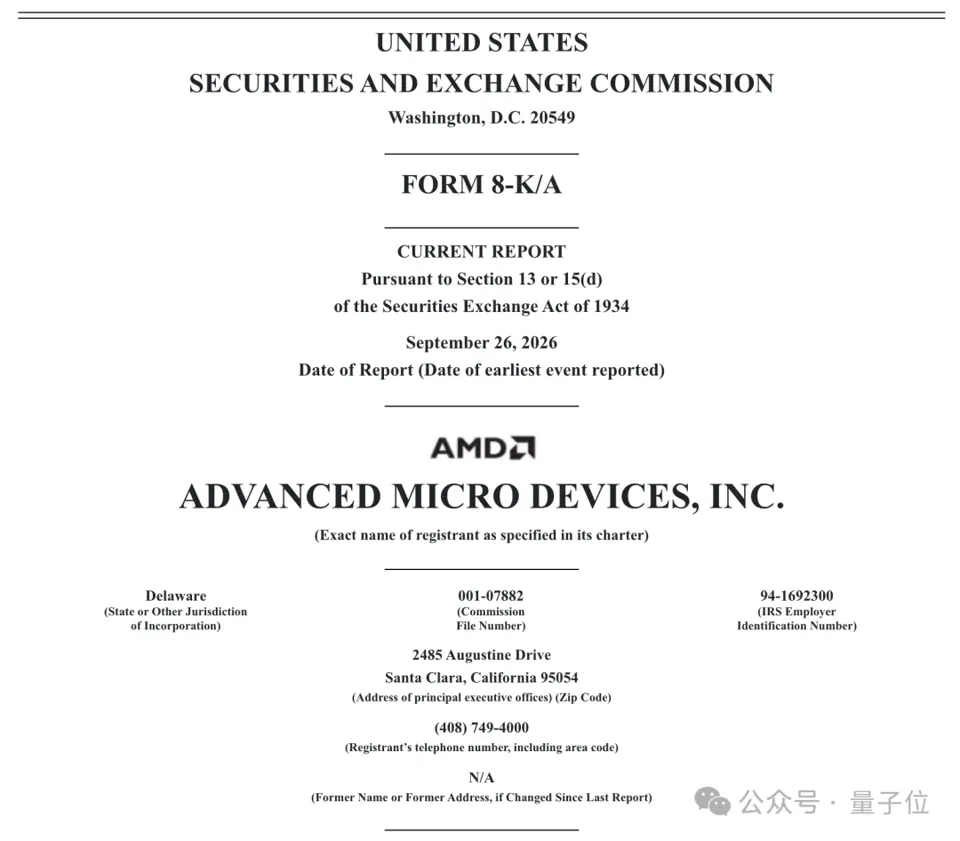
According to the Form 8-K/A supplemental filing AMD submitted to the U.S. Securities and Exchange Commission on November 16, the acquisition completed its full closing on November 13.
That pace is considerably faster than the two sides' initial expectation of closing before year-end.
The closing used an all-stock private placement, with AMD issuing 14.978 million shares of common stock to World Labs' existing shareholders, at a total valuation of approximately $8.2 billion (about 54.6 billion RMB).
In AMD's M&A history, this deal's size is second only to the Xilinx acquisition, which closed in February 2022.
In 2022, Lisa Su led AMD to swallow FPGA leader Xilinx in an all-stock deal worth approximately $49 billion at closing.
That acquisition set a chip-industry M&A record in one stroke and directly underpinned AMD's later embedded and adaptive computing footprint.
Four years later, Lisa Su has once again pulled out $8.2 billion in stock, this time to buy an AI team focused on 3D world models.
With the deal finalized, World Labs co-founder and CEO Fei-Fei Li formally joins AMD's core management as Executive Vice President and Chief Scientist, reporting directly to Lisa Su.
World Labs' other two co-founders, Justin Johnson and Ben Mildenhall, will also stay on.
They will continue advancing foundation model research as an independent frontier research organization within AMD, while working alongside AMD's hardware, software, and systems engineers.
In the computer vision community, these two are likewise familiar faces with stellar credentials.
Justin Johnson is a PhD student Fei-Fei Li mentored at Stanford, participated in building the CS231n course that virtually every AI beginner has seen, and was a core driver of real-time style transfer and the PyTorch3D library;
while Ben Mildenhall, from Google Research, is a co-inventor of the NeRF paper that set off the entire wave of 3D visual reconstruction in 2020.
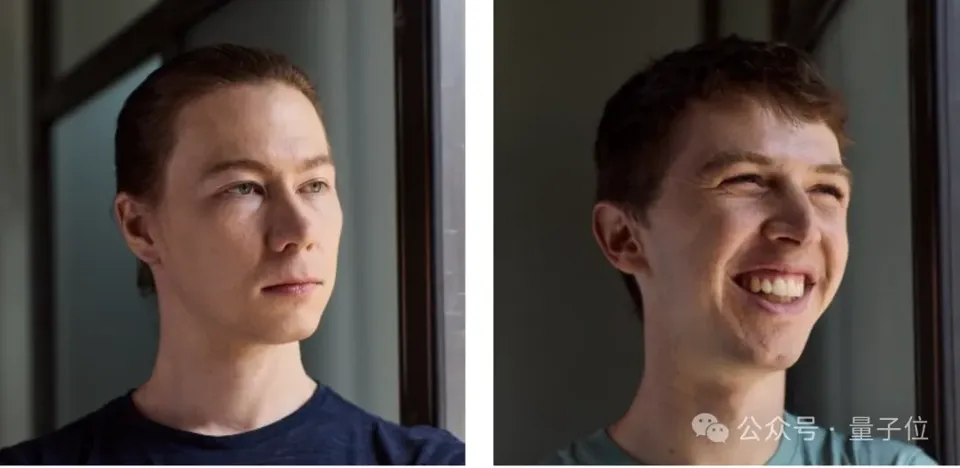
△Left: Justin Johnson; Right: Ben Mildenhall
In the celebration posts released simultaneously by both companies, World Labs also borrowed the line from Tennyson's "Ulysses"—"Come, my friends, 'tis not too late to seek a newer world"—echoing the title of Fei-Fei Li's earlier open letter.
In sharp contrast to the warmth between the two sides, the capital market's reaction that day carried a note of coolness.
After the market opened on Monday, November 16, amid a pullback across the semiconductor sector and AI infrastructure concept stocks, AMD's share price not only failed to rise but at one point fell about 5%.
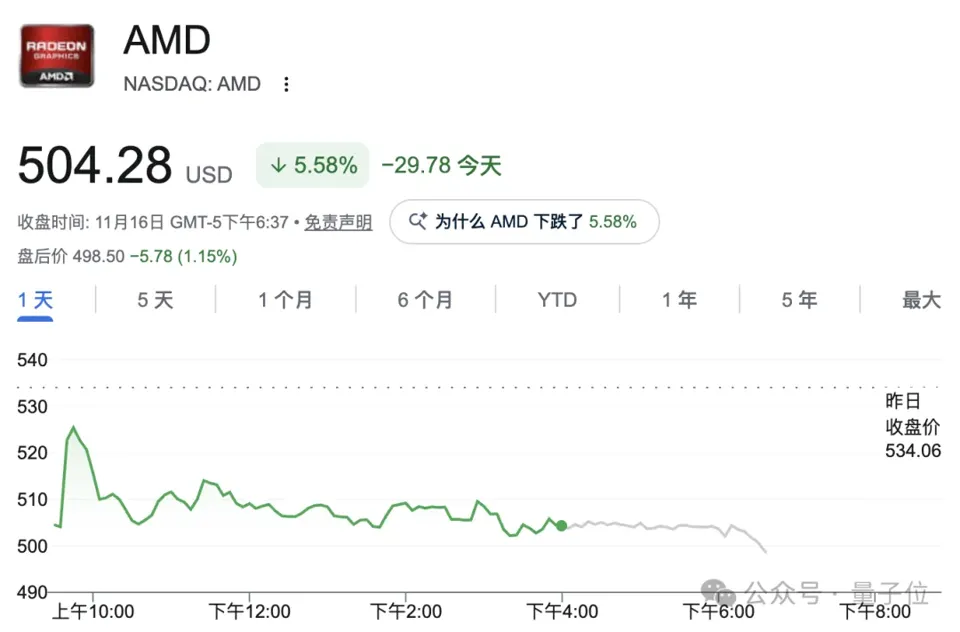
Wall Street is clearly still waiting for this newly assembled team to deliver its first demonstration of software-hardware synergy.
From $230 Million to $8.2 Billion, What Did They Build
In 2024, Fei-Fei Li co-founded World Labs, steering clear of the then-crowded large language model space and going directly after spatial intelligence capable of understanding and simulating the 3D physical world.
When the company emerged from stealth that year, it had already raised $230 million in funding, pushing its valuation straight to $1 billion.
Last November, World Labs delivered its first multimodal world model, Marble.
Users only need to input text, images, or a rough 3D layout to generate 3D scenes that can be freely explored, edited, and exported.
This February, World Labs completed another new funding round of up to $1 billion, with an investor list that included Autodesk ($200 million), Nvidia, and AMD itself at the time.
But what truly showed the industry the technical caliber of this company was the new-generation all-purpose world model Atlas, released on September 1 this year.

A few days ago at CoRL 2026, Fei-Fei Li specifically broke down the technical foundations of Atlas.
At a time when large language models generally swear by "Next Token Prediction," Atlas's core idea is "Viewpoint Is All You Need," predicting the next viewpoint through precise camera pose conditional control.
During training, Atlas ingested text, images, video, depth signals, and 3D structure signals simultaneously, and can switch among three modes—dense reconstruction, sparse reconstruction, and pure text generation—under the same autoregressive diffusion Transformer architecture.
In a blind test initiated by the third-party organization RapidData, the testers collected approximately 500,000 human evaluations to compare the camera-control generation capabilities of major video and world models.
Ultimately, Atlas ranked first, capable of generating coherent-perspective videos exceeding 60 seconds at 1440p resolution.
Even more important is the deployment in the robotics direction.
This year, World Labs also acquired Scenix, a robotics company specializing in real-world-to-simulation and simulation-to-reality pipelines.
At the event, Fei-Fei Li demonstrated a robot trained entirely within a virtual simulation environment built on Atlas, then deployed directly to the real physical world in a zero-shot manner.
Just one day before the acquisition closed, on November 12, World Labs announced that Atlas would be fully opened to all members of the public and developers.
Taking On NVIDIA, AMD Decides to Build Its Own Models
Just a few days before the announcement of the acquisition closing, Lisa Su and Fei-Fei Li shared the stage for the first time in a conversation at CoRL 2026.
At the start of the conversation, Lisa Su judged that physical AI, especially the robotics track, will be a multi-trillion-dollar opportunity in the coming years.
She also revealed that AMD actually already has a sizable robotics research team internally, though the overall布局 is still in its early stages.
On stage, Fei-Fei Li put forward the judgment that "AI is compute, and compute is AI."
This dovetails perfectly with what Lisa Su emphasized in the acquisition announcement: "compute platforms and AI models must be co-optimized."
When previously asked why World Labs didn't start with Atlas right away, Fei-Fei Li once half-jokingly said outright, "Because Justin's team needs massive amounts of chips."
Truly scaling up world models to be big and strong is inseparable from massive GPU compute as the foundation.
Previously, AMD and World Labs were merely partners, and since 2025 the two sides had been jointly debugging model training and inference on AMD GPUs.
But external partnerships always have a layer of commercial boundaries, making it hard to lay bare and fix underlying pain points before the chip has even been taped out and finalized.
Now the two companies have become one family, and Fei-Fei Li's team can directly bring Atlas and subsequent frontier models to participate in the architectural design of AMD's future Instinct series chips and ROCm software stack, stress-testing with real spatial intelligence workloads before the hardware blueprints are even finalized.
AMD's recent moves to fill out its map have also been notably密集. In addition to spending $8.2 billion to acquire World Labs and announcing the acquisition of inference chip company Taalas, it recently also planned to take a stake in quantum computing company PsiQuantum and signed a data center compute leasing agreement with Core Scientific.
On the other side, old rival NVIDIA also spent $12.9 billion in early September to buy the open-source model platform Hugging Face, and in the robotics and physical AI track it has rolled out the Cosmos world foundation model, Omniverse, and GR00T.
Facing the high wall of integrated software and hardware that NVIDIA has built, AMD, from signing in September to closing in November this year, has repeatedly emphasized the "open AI ecosystem."
AMD wants to use open hardware, open software, plus self-developed frontier models to offer developers another choice.
Competition among chip giants can no longer be decided by the spec sheet of a single graphics card.