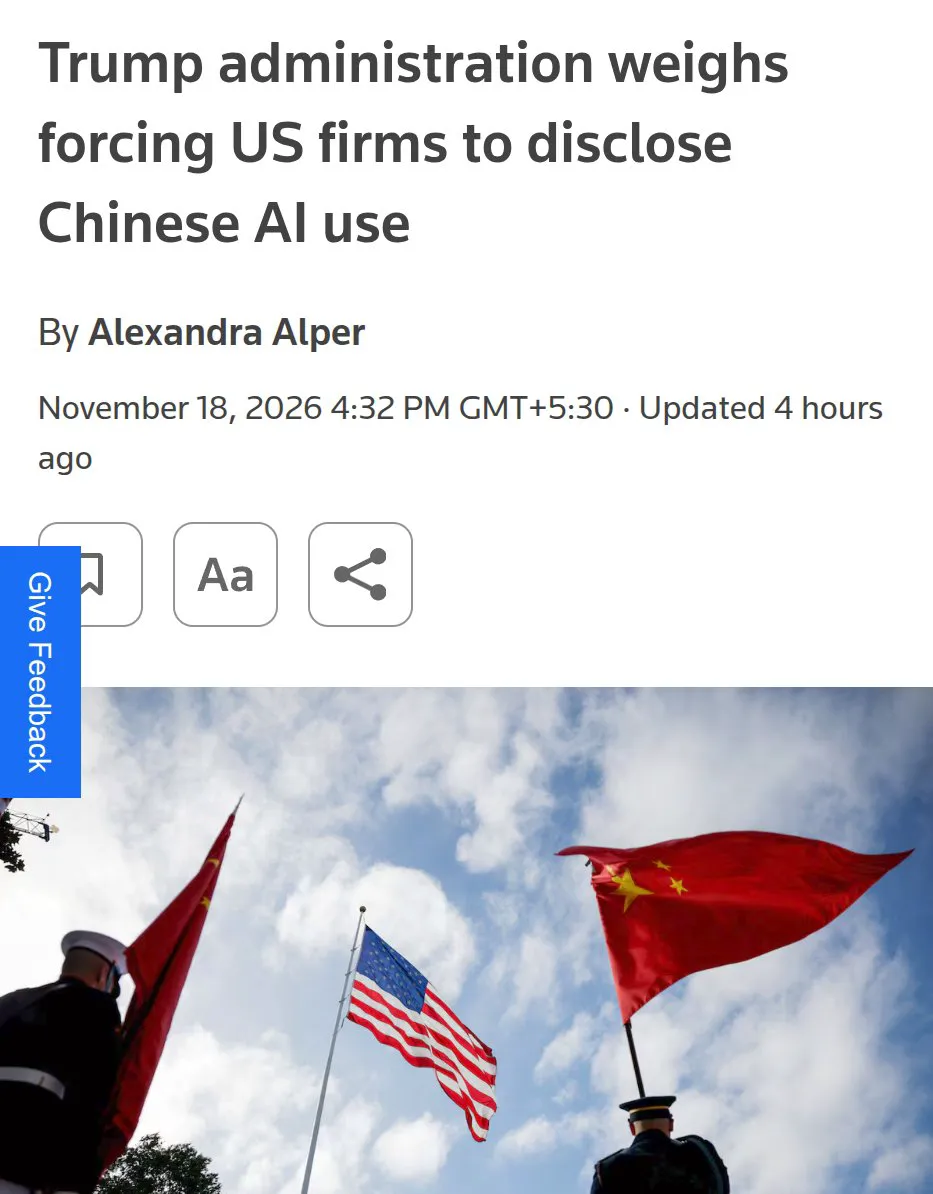
White House Weighs Public Disclosure Rule for Chinese AI Model Use
The Trump administration is weighing a rule requiring US companies to publicly disclose any use of Chinese AI models, relying on name-and-shame pressure rather than new restrictions. Airbnb's customer service agent runs on Qwen, Anysphere's Composer 2 was built on Kimi, and DoorDash routes internal tasks through Kimi, with House China committee chair Moolenaar backing the disclosure idea.
Related Entities
Full Report
Rohan Paul (@rohanpaul_ai) · 2026-11-18 19
The Trump administration is considering making US companies post any use of Chinese AI models on their websites.
The aim is to discourage reliance through “name and shame” pressure, without new restrictions that could anger industry or Beijing.
Airbnb runs its customer service agent on Qwen, yet says its AI runs overwhelmingly on US models and routes Chinese ones only through approved US-based providers.
John Moolenaar (chair of the House select committee on China) welcomed the disclosure idea and argues risks remain even when Chinese models run on US companies’ own infrastructure, which undercuts that hosting defense.
House investigators have also sent letters to Anysphere, whose Composer 2 coding model was built on a version of Moonshot AI’s Kimi, and to DoorDash, which routes some internal tasks through Kimi.
Even a US government website deployed an Alibaba model to search proposed federal regulations, Reuters reported in September.