Rohan Paul (@rohanpaul_ai) · 10/20/2026, 20:06:00
Open-Science Launches Open-Source Research Agent Workbench
AIPOCH released Open-Science, an open-source (Apache-2.0) desktop workbench that transforms coding agents into traceable research assistants. It addresses context fragmentation and reproducibility issues in AI-assisted analysis via immutable versioning, Provenance views, and isolated replay mechanisms, achieving top rankings on the BiomniBench-DA benchmark.
SOURCE COVERAGEFull Original Report
Rohan Paul (@rohanpaul_ai) · 2026-10-20 12
AI research with a paper trail, and it’s open source.
@aipoch_ai has released Open-Science, a free Apache-2.0 desktop workbench that turns coding agents into research assistants for scientists.
The problem is familiar to anyone using AI for analysis. You get a clean figure, then someone asks how it was made: which input, which code, which branch of the chat where an assumption changed. That context usually sits scattered across chats, notebooks and folders.
Open-Science keeps it in one place. You open a project, describe the goal, attach data, and the agent works through it with Python or R notebooks, scientific skills like AlphaFold2 and ESM-2, and connectors to databases such as PubChem, GTEx and cBioPortal. You choose how much it does alone, from approving every command to full access.
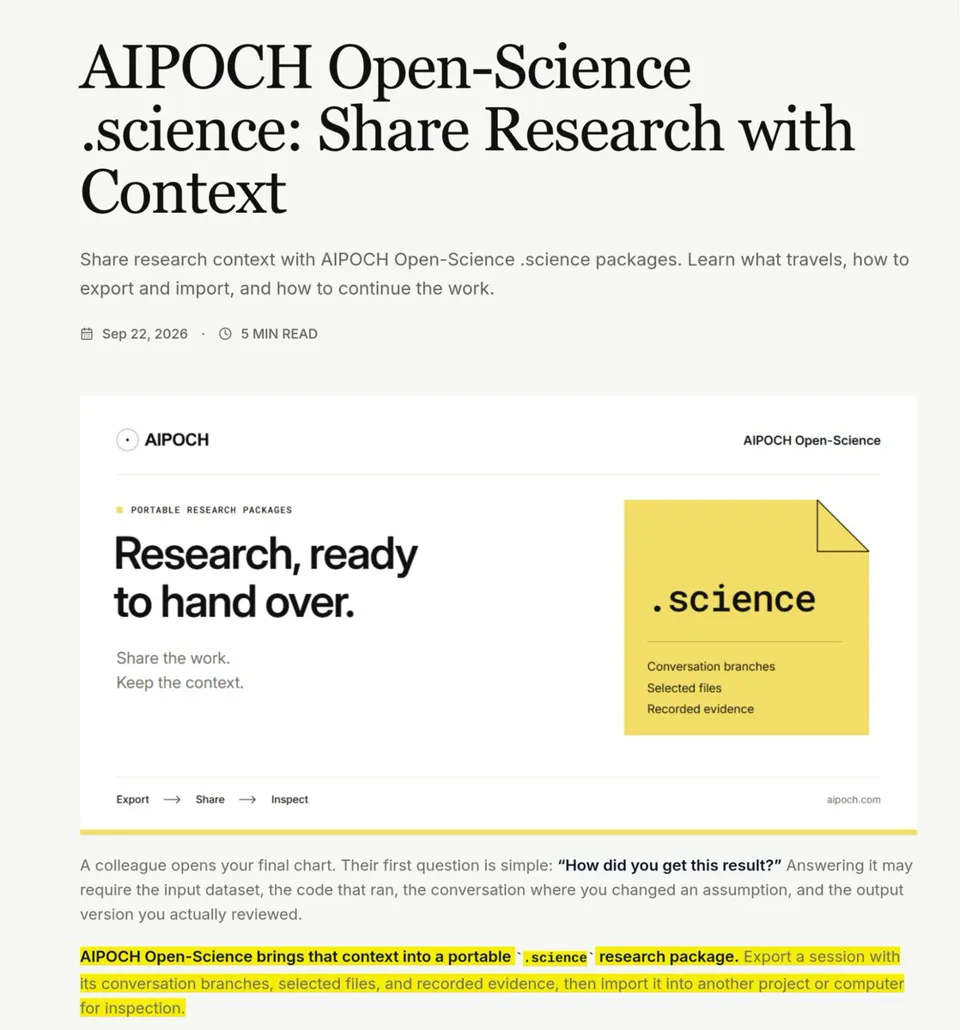
Each output is stored as an immutable, checksummed version, with a Provenance view showing the producing code, inputs, environment and execution history. A built-in replay can rerun that version from its sealed recipe in isolation and compare the new files against the originals. When you’re done, the session exports as a .science package a collaborator can import to inspect your branches, files and evidence.
Model choice stays open. Open-Science runs Claude Code, Codex, OpenCode or CodeBuddy as the agent engine, with cloud APIs, a local model through Ollama or vLLM, or your existing Claude or Codex subscription, and projects stay local by default. Bigger jobs can go to your own server over SSH or Slurm.
AIPOCH reports 79.05 with gpt-5.6-sol on BiomniBench-DA’s public tasks, ranking first in its comparison on a benchmark that grades agents on full biomedical analyses taken from published papers.