Google Open Sources WeatherNext 3 Weather Datasets
Google DeepMind has publicly released SatWeave and PARDIG, the two foundational datasets behind its WeatherNext 3 weather model, both hosted on Google Cloud Storage under CC BY 4.0. PARDIG uses a spherical-grid Transformer with ~10 km spatial and 15-minute temporal resolution, outperforming NASA IMERG-Final by over 30% on hourly light-to-moderate precipitation detection and remaining reliable in regions lacking ground radar.
Related Entities
Full Report
IT之家 November 13 news: Google DeepMind today officially opened up the two foundational datasets behind the WeatherNext 3 weather model, SatWeave and PARDIG. These datasets are provided to researchers and developers worldwide with real-time data streams and historical archives, and can be used for modeling weather, hydrology, climate, and related downstream applications.
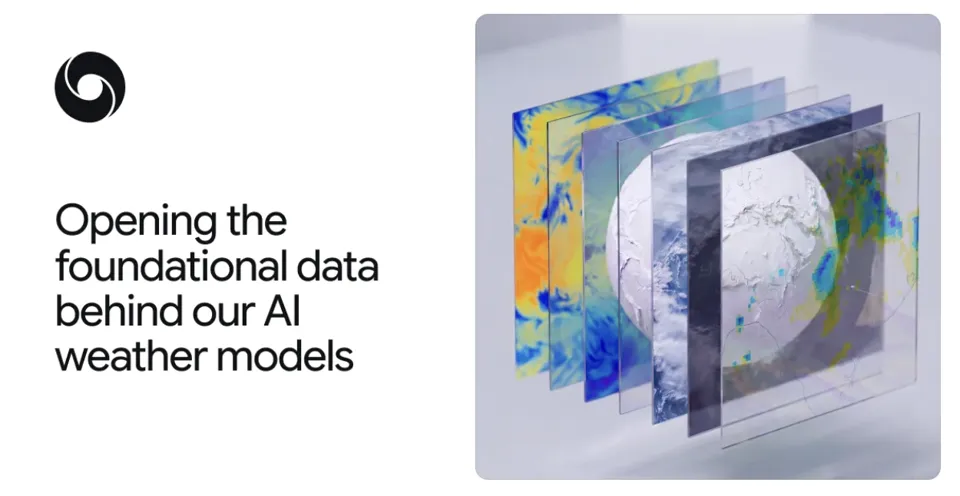
According to the introduction, SatWeave is a global imagery mosaic product integrating multiple geostationary meteorological satellites. It aggregates observation data from five satellites: GOES-East, GOES-West, Meteosat 0, Meteosat Indian Ocean, and Himawari, solving the challenges posed by differences among satellites in map projection, file format, sensors, and scanning cadence. The dataset is updated once per hour and provides a historical archive spanning more than ten years, enabling WeatherNext 3 to generate hourly global forecasts based on real-time cloud imagery and storm dynamics, whereas traditional analysis data typically refreshes only every six hours. Google also hopes the research community will extend it to scenarios such as solar power forecasting and wildfire monitoring.
PARDIG, meanwhile, is a global precipitation reanalysis dataset based on an AI architecture. It adopts a spherical graph grid Transformer architecture similar to that of WeatherNext 3 and directly uses sparse spaceborne radar observations from NASA's Global Precipitation Measurement Core Observatory as training targets, with SatWeave imagery and the European Centre for Medium-Range Weather Forecasts' atmospheric fields as inputs. Its spatial resolution is about 10 kilometers (0.1°), its temporal resolution is 15 minutes, and its average latency is about 5 hours.
Google's evaluation against the three major land-based radar networks of the United States, Europe, and Japan, as well as more than 36,000 weather stations worldwide, shows that PARDIG outperforms mainstream baseline products such as NASA IMERG-Final across all rainfall intensity levels; its hourly detection skill for light to moderate precipitation is more than 30% higher than that of IMERG-Final, and its ability to capture extreme precipitation is particularly outstanding. Because the model learns directly from satellite observations, it also has reliable accuracy in regions lacking ground-based radar and rain gauges.
In addition, Google has also simultaneously opened up the PARDIG historical archive from 1999 to 2026, as well as the real-time data streams of SatWeave and PARDIG. The corresponding data is hosted on Google Cloud Storage and released under the CC BY 4.0 license.