UC Berkeley Supervisor Rebuilds Coding Agent Teams to Beat Expert GPU Kernels
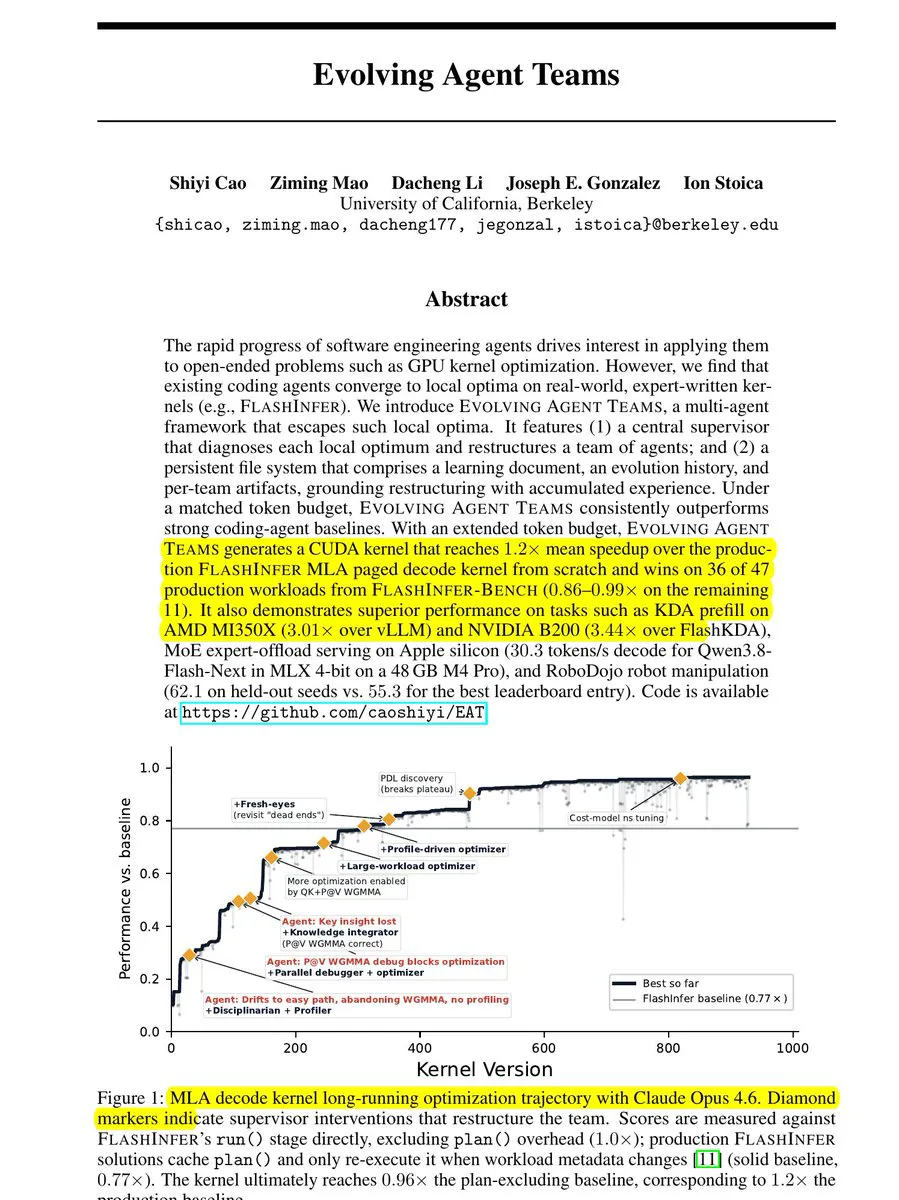
A new UC Berkeley paper introduces Evolving Agent Teams, in which a supervisor diagnoses plateaus in coding-agent teams and rebuilds roles such as profiler, debugger, and knowledge integrator, with a shared file system carrying lessons across teams. On the MLA decode kernel it reached 0.74x FlashInfer speed under the same token budget versus 0.31x for a fixed four-role team, and 1.21x with more budget, winning 36 of 47 production workloads.
Related Entities
Full Report
Rohan Paul (@rohanpaul_ai) · 2026-11-09 21
New UC Berkeley paper shows that a supervisor that keeps reorganizing a team of coding agents can beat expert GPU kernels where single agents stall.
Coding agents make fast early progress on GPU kernels, then settle on easier designs and plateau far below expert code. On the MLA decode kernel, Claude Code stalled at 0.51 times FlashInfer's speed.
Evolving Agent Teams adds a supervisor that diagnoses each plateau and rebuilds the team, inventing roles like a profiler, a debugger, or a knowledge integrator. A shared file system keeps lessons from every past team.
Under the same token budget it reached 0.74 times FlashInfer on MLA decode, against 0.31 for a fixed 4-role team. With more budget it hit 1.21 times FlashInfer's speed, winning on 36 of 47 production workloads.
For long, hard optimization runs, have a supervisor restructure agent roles when progress stalls instead of running 1 fixed agent setup.