Tsinghua Proposes ParallelWorld: Multi-Step Simulation Boosts Embodied Agent Success to 83%
Researchers from Tsinghua University and NUS introduced ParallelWorld, integrating test-time computation into high-level planning for embodied agents. By simulating multiple candidate action paths and comparing future observations, the method allows robots to anticipate consequences before execution, boosting task success rates from 56% to 83% and offering a new paradigm for embodied decision optimization.
Full Report
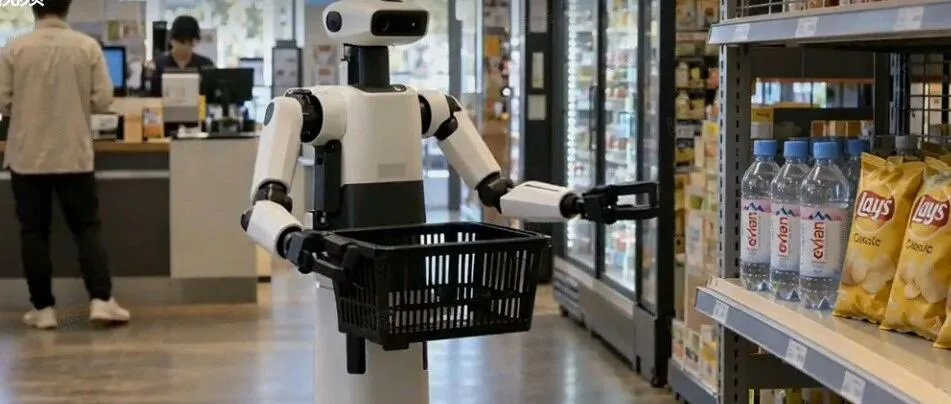
ParallelWorld introduces multi-step lookahead into high-level planning for embodied agents, boosting task success rates from 56% to 83%.

Can a robot foresee the consequences of different choices before acting? ParallelWorld integrates multi-step lookahead into the high-level planning of embodied agents, increasing task success rates from 56% to 83%.
Moving two moka pots from the table to the stove might seem like a simple "pick up and place" task. However, for a robot, decisions such as which pot to move first, where to grasp it, and how placing it affects subsequent steps can significantly alter the outcome.
If the system selects an action that appears reasonable based solely on the current visual input, only to discover issues during execution, subsequent planning must restart from a more difficult state.
Researchers from Tsinghua University and the National University of Singapore proposed ParallelWorld, aiming to shift this judgment earlier in the process. The approach allows the agent to explore multiple candidate action paths from the current state, compare future observations and task progress, and then decide on the immediate next step.
The core of this work lies in leveraging additional computation at test time to simulate the consequences of actions. The system retains promising branches and continues forward simulation as needed; once a trajectory is selected, it executes only the first action and replans based on new observations post-execution.
- Paper Title: ParallelWorld: Test-Time Scaling for Agentic Embodied Reasoning
- Paper Link: https://arxiv.org/abs/2608.22971
- Code Repository: https://github.com/AgenticEI/ParallelWorld
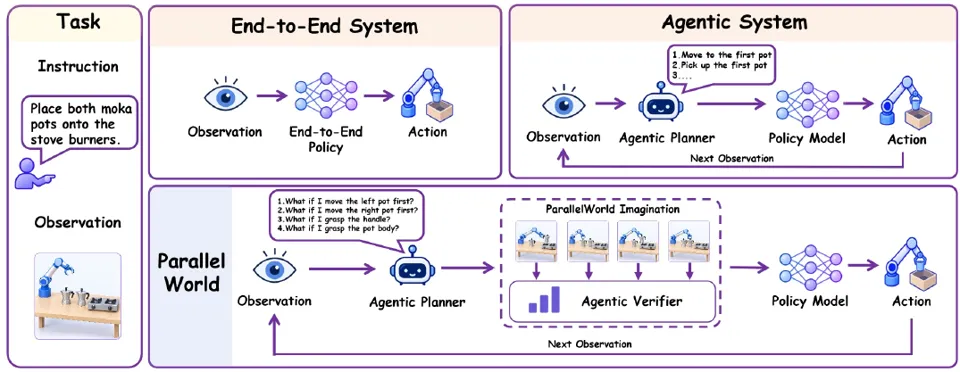
Figure 1 | Three decision-making approaches for embodied systems. ParallelWorld inserts lookahead and verification of candidate futures between high-level planning and action execution, allowing downstream outcomes to inform current decisions. Image source: Figure 1 from the paper.
Beyond Task Decomposition: Looking One Step Ahead
High-level planners can decompose complex instructions into executable skills. For spatial understanding tasks, they orchestrate camera movements or object interactions to gather evidence required to answer questions. For manipulation tasks, they combine actions like grasping, moving, and placing to drive the environment toward the goal state.
The challenge is that sequential task decomposition does not automatically imply that the system considers the downstream impact of different actions. The value of certain actions may only become apparent after several interactions. When the current viewpoint cannot identify an occluded object, a single movement might only change the occlusion relationship but create conditions for subsequent observation. In manipulation, one grasping method might facilitate picking up an object but hinder the subsequent placement.
ParallelWorld therefore incorporates "what will be seen in the future" and "how far the task will progress" into action selection. This search occurs over high-level actions with defined execution scopes and termination conditions, while low-level control remains handled by existing skills or policies.
Integrating Different Futures into a Single Decision
ParallelWorld organizes planning into interconnected lookahead and execution loops.
In the lookahead loop, the planner proposes multiple candidate actions based on the task and current observation, each expanding from an existing branch. The system predicts or simulates observations following these actions, forming a search tree containing diverse future paths.
A verifier then compares candidate outcomes, determining which branches are more conducive to gathering evidence or completing the task, and provides feedback. Poorer branches are pruned, while those worth further exploration are retained. The planner combines these results to decide whether to continue lookahead or transition to execution.
Both the width and depth of the search can adapt to the decision context. The planner determines how many candidate actions to propose, the verifier decides which branches to keep, and the planner then decides whether to continue forward simulation. This enables the system to allocate more computation to ambiguous choices.
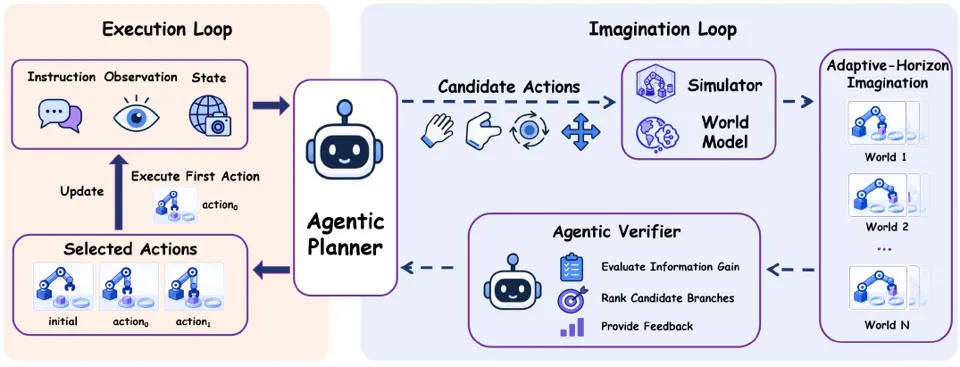
Figure 2 | The lookahead and execution loops of ParallelWorld. The right side compares future outcomes of different actions, while the left side executes the first action of the selected trajectory and feeds new observations back into the next planning round. Image source: Figure 2 from the paper.
Upon entering the execution loop, the system takes only the first action of the selected trajectory. The remaining steps serve as reference for the current decision but are not executed all at once.
This "rolling planning" mechanism has practical significance: future predictions may diverge from the environment as the number of steps increases. Re-observing after each executed step allows for timely plan corrections, combining the benefits of multi-step lookahead with execution feedback.
From Clearer Vision to More Accurate Manipulation
Embodied Understanding Gains Concentrate on Tasks Requiring Additional Interaction
ESI-Bench covers 10 categories of embodied spatial intelligence tasks across 29 subcategories. Since liquid pouring actions could not be executed in the environment, the study excluded the liquid volume subcategory and evaluated the remaining 28 items. Active methods used the same answering model.
According to Table 1 in the paper, ParallelWorld outperforms sequential Active Exploration in 26 of these tasks. Representative results are shown below.
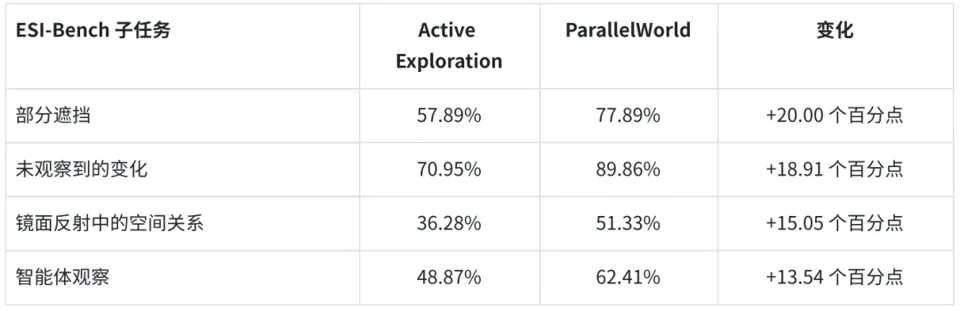
The common difficulty in these tasks is that the current view is insufficient for reliable judgment, requiring interaction to obtain more discriminative observations. In qualitative examples from the paper, sequential exploration misidentified the target as a pen, whereas ParallelWorld found a more informative viewpoint and correctly identified it as a paintbrush.
Improvements were not universal across all subtasks. Rigid containment tasks dropped from 60.00% to 50.00%, and geometric configuration tasks fell from 17.96% to 16.90%. This suggests that even with more observations, models may still be limited by their geometric reasoning capabilities.
Robot Manipulation Outperforms Direct Baselines Across Eight Settings
Manipulation evaluations utilized LIBERO-Pro, focusing on generalization under instruction redirection and position swap perturbations. The study covered four task suites—Spatial, Object, Goal, and LIBERO-10—with each setting comprising 10 tasks and 10 random seeds per task, totaling 800 episodes.
ParallelWorld is built upon HarnessVLA. The paper reproduces HarnessVLA using Codex as the high-level planner to serve as a direct baseline for comparison. The table below summarizes the success rates of both methods from Table 2 in the paper.
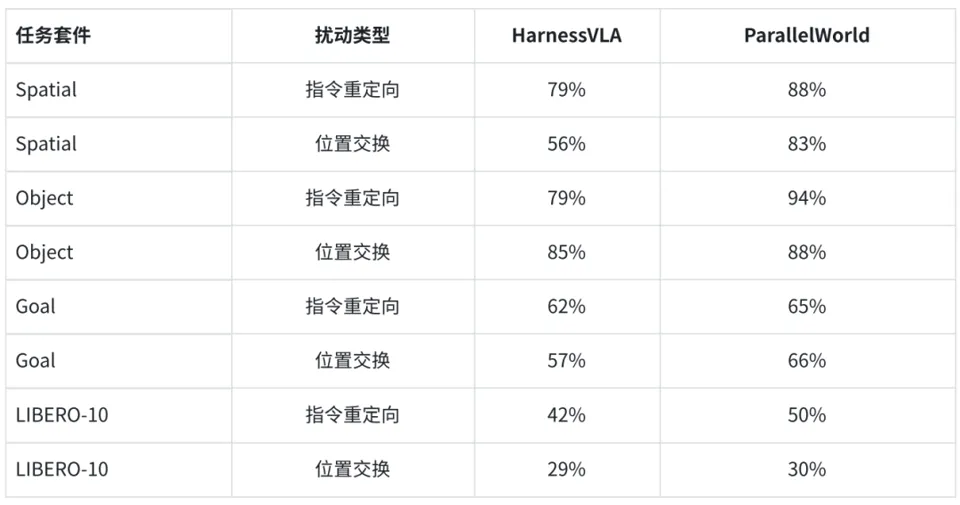
ParallelWorld achieves higher success rates across all eight settings. Notably, it improves by 27 percentage points in the Spatial position-swapping setting and by 15 percentage points in the Object instruction-redirecting setting. When tasks involve target identity, relative positioning, or placement geometry, comparing the visual consequences of candidate actions provides valuable evidence for decision-making.
The gains in Goal-oriented tasks and LIBERO-10 are relatively limited. Joint states, contact dynamics, and error accumulation in long-horizon tasks have a greater impact on execution outcomes, factors that are difficult to fully capture through visual prediction alone.
Thinking more helps, but how you search matters just as much
Does increasing the number of candidate paths always lead to better results? The paper conducted an ablation study on search width across three Spatial position-swapping tasks, using 10 random seeds per task for a total of 30 episodes.

Adaptive width achieved the highest success rate in this set of experiments, with lower latency compared to both fixed-width strategies. With a fixed width of 2, the success rate was actually lower than direct execution, demonstrating that adding rollouts does not guarantee performance improvements.
The authors attribute these differences to the alignment between search budget and current decision uncertainty: too few branches may miss useful options, while too many increase redundant computation and filtering difficulty. An adaptive strategy allows the system to adjust the number of candidates based on the task state.
However, these results also highlight clear costs. The average total time for adaptive search is approximately 5.8 times that of direct execution; since this ablation covers only three tasks, it is insufficient to establish general laws regarding computational cost versus performance gains. Reducing rollout costs remains a key challenge for future real-world deployment.
The boundary of rollouts lies in whether they can predict truly consequential outcomes
Figure 3 | Effective scenarios and failure cases. The top row shows more informative observations and more favorable action choices; the bottom row illustrates that even with sufficient observation or plausible-looking future predictions, precise geometric reasoning and physical contact can still lead to failure. Image source: Figure 3 from the paper.
The benefits of ParallelWorld depend on whether the factors determining task success can be reliably represented by rollout outcomes. When difficulties primarily stem from viewpoint selection, object identification, or spatial layout, comparing different futures can improve decision-making. However, when tasks require precise metric estimation, contact dynamics, or detailed prediction of execution errors, visual rollouts still have significant limitations.
In the failure cases presented in the paper, the model sometimes had access to sufficient information yet failed to determine the precise geometric relationships between objects; in other instances, generated frames looked plausible, but the actions failed during execution. Visual plausibility in image prediction cannot be directly equated with physical feasibility.
This study demonstrates a specific application of test-time compute in embodied systems: before an action is executed, compare its potential subsequent observations and task progress, then continuously refine the plan using execution feedback.
For such rollouts to be effective in more real-world scenarios, we need more reliable physical prediction, more accurate verification mechanisms, and affordable inference overheads. The results of ParallelWorld provide a verifiable starting point for further research into these challenges.

© THE END
Please contact this official account for authorization to reprint.
Submissions or media inquiries: [email protected]