ModelBest Open-Sources ForgeKernel: AI Agent Outperforms Human-Written DeepSeek Operators by 9.8%
ModelBest has open-sourced 'ForgeKernel', an autonomous agent for kernel generation. Without access to source code, the system evolved over 22.5 hours to produce a FlashMLA Prefill kernel on NVIDIA B200 that outperforms DeepSeek's human-written implementation by 9.8%, marking a significant milestone in AI-driven infrastructure optimization.
Related Entities
Full Report
Contents5 sections

Previously, it topped all three Ascend leaderboards.
Jin Lei, reporting from Aofei Temple
QbitAI | WeChat Official Account: QbitAI
No source code, no paper—starting completely from scratch.
Just this morning, ForgeKernel, an autonomous agent with no human intervention, publicly demonstrated that it could optimize DeepSeek’s latest core operator to be 9.8% faster than the original implementation, without referencing any existing DeepSeek code.
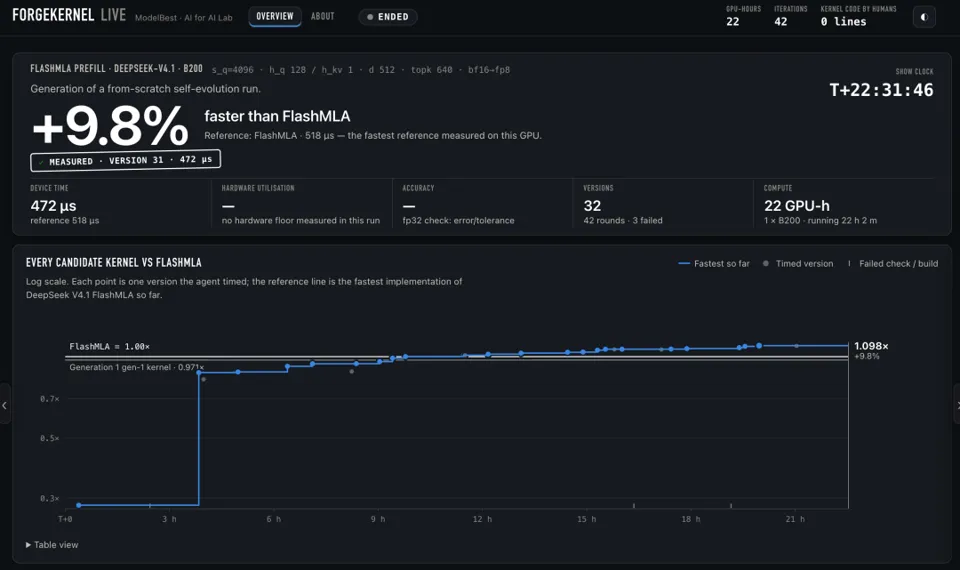
The entire live-streamed process took only 22.5 hours (which is remarkably short for operator design), attracting significant attention from netizens:

Specifically, the live stream featured an agent optimizing the FlashMLA Prefill operator on an NVIDIA B200 GPU, surpassing the performance of DeepSeek-V4.1.
FlashMLA is DeepSeek’s open-source core attention operator library, recently integrated into their inference framework DeepInfer released on October 20. Developed by a team widely recognized as having the strongest infrastructure capabilities in the industry, FlashMLA represents the peak of human-written operators.
As mentioned earlier, the AI was provided only with the mathematical definition of the operator and target hardware constraints. It had to start from zero context, improving iteratively through self-evolution.
Over these 22.5 hours, every rewrite and performance metric fluctuation was displayed transparently to the global audience:
- The first version passed correctness checks but took 1,834 microseconds, indicating relatively low efficiency;
- Within less than 4 hours, execution time dropped to 593 microseconds—a reduction of approximately 67.6%, bringing it close to 90% of the current best implementation’s performance;
- Around the 7-hour mark, a breakthrough in core structure allowed it to surpass its previous iteration and then outperform FlashMLA for the first time;
- By around 9 AM, the live stream concluded. The final version achieved 472 microseconds, compared to FlashMLA’s 518 microseconds—making it 9.8% faster.
Throughout the process, there were 42 iterations, resulting in 32 versions, utilizing 1 B200 GPU and 22 GPU-hours. Meanwhile, the amount of human-written code for this operator remained at zero lines.
The pinnacle of human craftsmanship has been surpassed by an operator containing not a single line of human code.
So, what exactly is this agent?
It is ForgeKernel, the operator generation system developed by ModelBest; immediately following the live stream, the Intelligent Evolution Lab jointly announced its open-source release with the OpenBMB community.

However, this live stream was not ForgeKernel’s debut. Just days prior, it had already gained fame.
Sweeping Three Top Spots on Domestic Compute Leaderboards
On October 27, Ascend CANN officially acknowledged ForgeKernel—
Simultaneously topping the CANNBench 950DT, 950PR, and A3 hardware leaderboards!
These three leaderboards correspond to different classes of Ascend hardware, each with distinct performance highlights.
Let’s first look at the 950DT leaderboard, where the economic impact is most evident among the three.

ForgeKernel ranked first on this leaderboard with a score of 4,010.75, leading the second place by 27.8%; its baseline speedup ratio was 1.533×, approximately 143% of the second-place entry.
This implies that with equivalent hardware investment, usable compute capacity increases by nearly 50%, allowing enterprises to reduce compute procurement and deployment costs by roughly half.
The significance of this leaderboard lies in the fact that the 950DT is a new-generation chip whose accompanying operator library is still in early development stages, requiring long manual adaptation cycles. ForgeKernel was the first to complete adaptation and secure the top spot.
This demonstrates that even when new hardware launches, AI can rapidly produce high-quality operators, significantly compressing the gap between chip release and full software stack optimization.
950PR features the fiercest competition among the three leaderboards, with the top three entries all achieving baseline speedup ratios exceeding 1.3×:

ForgeKernel also ranked first here with a total score of 4,165.94; its baseline speedup ratio was 1.638×, approximately 1.18 times that of the second-place entry.
Finally, there is A3, which corresponds to the currently widely used Ascend 910C.
Even before the v2.0 leaderboard opened, ForgeKernel had already secured first place on the A3 hardware leaderboard in CANNBench v1.1, which closed on October 15. Since v2.0 launched, it has maintained this position, currently holding a total score of 4,341.16 and a baseline speedup ratio of 1.898×, approximately 1.22 times that of the second-place entry.
During this live stream, ForgeKernel ran on an NVIDIA B200 using CUDA—an ecosystem built upon years of accumulated expert experience. In contrast, the three aforementioned leaderboards were based on Ascend hardware, which possesses its own independent architecture and toolchain.
Despite the significant differences in software and hardware between the two platforms, ForgeKernel managed to achieve first place on both using the same system.
The next question is: How did it accomplish this?
Self-Taught Mastery
Ultimately, model performance depends heavily on operators.
For the same model running on the same chip, switching to more efficient operators can result in substantial performance gains.
For a long time, high-performance operators have relied on senior engineers to hand-write and tune them one by one—a process characterized by long cycles and high barriers to entry. The CUDA ecosystem has reached its current state through years of accumulated expert knowledge; meanwhile, every new generation of domestic chips or new model requires a complete re-adaptation from scratch.
In short, the number of human experts cannot keep pace with the iteration speed of chips and models.
So, how can this deadlock be broken?
On October 27, the ForgeKernel team, in collaboration with Tsinghua University and other institutions, published a paper on arXiv titled JustGoal: With Only a Goal, the AI Baseline Is Above the Expert Kernels.
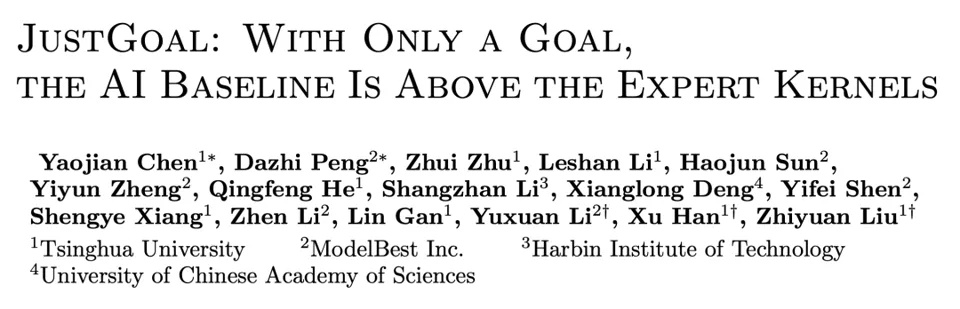
In this study, the research team provided the model with only an optimization goal—without supplying any operator-specific knowledge or prescribing fixed workflows—and let it write the code autonomously. The results showed that on the B200 platform, the model outperformed human-maintained open-source libraries in 8 out of 10 operators.
They also tested the same model using KDA-0.5, a specialized framework co-developed by Han Song’s team at MIT. Surprisingly, its average performance on single-configuration optimization tasks was only 0.95× that of JustGoal. This indicates that writing operators increasingly depends on the model's inherent capabilities, while the value of pre-defined expert experience and workflows is diminishing.
However, relying solely on goals has its limitations. While models excel at fine-tuning details, they struggle to independently design robust overall architectures. They often lock into a specific path during initial attempts, leaving subsequent iterations confined to minor adjustments within that existing structure. ForgeKernel was built upon JustGoal specifically to address this weakness.
Its approach consists of three key components:
- Separating architectural design from implementation capabilities, abstracting architecture design into milestones to decompose problems;
- Storing every hardware insight validated through empirical testing in a knowledge base, allowing reuse across different operators;
- Treating its own best-performing version as the opponent for the next round, enabling iterative self-evolution.
These three components correspond directly to the live demonstration we just reviewed.
ForgeKernel first surpassed its previous version before overtaking FlashMLA—this is self-evolution in action.
Later stages revealed that the model independently identified contention between Q's burst loading and KV data transfer for memory access resources. It then proactively controlled the request pacing for Q, reducing latency by another 2.4%. Such judgments previously required senior experts.
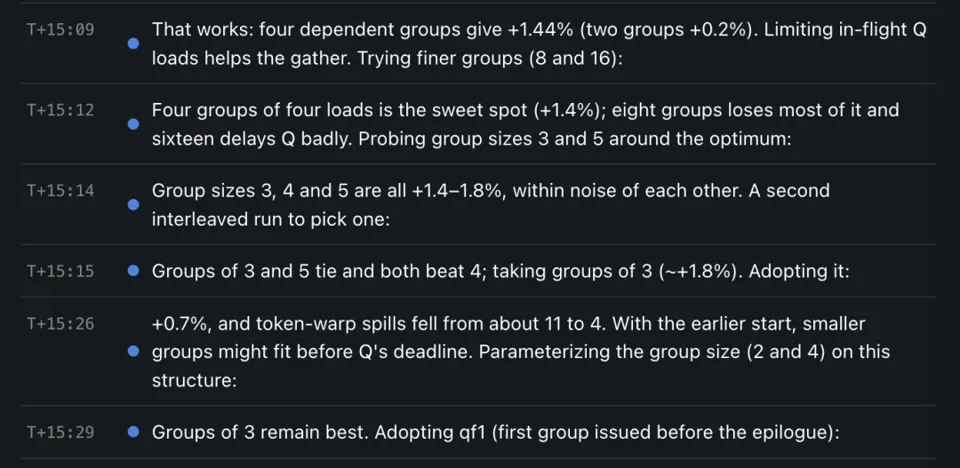
△ Agent execution logs from ForgeKernel Live
When applied to a broader range of operators, ForgeKernel matched or exceeded expert implementations in 24 out of 29 comparisons. It also matched or surpassed all seven strongest operators publicly released by three leading agent systems.
This benefit is replicable across different domestic chips because ForgeKernel’s design offers an additional advantage for domestic hardware: it does not depend on any specific chip model.
While concrete operator implementations must align closely with each chip’s hardware characteristics and cannot simply be copied, ForgeKernel’s methodology for organizing optimization is universal, without presetting fixed workflows for any particular chip. When switching from NVIDIA to Ascend, it only requires replacing the performance analysis tool from NCU to msprof. The necessary hardware knowledge for the new chip is then accumulated by the model through testing on that specific hardware.
Consequently, ForgeKernel can rapidly migrate to other domestic chips. When a new generation of domestic chips is launched, there is no need to build an adaptation pipeline from scratch.
Real Financial Savings
What exactly does a 1% speedup in operators mean?
According to Gartner’s latest forecast, global AI infrastructure spending will reach approximately $1.48 trillion in 2026. At this scale, every 1% improvement in compute efficiency corresponds to roughly $14.8 billion.
The impact is even more pronounced when considering domestic chips.
NVIDIA’s CUDA has been optimized by experts for years, resulting in many ready-made high-performance operators, leaving limited room for further acceleration via AI. In contrast, the operator libraries accompanying domestic chips are still incomplete, with many operators lacking thorough tuning. Therefore, the improvements brought by AI are significantly more substantial.
The ForgeKernel team observed this disparity when using AI to optimize training frameworks. The same approach yielded a 20%–30% speedup on domestic chips compared to 5%–10% on NVIDIA hardware. This means ForgeKernel can further enhance the cost-effectiveness of domestic chips in training and inference tasks, narrowing the gap with NVIDIA.
Once coding becomes virtually cost-free for AI, optimizations previously deemed too expensive or impractical due to high expert costs become worthwhile—for example, customizing a dedicated set of operators for a specific model or chip.
In fact, these operators, which surpass human expert benchmarks, have already moved beyond leaderboards into real-world industrial applications.
Currently, operators generated by ForgeKernel have been officially integrated into training frameworks, completing long-term training tests for MiniCPM5-1B on both domestic chips and NVIDIA platforms.
More notably, in this fundamental restructuring of the compute layer, domestic large models represented by DeepSeek V4.1 have begun participating in operator generation and optimization. These operators ultimately run stably on domestic chips.
"Domestic models write operators, domestic chips run operators"—a full-stack ecosystem loop unique to China’s AI sector is taking shape.
This is not just a victory for operators, but a tangible manifestation of RSI (Recursive Self-Improvement): The primary actor in AI R&D is shifting from humans to AI.
As Li Yuxuan, Chief Scientist of Intelligent Evolution at ModelBest, stated, since code can be quickly verified by machines, engineering implementation will achieve closed-loop validation ahead of theoretical research:
In the past, top-tier operators like those in the FlashAttention series, requiring deep architectural refactoring, often took human experts months or even half a year to iterate once. Now, within our team, AI completes operator optimization tasks that surpass the best human implementations in at most two days.
With the official open-sourcing of ForgeKernel, this methodology will serve as infrastructure, providing domestic chip manufacturers and model teams with a new path to efficiency.
Previously, the difficulty for domestic chips in catching up with NVIDIA lay not necessarily in hardware metrics, but rather in the decade-plus accumulation of expert experience and software layers within the CUDA ecosystem. However, under the RSI paradigm, AI is breaking down these ecological barriers built through manual labor over years, directly generating optimal solutions end-to-end.
When "domestic models write operators, domestic chips run operators" becomes the new paradigm for operator engineering, the subject of R&D may be irreversibly shifting from humans to models. But this does not imply the exit of human experts; rather, their focus undergoes a fundamental leap:
From manually polishing every line of low-level code to building environments, setting goals, and defining verification standards for AI, collaborating with it to write better operators.
As humans transition from code artisans to system architects, the gap between "running" and "running well" for domestic chips is being rapidly bridged by AI on an hourly basis.
Open Source Repository: https://github.com/OpenBMB/ForgeKernel
Like, Share, and Favorite!
We welcome your thoughts in the comments section!
— End —
🌟 Star Us 🌟
Daily Updates on Cutting-Edge Technology