Declare Debuts a UI Language Built for AI Authoring
Declare is a UI language designed for both humans and AI, emphasizing expressiveness and verifiability. Its calendar and desktop demos are complete programs of roughly 568 and 1,279 lines, all compiler-checked, and were human-directed but AI-written. The author notes the first build passed all hidden checks, while cautioning these are single runs rather than a benchmark.
Related Entities
Full Report
Expressive. And verifiable.
A calendar that zooms through time, a desktop with real windows: complete programs, each readable end to end and checked by the compiler. Open one, or edit it live in the browser you’re using.
1
Declare Calendar
Day, week, month and year views are one surface, zooming continuously; a view doesn’t switch so much as become the next one, and every motion can be interrupted. It runs on real data: drag an event to another day, and it’s moved.
568
lines of code, plus 228 of comments — four views, zoom, drag and edit
177 KB
over the wire, gzipped — app (structure, logic, styling) and runtime
0
lines typed by hand — human-designed and directed, built with AI
Run Declare Calendar →
2
Declare Desktop
→
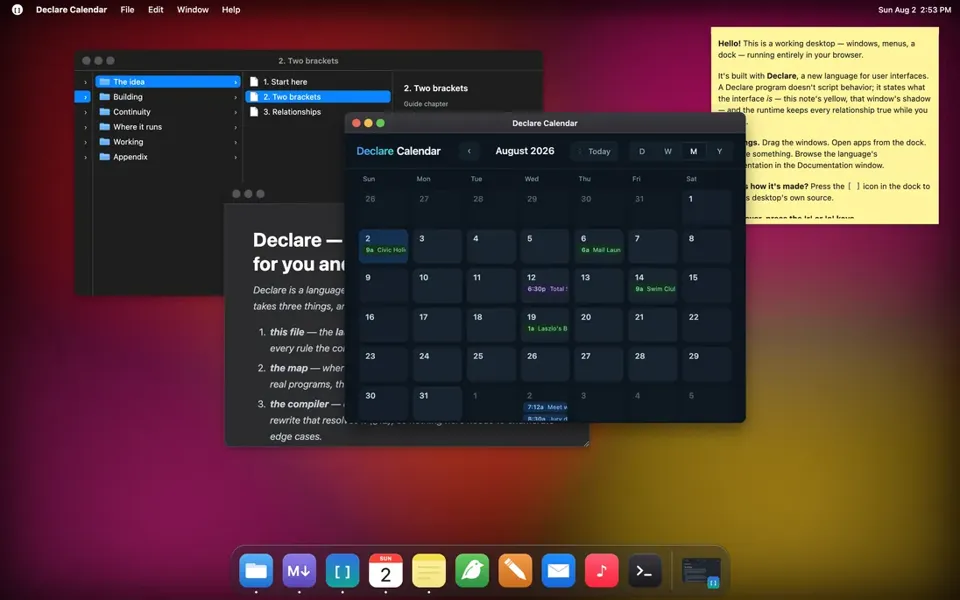
The acid test for a UI language: multiple applications, windows that drag, resize, layer and minimize into live thumbnails, a magnifying dock, menus that follow focus, and separately loaded apps running inside its windows. Elsewhere that is a project assembled from several libraries; here it is one program.
3529 lines — 2011 code, 939 comment · 264 KB over the wire · every pixel drawn from shapes, no image assets
3
Declare Tracker
→
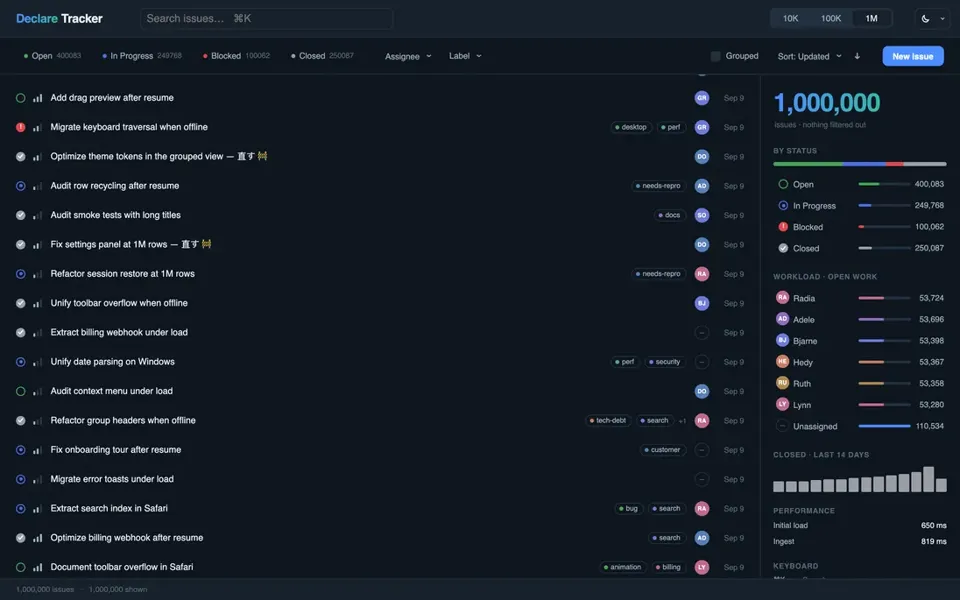
1,000,000 issues · search as you type · edit in place, with undo · not one line of virtualization code
1508 lines — 983 code, 251 comment · 194 KB over the wire, before its data · no dependencies
And more:
02
Say what you mean. Exactly.
Declare was designed first for the people who make interfaces. Layout, motion, states, theming and drawing are the language itself, not libraries bolted on — so the experience you have in mind is something you can write down directly, and read back later as it was meant.
Rules
Data
Motion
Three things follow one value: the number, the bar’s length and its color. Click to change v — all three update together, because each is a relationship that stays true, not a step someone remembered to run.
LIVE · EDITABLE
Revert
40
click anywhere to change v
Your AI can write the code. Can it tell when it’s wrong?
In Declare, yes. A small language gets it started; these four tools let it catch its mistakes, fix them, and finish.
Start with context
One installable skill: the language, the library, the conventions, the working loop — nothing to reconstruct from a repository. And declare-help answers any name or error code on demand.
Correct, don’t guess
Every diagnostic names the broken rule and the valid rewrite. Try it: change textColor to color in the panel above and read what comes back.
Question the result
The Inspector can tell you or an agent why a live value is what it is, what it depends on, and what happens if you change it — live, in the running program, not guessed from source.
Prove the change
A formal six-rung ladder, from parse to pixels, is how an app is shown to be correct. Your AI climbs it one rung at a time, and every rung reports what it proved — and what it cannot see.
Measured: given the same brief, the same agent built a ticket-buying app twice. The Declare app was 1,279 lines to React’s 2,666, and its first build that ran passed all eleven hidden checks; React’s passed six. Single runs, not yet a benchmark — every run is in the repository.
The calendar above was built this way: human-designed and directed, built with AI, and kept honest by the compiler.