Counterpoint: Global DRAM Revenue Nears $200B in Q3, Up 369% YoY
Counterpoint reports global DRAM revenue reached nearly $200B in Q3 2026, up 369% year over year, while unit shipments rose only about 4% sequentially, meaning growth was almost entirely price-driven. AI has turned memory from a commodity into a scarce resource; HBM4 competition and a GPU-to-CPU ratio trending toward 1:1 are reshaping vendor standings, and supply tightness is expected to persist as new fabs won't come online until 2028.
Full Report
IT Home News, November 5: The "Global Memory Market Tracker" report released today by market research firm Counterpoint Research shows that global DRAM market revenue in the third quarter of 2026 reached nearly $200 billion (IT Home note: approximately RMB 1.34 trillion at current exchange rates), up 369% year over year and nearly 5 times the level in the same period last year.
Counterpoint Research points out that this round of DRAM market growth was driven mainly by price increases rather than a sharp rise in shipments. DRAM unit shipments in the quarter grew only about 4% quarter over quarter, while the average selling price per Gb reached $1.9.
Senior Analyst Jeongku Choi said that this cycle is a price-driven supercycle, not a shipment-driven one. "AI has transformed memory from an ordinary commodity into a high-value scarce resource. Buyers' core action right now is to secure supply rather than negotiate on price. Against the backdrop of continued price increases, memory manufacturers will set new profit records next quarter."
By manufacturer, Samsung Electronics held the top spot in the DRAM market with a 38% market share; SK Hynix's revenue grew more than 40% quarter over quarter, significantly narrowing the gap with Samsung and recovering some of the market share it lost earlier this year; Micron also performed strongly, driven by memory demand from AI data centers, but its growth rate lagged behind Samsung and SK Hynix; CXMT's market share fell from 10% in the second quarter to 9% in the third quarter. As competitors begin shipping higher-premium HBM4 products starting in the fourth quarter, CXMT's share is expected to remain under pressure.
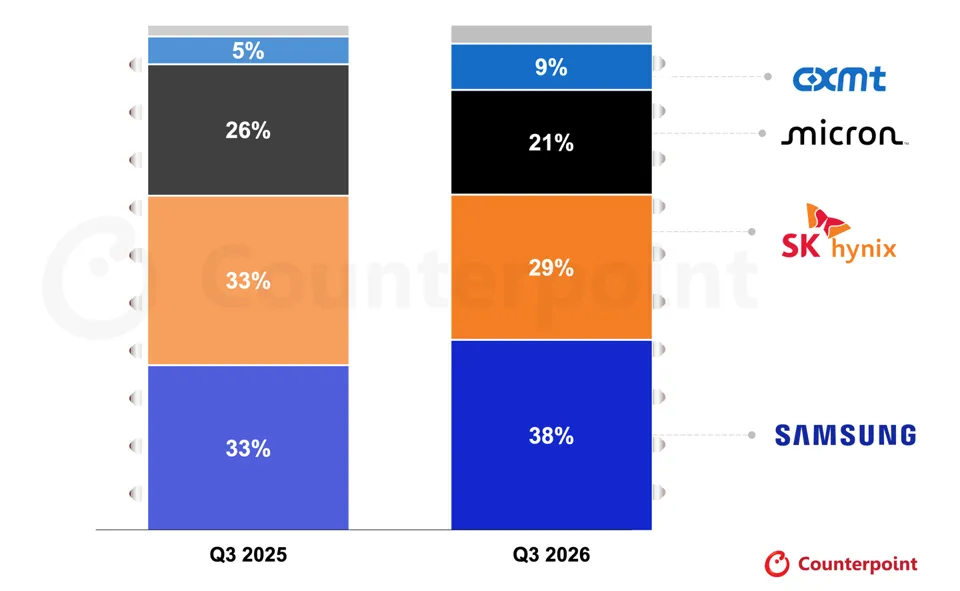
In terms of product mix, HBM revenue nearly doubled, but its share of total DRAM revenue actually declined because traditional DRAM products grew faster.
MS Hwang, Research Director at Counterpoint Research, said that with the successive launch of new-generation HBM products, the competitive landscape among manufacturers is also changing. SK Hynix previously held an advantage in the HBM3E market, while Samsung's HBM4 has received positive feedback from customers. He expects Samsung to become the manufacturer with the highest HBM market share next year.
Demand growth for traditional DRAM is also related to changes in AI infrastructure. Brady Wang, Associate Director at Counterpoint Research, said that AI agents are driving demand growth for traditional DRAM.
Counterpoint Research's cloud AI compute tracker data shows that the GPU-to-CPU ratio has narrowed from 4 to 2 and is trending further toward 1. Taking Nvidia's Vera Rubin rack as an example, the DRAM capacity per CPU socket has increased to 1.5TB, nearly 3 times that of the previous generation.
Brady Wang also noted that the average selling prices of DDR and LPDDR have both risen to historic highs, with related product revenue growing 500% and nearly 400% year over year, respectively. As server CPU usage increases, demand for traditional DRAM is expected to continue growing, potentially pushing up the average selling price per Gb next year further while putting cost pressure on the edge device market.
MS Hwang added, "Memory prices will remain strong next year. HBM prices, which lagged behind general-purpose DRAM in this year's increase, are now catching up, long-term agreements (LTAs) are supporting prices, and because major new wafer fabs will not begin production until 2028, supply will remain tight. In the short term, manufacturers' performance will vary due to LTA terms, but in the long term all will maintain an upward trend."
Regarding the subsequent trajectory, MS Hwang said memory prices are still expected to remain strong next year. HBM prices, which had previously lagged, are catching up with traditional DRAM, and long-term supply agreements are also supporting prices. In addition, new wafer fabs from major manufacturers are expected to begin production only in 2028, so the tight supply situation may continue.
"Massive demand has pushed the average selling prices of DDR and LPDDR to record highs, with their revenue growing 500% and nearly 400% year over year, respectively. We have observed a significant increase in memory consumption related to server CPUs, which will further push up the average price per Gb next year while putting pressure on the end market."