DeepSeek Opens Full App Capability APIs with Search Priced Under 8% of Rivals
DeepSeek opened a full suite of app-level APIs on November 13, bundling its official app's web search, deep-thinking search, file input, web reading, OCR, ASR and TTS into existing endpoints, with server-side search, crawling and context handling triggered by tool declarations. The company claims developers can replicate the DeepSeek app 1:1 and that web search costs under 8% of OpenAI and Claude equivalents, though developers question the quality and value of its speech capabilities.
Full Report
Contents3 sections
Getting a large model to answer questions isn't hard, but getting it to search the internet, read web pages, parse PDFs, and then organize the information it finds into an answer with citations often requires developers to build an additional tooling system. This work constitutes an easily overlooked layer of engineering burden in AI application development.
On November 13, DeepSeek announced the opening of its "full-suite application API," attempting to reduce this work. It integrates the capabilities used by its official App and web client—such as web search, deep-thinking search, file input, and web page reading—into the existing API, while also opening up standalone interfaces for search, web scraping, OCR, ASR, and TTS.
DeepSeek claims that developers can use these capabilities to achieve a conversational experience essentially consistent with the official App, and even replicate the complete DeepSeek App 1.
For web search and web page reading, developers only need to declare the corresponding tools in the API request, and the model can autonomously decide whether to invoke them based on task needs. Search, web scraping, and related context processing are handled by DeepSeek's server side. File input requires first uploading and parsing through the Files API, then adding the returned file ID to the conversation; capabilities such as OCR, ASR, and TTS support invocation through standalone interfaces.
"Things really are different after productization. DeepSeek has even started splitting out its own App capabilities—from search to OCR to voice. This somehow feels like it's aimed at Baidu," commented Lianmao, author of the open-source project GSYVideoPlayer, on Zhihu.
Regarding pricing, the official statement says that when users call the DeepSeek API to use extended capabilities, in addition to token fees, they will also be charged for the invocation of the relevant tools. The specific prices are as follows:
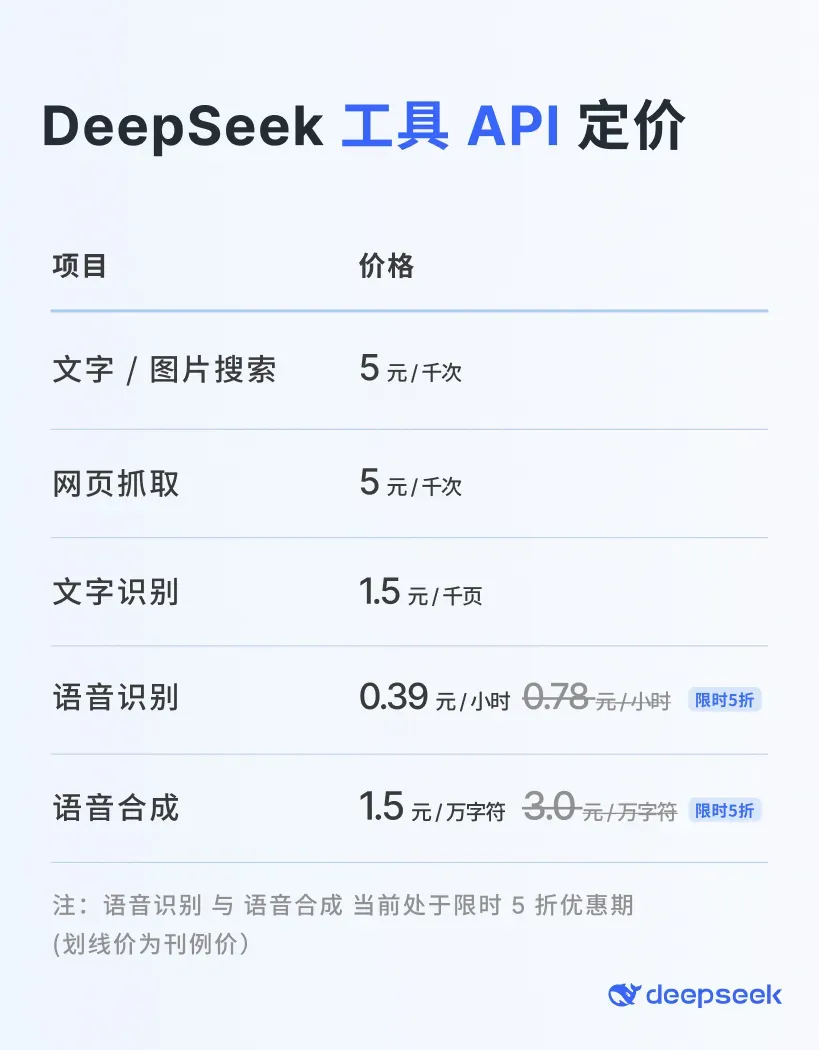
"I calculated it based on the official price list: writing an article with material retrieval costs less than 0.4 yuan," summarized Zhihu user Yaochen Ray. "The money for the API is already cheap enough to ignore. What's expensive is three things: the engineering to control the number of invocations, compliance, and your own judgment. The third is the most expensive."
Users who use the free voice chat in the DeepSeek App say the text-to-speech effect "is actually a bit weak." If the commercial API delivers the same effect, "then this price isn't worth it—better to use Volcano Engine with Doubao."
Some users also believe that "the pricing for speech recognition and speech synthesis feels a bit abstract, though it isn't expensive. It should just be there to cover users, considering those who can't conveniently deploy their own speech recognition and speech synthesis services. As for text recognition, overall it may not necessarily be cheaper than Baidu. Baidu's is more expensive at 2.5 yuan per thousand pages, but it has a free quota of 1,000/2,000 calls."
In fact, there are already many forerunners on this path. OpenAI, Anthropic, and Google are all integrating models, search, file processing, and tool execution through their respective APIs. DeepSeek's move to fill in application-layer capabilities this time also extends competition among model vendors into the toolchain that developers previously maintained themselves.
Some users also compared the prices of the three: DeepSeek's web search costs 5 yuan per thousand calls. By comparison, similar tools from OpenAI and Anthropic both cost 10 USD per thousand calls.
From Calling a Model to Calling a Complete Application: What Can Developers Save?
In the traditional model, developers declare available tools to the model in a request. When the model believes it needs to query external information, it returns the tool name and parameters. The application executes search, database queries, or other operations based on these parameters, then passes the results back to the model. The model can choose tools, but how tools are executed, when to retry, and what data is returned are mainly the application's responsibility.
As task complexity increases, this process also becomes cumbersome. For example, an Agent that requires multiple searches may generate several tool calls in a single round of conversation. Each call involves data passing, result organization, and context updates. Developers also need to handle parameter formats across different tools, invocation failures, and cases where the model misuses tools.
The server-side tools provided by DeepSeek this time change part of this process.
According to the official development documentation, developers can declare two tools, deepseek_web_search and deepseek_read_url, in existing API requests. The former handles web search, and the latter handles reading links provided by users.
When non-thinking mode is enabled, the model can automatically search web pages or images based on user questions and generate answers with source citations. When thinking mode is enabled, the model can also search multiple times, open web pages, and look up page content during the reasoning process. DeepSeek says that with thinking mode enabled, the model can execute up to about 20 tool calls, including web search, opening web pages, and in-page lookup, enabling the model to continuously retrieve and verify information during multi-step reasoning.
Compared with developers organizing the search process themselves, the new interface integrates search decisions, tool execution, and result processing into the server side. The client no longer needs to separately send requests to the search and scraping interfaces.
The returned results still retain tool call records, search results, and citation information. Developers need to correctly display this content in the interface and, in subsequent conversations, pass the relevant content blocks back according to the protocol, but they do not need to execute the server-side search tools provided by DeepSeek themselves.
This change is especially suitable for applications requiring web-based Q&A, news retrieval, and material lookup. Developers can directly use the officially maintained search pipeline and focus more energy on business features and user experience.
File processing follows a similar approach. The new API allows developers to upload PDFs, Word documents, PowerPoint presentations, and images to the DeepSeek Files API. After parsing is complete, a file ID is returned, which can then be added to the conversation. Developers can choose plain text recognition or mixed text-and-image recognition.
The latter can extract images, charts, and diagrams from documents and provide them to the model together with the text in their original positions. This means developers can let the model read some complex materials containing both text and images without separately integrating OCR and basic document layout parsing services.
However, file parsing still requires two steps: upload and reference. The official documentation also clearly states that mixed text-and-image recognition cannot guarantee the extraction of all charts, and parsed images will still consume model input tokens.
DeepSeek has also opened standalone Search, Fetch, OCR, ASR, and TTS interfaces. Developers can either use server-side automatic orchestration or integrate standalone tools into their own workflows.
In fact, DeepSeek opened the Search and Fetch APIs of its self-developed search engine as early as October 17. The main increment in this release is further integrating these underlying tools into model conversations, letting the server side take on part of the work previously handled by applications.
To demonstrate this change, DeepSeek has also open-sourced the chat-demo project on GitHub. The project provides streaming conversation, search, file input, voice interaction, history import, and multiple message rendering features. Developers can run it after configuring an API Key, and the static version does not even require a separate application backend.
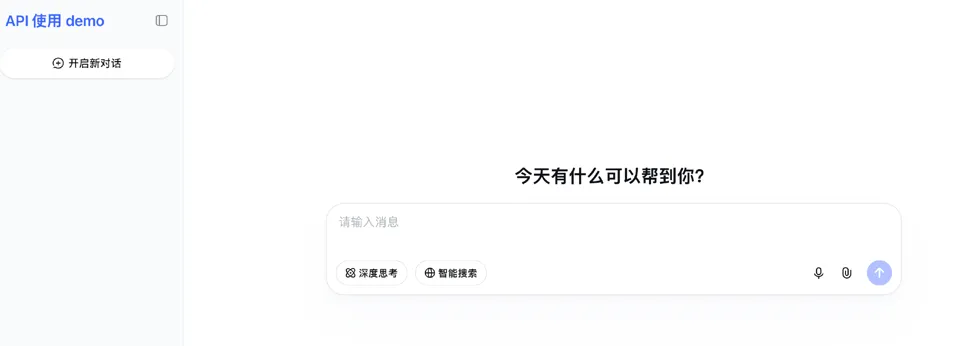
Demo experience entry: https://cdn.deepseek.com/chat-demo
Example code entry: https://github.com/deepseek-ai/chat-demo
OpenAI and Anthropic Have Already Entered
As AI applications evolve from simple conversations into multi-step tasks, model vendors have gradually realized that providing only text generation interfaces is insufficient to support a complete product experience. Search, data retrieval, code execution, file processing, and tool orchestration have begun to become important components of API platforms.
OpenAI already provides hosted web search and file search tools through the Responses API. Among them, file search allows the model to retrieve uploaded files. After developers create a vector store and upload materials, OpenAI handles the execution of the retrieval tool, eliminating the need to implement vector indexing and semantic search logic themselves.
It should be noted that OpenAI's file search leans toward knowledge base RAG, while the file functionality DeepSeek is opening up this time mainly involves uploading and parsing documents, then adding the document content to the model context. The two cover some similar development needs, but their underlying processing flows and applicable scenarios are not entirely the same.
Anthropic also provides server-side web search and web fetch tools in the Claude Messages API.
In this mode, Claude can directly execute searches and read web pages, and developers do not need to build a complete execution environment themselves. Anthropic also provides controls such as search count limits, domain filtering, and result citations. Its newer tool versions further introduce dynamic filtering, allowing Claude to use code to filter relevant information before search results or web page content enter the model context, thereby reducing token consumption caused by irrelevant content.
Google, meanwhile, provides tools such as Google Search Grounding, URL Context, and File Search through the Gemini API. Built-in search and web page reading can be completed within a single model API call, with Google running the tools and passing the results to the model.
The implementation approaches of these vendors differ, but the direction is fairly clear: some capabilities originally scattered across application frameworks, retrieval tools, and third-party services are being integrated into the API systems provided by model vendors.
For developers, this change lowers the barrier to use. A feature that originally required integrating multiple external tools may now have a basic version completed by enabling a few parameters.
For model vendors, the scope of competition has also expanded accordingly. When developers choose a model API, they no longer consider only model quality, inference speed, and token price, but also search results, document processing, tool execution stability, development convenience, and how much work the server side can handle.
DeepSeek also has a noteworthy design: the newly added features support three interfaces at the same time—Messages, Responses, and Chat Completions—including Anthropic- and OpenAI-style protocols.
This gives developers who already use the corresponding API protocols an opportunity to reuse existing clients or part of their call structures, reducing migration costs. However, protocol compatibility does not mean that all model capabilities, parameters, and tools can be directly replaced; the specifics still depend on each vendor's implementation.
DeepSeek currently explicitly supports these application-layer features with the V4.1-Flash model. If developers want to use its hosted search and document processing capabilities, they need to consider whether the corresponding model meets their business needs.
Less Code Written, but Also Part of Control Handed Over
After tool orchestration is moved to the model vendor's server side, a question arises: to what extent can developers still control the model's execution process?
DeepSeek's new interface provides a concrete example. According to the official documentation, when developers enable the hosted web search or web page reading tools, they cannot use tool_choice to force the model to execute one of the tools, otherwise a 400 error will be returned. Whether to initiate a search and whether to read a link are determined by the model itself.
In addition, DeepSeek has not yet opened control parameters such as domain whitelists and blacklists for hosted search. If an application needs to limit search sources, developers still need to implement it through independent Search and Fetch interfaces or a self-built toolchain. DeepSeek has also set restrictions on some API parameters. When developers declare hosted web tools, enable advanced security checks, or enable session titles, some generation and tool control parameters will be determined by the server side, and will not take effect even if passed in by developers.
This may be convenient for ordinary chat applications, but for business processes that require mandatory retrieval, it means developers cannot simply rely on the original tool selection parameters to guarantee execution.
More noteworthy is parameter control. DeepSeek's documentation shows that after enabling some hosted tools or security features, certain request parameters will be determined by the server side and will be ignored even if passed in by developers. For applications that rely on fixed configurations for model evaluation, repeatedly execute tasks, or need to precisely limit external tool calls, this is a change that needs to be considered in advance.
In the Messages API, these parameters include temperature, top_p, top_k, and some thinking control parameters;
in the Responses API, they include max_tool_calls, parallel_tool_calls, and others;
in the Chat Completions API, they involve seed, temperature, top_p, and others.
By comparison, some hosted tools from OpenAI and Anthropic provide control capabilities such as domain restrictions and call counts. This difference reflects different trade-offs in the design of model service platforms: the more complete the encapsulation, the fewer details developers usually need to handle; but if they want to decide search strategies, tool execution order, and exception handling themselves, they may still need to retain their own orchestration layer.
DeepSeek offers standalone Search and Fetch APIs, providing another option for this kind of requirement. Developers can bypass hosted search and directly control query terms, the number of returned results, and web page fetching, then decide for themselves how to pass the results to the model.
Therefore, for simple Q&A, prototyping, and standardized assistants, server-side hosting offers clear convenience; for products that emphasize data provenance, execution auditability, and complex business rules, a self-built toolchain still has value.
Reference links:
https://mp.weixin.qq.com/s/78KBHc4-4N5b2vfL9SkutQ?scene=1
https://api-docs.deepseek.com/zh-cn/
https://developers.openai.com/api/docs/guides/tools-file-search
https://aistudio.google.com/docs/tools?hl=zh-CN
https://platform.claude.com/docs/en/agents-and-tools/tool-use/web-search-tool