UIUC Paper Introduces ClaimNov to Fix AI Novelty Check Errors
A University of Illinois study reveals that current AI scientist pipelines frequently misjudge the novelty of research ideas, rejecting valid proposals later published by humans. The team introduced ClaimNov, a framework that decomposes proposals into individual claims and matches them against prior literature. This approach reduced false rejections from 96% to 1.5% while maintaining high plagiarism detection rates, offering critical insights for optimizing autonomous research agents.
Full Report
Rohan Paul (@rohanpaul_ai) · 2026-10-31 20
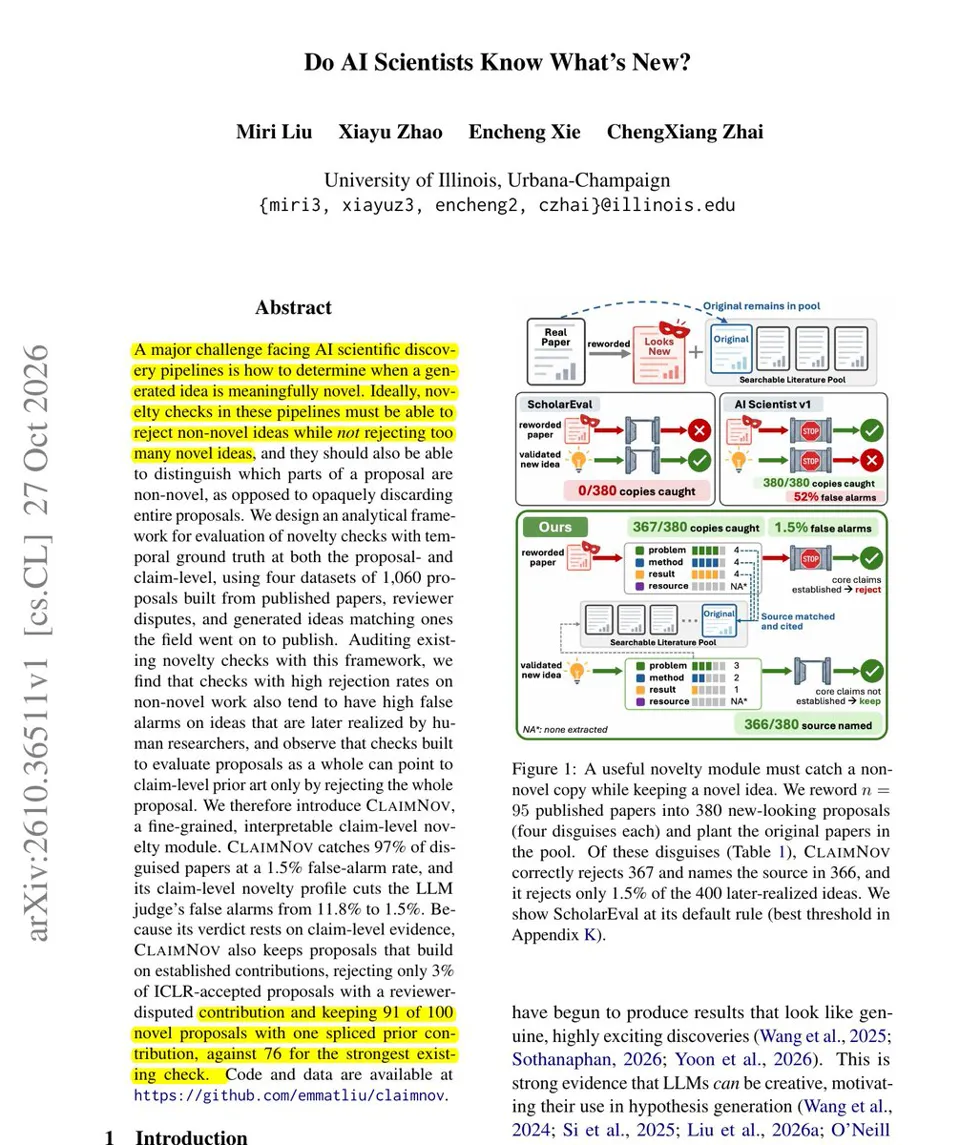
New University of Illinois paper finds that when AI decides if a research idea is new enough to work on, it often says no to ideas that human scientists later publish.
AI scientist pipelines run a novelty check to decide which generated ideas get compute. These checks judge a whole proposal at once, though most real papers build on some earlier contributions.
They built ClaimNov, which splits a proposal into a few claims, matches each against claims from prior papers, and gives a judge the claim-by-claim evidence.
A deployed check caught all 380 disguised copies but also rejected 96% of ideas researchers later published. ClaimNov caught 97% of copies while rejecting only 1.5% of those ideas.
If your pipeline filters ideas for novelty, score claims separately and keep proposals that build on 1 known result instead of discarding them.