X-Era AI Open-Sources E0.5 World Action Model, Outperforming pi-0.5 on Real Robots
X-Era AI has released and open-sourced E0.5, a native 4D world action model that unifies future physical geometric state prediction with action generation to enhance robotic spatial understanding. In real-world tests on AgileX Piper dual-arm and Zerith H1 humanoid robots, E0.5 achieved average success rates of 85.0% and 88.3%, surpassing the baseline pi-0.5 by 13.3 and 26.7 percentage points respectively. The model addresses complex tasks like manipulating deformable objects, advancing robotics from visual perception to physical reasoning and autonomous execution.
Full Report
Contents4 sections
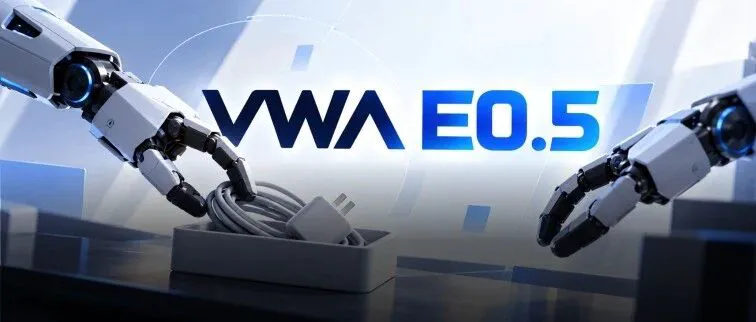
Using 4D spatiotemporal representation as the native architectural backbone, it unifies future physical geometric state prediction and action generation into a single model. This advances robotics from merely "understanding the world" to "deducing physical laws and directly generating executable actions."

Published by Synced (Machine Heart)
A charger and a tangled cable.
For humans, stuffing them into a storage box takes two seconds. For robots, this is a nearly unsolvable problem: the charger is a rigid body while the cable is a flexible one, meaning their motion dynamics differ significantly. Moreover, placement angles and the twisted shapes of cables rarely repeat in training datasets.
The difficulty of such tasks lies not in the actions themselves—grasping, translating, and lowering are individually simple operations. The challenge resides in the robot's understanding and judgment of the task: How much cable remains exposed? Will the second grasp press against parts already inside? Will the container edge obstruct the wrist? These judgments rely entirely on an accurate understanding of the current spatial state and a predictive assessment of how the space will change after each action.
The same object, viewed from a different angle, placed in a new location, or accompanied by an unrelated item, presents a completely new input distribution to the model. This explains why success rates on real-world robots are often significantly lower than those in laboratory settings.
X-Era AI has entrusted this difficult problem to its World Action Model, E0.5.
E0.5, pre-trained on robotic data for the AgileX Piper dual-arm robot and the Zerith H1 humanoid robot, achieved overall average success rates of 85.0% and 88.3%, respectively. This represents improvements of 13.3 and 26.7 percentage points over π0.5. In direct competition with strong mainstream baseline models, E0.5 demonstrates a clear advantage.
- Paper URL: https://arxiv.org/pdf/2610.36011
- Open Source Code: https://github.com/X-EraAI/e05
Most world models have yet to reach robotic arms
Over the past two years, world models have been viewed as a key pathway toward Physical AI. Four major approaches exist, each facing distinct bottlenecks.
One approach relies on game engines and artificial physics rules to generate simulation data. There is a natural gap between simulated environments and real-world dynamics; the complexity of reality cannot be exhaustively enumerated.
Another learns visual dynamics from massive video datasets. While image fidelity can be high, physical consistency, geometric consistency, and long-term temporal memory stability remain insufficient. More critically, image generation alone cannot close the loop for robotic control.
A third performs state prediction in abstract latent spaces. This saves computational resources, but the effectiveness of abstract representations is hard to evaluate, and the path to engineering deployment remains unclear.
The fourth jointly models world states and actions, focusing on "what physical consequences arise after action execution," directly targeting interaction and modification in the real physical world.
X-Era AI’s design philosophy decouples spatial modeling from physical modeling to enhance the model’s ability to learn and represent physical laws. Spatial modeling handles geometry, while physical modeling handles dynamic evolution. Each has clear supervision signals, allowing the model to better represent continuous changes such as contact, friction, and deformation. During cross-scenario transfer, it becomes easier to separate "laws" from "scenarios."
The reason for choosing this path is straightforward—the ultimate destination of world models is industrial implementation, requiring a complete pipeline from simulation to real-world robotic operation. And when it comes to implementation, visuals don't matter; only physics does.
Long-horizon manipulation tests out-of-distribution transfer capabilities
Performance in simulation environments serves only as a validation ground for architecture and loss functions; it cannot be directly equated with deployment capability. It is not uncommon for foundation models that score highly on simulation tasks to violate physical common sense or perform unsafe actions when deployed on real robots. Digital worlds lack disturbances such as friction, deformation, noise, lighting variations, and mechanical errors, whereas real robots must maintain stability amidst these perturbations.
Building upon existing 3D foundation models, E0.5 further conducts embodied pre-training using over 160,000 real-world robot trajectories. On the AgileX Piper dual-arm robot and the Zerith H1 humanoid robot, E0.5 achieved average success rates of 96.7% and 100.0% on in-distribution tasks, respectively. Considering both in-distribution and out-of-distribution settings, the overall average success rates were 85.0% and 88.3%, representing improvements of 13.3 and 26.7 percentage points over π0.5.
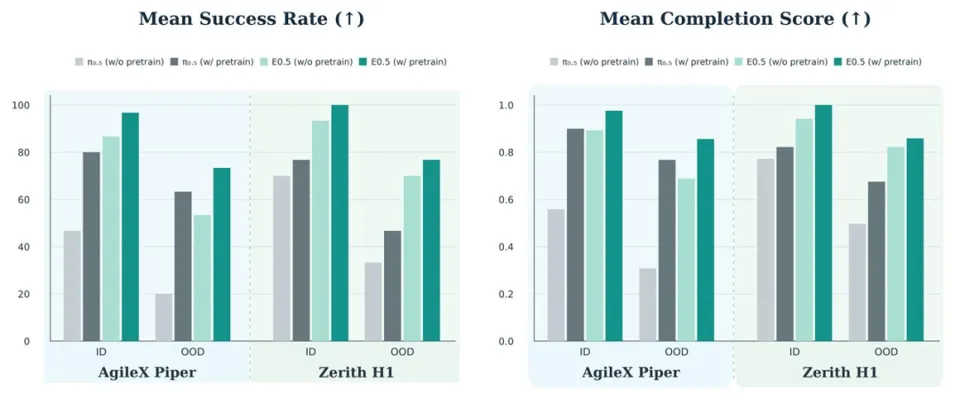
Performance on real robots perfectly illustrates the value of this "future geometric supervision" under real-world disturbances.
Real-world evaluations covered the AgileX Piper dual-arm system and the Zerith H1 humanoid robot. Tasks included mouse homing, charger organization (stowing the rigid charger body and the entire flexible cable into a storage unit), and trash cleanup. Each task was divided into EASY and HARD levels. The HARD level introduced mouse poses outside the training distribution, unfamiliar chargers and cables, and larger trash sets containing unseen objects. Each policy underwent a cumulative total of 120 trials across the two platforms, resulting in 480 total experiments.
Core Results (Task post-training without large-scale robot data pre-training, compared to π0.5):
- Piper achieved an average in-distribution success rate of 86.7%, and H1 reached 93.3%. Compared to π0.5 (46.7% and 70.0%) which also lacked embodied pre-training, these represent improvements of 40.0 and 23.3 percentage points, respectively.
- Charger organization improved by 20 and 40 percentage points on the two platforms, respectively—Piper increased from 50% to 70%, and H1 from 40% to 80%. Tasks requiring the complete stowage of rigid and flexible components rely most heavily on geometric understanding of action consequences, which is precisely where E0.5’s alignment strategy excels.
- Piper’s trash cleanup success rate increased from 40% to 100%, achieving full success across all trials in in-distribution scenarios.
- On H1, with the same budget of 600 demonstration episodes and 5 epochs of post-training, E0.5 improved the overall average success rate from 51.7% to 81.7%. Specifically, in-distribution (ID) performance improved by 23.3 percentage points, and out-of-distribution (OOD) performance by 36.7 percentage points. This indicates that pre-trained 3D geometric knowledge effectively transfers to robotic control, delivering significant operational performance gains even without additional large-scale embodied data pre-training.
Core Results (Task post-training after large-scale embodied data pre-training, compared to π0.5):
- Piper achieved an average success rate of 96.7% in the in-distribution (ID) setting and 100.0% on H1, representing improvements of 16.7 and 23.3 percentage points, respectively, over π0.5 after embodied pre-training (80.0% and 76.7%). Notably, H1 achieved a 100% success rate across three tasks: mouse homing, charger storage, and trash cleanup.
- Facing unseen objects and novel spatial configurations, Piper and H1 achieved average out-of-distribution (OOD) success rates of 73.3% and 76.7%, respectively. These results represent improvements of 10.0 and 30.0 percentage points over π0.5 (63.3% and 46.7%), demonstrating strong OOD generalization capabilities.
- Performance was particularly outstanding in complex manipulation tasks: In the OOD charger storage task, Piper’s success rate increased from 40% to 80%, while H1’s rose from 30% to 50%. In H1’s OOD multi-object trash cleanup task, the success rate surged from 20% to 80%, a 60-percentage-point improvement.
- Large-scale embodied pre-training further unlocks the manipulation capabilities of 3D foundation models: After pre-training on approximately 160,000 robot trajectories from AgiBotWorld-Beta, E0.5 improved its overall average success rate across both ID and OOD settings on Piper from 70.0% to 85.0%, and on H1 from 81.7% to 88.3%, representing gains of 15.0 and 6.7 percentage points, respectively. This indicates that future geometric prediction can be effectively combined with large-scale robot interaction data to continuously enhance model manipulation capabilities in real-world physical environments.
Building Native World Action Models with 3D Geometry as the Backbone
E0.5 integrates 3D scene understanding, geometric state prediction, physical constraints, action generation, and robot body control into a unified learning framework.
Its focus is not merely on whether a robot can see objects, but on whether it can build an internal model of "how objects change," translating this dynamic understanding into continuous, stable, and correctable physical actions.
01: Natively Integrating Future 3D Geometric Prediction into the Action Learning Framework
Traditional Vision-Language-Action (VLA) models typically rely on vision-language foundation models as their core, generating action sequences based on visual observations, language instructions, and robot states. While this approach leverages knowledge from large-scale vision-language pre-training, its primary training objective remains action prediction, lacking explicit modeling of world state changes following action execution. Robots may learn how to grasp and place objects in specific scenarios, but they do not necessarily fully understand how these operations alter spatial relationships between objects.
The emergence of World Action Models (WAMs) extends action learning to include future world state prediction. By jointly modeling robot actions and future environmental changes, models learn not only "what to do" but also "what happens after doing it." However, current mainstream WAMs are primarily built upon video foundation models. Video-prediction-based WAMs learn environment dynamics by generating future visual frames, where prediction targets include both spatial structural changes and appearance information such as texture and lighting. Although some methods incorporate 3D information like depth or point clouds, they typically treat these as auxiliary features or supervision signals, with the model's core computation still relying on video backbones.
A key innovation of E0.5 is elevating the 3D foundation model from an auxiliary perception module to the native backbone of the world action model, directly integrating future 3D geometric prediction into action learning.
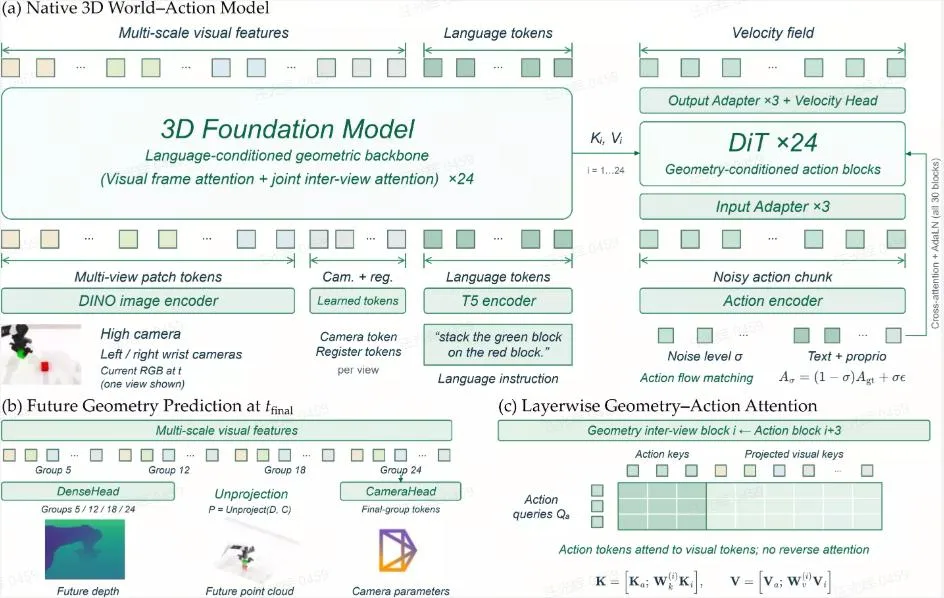
First, regarding model architecture, E0.5 uses the 3D foundation model as its core. Through language-conditioned geometric representations and layer-wise geometry-action interactions, it tightly couples spatial understanding with robot action generation. 3D geometry is no longer just additional information appended to VLAs or video models; it serves as the foundational representation supporting the entire world action model.
Second, regarding prediction targets, E0.5 moves beyond reconstructing the current scene or relying on future video frames as the primary prediction target. Instead, it jointly learns action sequences and the corresponding future 3D states at their endpoints. While learning operations such as grasping, moving, and placing, the model predicts the depth, 3D spatial structure, and camera parameters after the action is completed. This evolves the 3D foundation model from static spatial reconstruction to dynamic spatial prediction.
More importantly, future geometric prediction directly supervises the trainable 3D backbone, embedding knowledge of spatial changes into the foundational representations relied upon for action generation. During actual execution, the model can output action sequences based on current observations and task instructions without needing to generate additional future videos or 3D scenes.
Ablation studies validate the effectiveness of this design: Under identical training budgets, predicting future 3D states rather than merely reconstructing current geometric states improved the average task success rate on RoboTwin 2.0 by nearly 10 percentage points.
02: Geometry-Driven Generalization Maintaining Manipulation Logic Amid Object, Pose, and Layout Shifts
The most challenging aspect of deploying embodied AI has never been standardized items in the training set, but distribution shifts: the same charger placed at a different angle, cables twisted into unfamiliar shapes, or combinations of clutter never seen before. Many models perform stably on standard samples, but once object appearances or poses deviate from the training distribution, the entire manipulation logic tends to fail.
E0.5’s solution relies on transfer via geometric representations. It does not learn that "a specific image of a charger corresponds to a specific grasping script"; instead, it learns the spatial relationships and interaction laws between rigid objects, flexible cables, and containers. In real-world validation, the test group deliberately selected items completely unseen during training and unconventional placement poses to verify whether the model could transfer its learned manipulation logic. This generalization is not based on visual similarity matching, but on the reuse of relationships within physical space.
In three real-world tasks on the Zerith H1, E0.5—after robot data pre-training and subsequent fine-tuning on corresponding data—achieved an average OOD success rate of 76.7%, a 30.0 percentage point improvement over π0.5’s 46.7%. This result further demonstrates the model’s manipulation generalization capability under variations in tested objects, poses, and quantities.
03: Long-Horizon Task Closed Loops Ensuring Every Action Segment Serves the Final Goal
Single-point grasping tasks have simple constraints and direct feedback, making them relatively easy to implement. However, many real-world robot tasks consist of chained multi-step actions. Tasks such as clearing cluttered debris or sorting and storing multiple items require robots to cyclically execute grasping, transferring, and dropping until the task termination condition is met. In long-horizon chains, errors propagate and amplify continuously; a single misplacement can alter subsequent occlusion relationships and available drop spaces, causing all following steps to deviate from expectations. If demonstration action sequences are simply concatenated, the robot will mechanically complete a fixed number of steps without the ability to judge whether the task is finished or if the state has deviated from expectations.
E0.5 extends the core philosophy of future geometry by binding each action segment to its expected 3D state post-execution, establishing a series of verifiable spatial sub-goals for the entire task chain. Rather than blindly generating continuous actions, the model is guided by the final task objective, continuously comparing the deviation between the currently observed scene state and the predicted future geometric state.
Through this spatial verification loop, the model can autonomously perceive progress in multi-step tasks, determining whether intermediate goals have been achieved or if further operations are required. This avoids rigid execution of fixed-length action sequences, providing fault tolerance for complex, continuous operations.
Real-Time Closed-Loop on the Edge for Industry
In the field of Physical AI, there appears to be a straightforward path: scaling up model parameters to let the cognitive capabilities of general-purpose foundation models "overflow" directly into robot control.
However, industrial constraints inevitably arise. Training large models is costly; not all teams or scenarios have the computational resources to continuously iterate on robot-specific data. Robot edge devices and controllers face hard ceilings on inference latency and memory usage. Once inference latency increases, the closed-loop control becomes sluggish, directly disrupting the robot's dynamic interaction with its environment.
In systems requiring reactions within 10 milliseconds, a model's "intelligence" must be built upon being "timely." This is not an issue that can be bypassed through engineering optimization alone. Impedance control for robotic arms and balance maintenance for humanoid robots require completing the perception–decision–execution cycle at the millisecond level. No matter how powerful the model, if inference latency exceeds this window, outputs will lag behind the robot's physical state, causing actions to jitter or overshoot, potentially leading to instability. Therefore, the size of the model that can run on the edge fundamentally determines the level of control achievable.
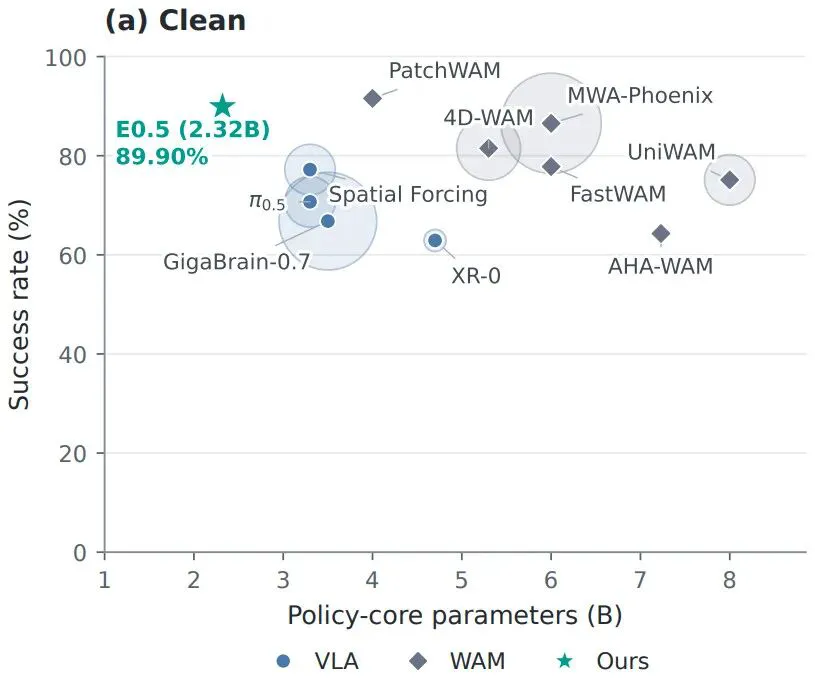
E0.5 chooses to focus on architectural priors, 3D geometric supervision, and joint modeling of actions and states. A well-designed architecture and model imply lower training barriers, allowing small teams and niche scenarios to iterate on data based on this foundation. It also enables faster inference, better adaptation to robot edge deployment, and easier scenario fine-tuning and online incremental learning.
Conclusion
Over the past year, the narrative focus of Physical AI has shifted from "can we build it?" to "can we use it?" The former competes on the upper limits of model capability, while the latter competes on engineering metrics such as cost, latency, and maintainability. Whoever first translates physical common sense into computable constraints, and whoever first thoroughly understands "how the world changes after an action is executed," will be able to ensure this intelligent system stably completes full physical interaction workflows on real-world robots.
In X-Era AI (Tuoyuan Intelligence)'s technical architecture, VWA and PhyAgentOS (the Physical Agent Operating System) form a dual-layer foundation of Model + System. The World Action Model handles environmental perception, physical reasoning, and action sequence generation; PhyAgentOS manages solution verification, exception recovery, and task experience accumulation. Verified real-scenario data continuously flows back, driving model iteration and upgrades. This system has already been validated in scenarios including smart retail, warehousing and logistics, industrial manufacturing, and human-centric services.
This architecture also redefines the logic of industrial implementation, moving beyond the traditional demo-driven path. Past robotic solutions relied heavily on on-site debugging by engineers, using hard-coded branch logic and task flows, resulting in long adaptation cycles, high costs, and difficulty covering numerous long-tail scenarios. Under the Model + System paradigm, humans only need to define task objectives and perform review checks, while the system autonomously reasons about spatial plans and optimizes action strategies.
© THE END
Please contact this official account for authorization before reprinting.
For submissions or media inquiries: [email protected]