Stardust Intelligence Unveils CoMind Multi-Robot Collaboration Framework
Shenzhen embodied-AI firm Stardust Intelligence released CoMind, a decentralized multi-robot collaboration framework in which robots proactively exchange only task-critical information instead of full camera feeds. In real-robot tests, success on a wall-separated pen task rose from 0% to 100%, blind-box placement accuracy climbed from 38.9% to 88.9%, while communication volume dropped 80%.
Full Report
Contents4 sections
80% Less Information Transmitted, Yet Accuracy Improves
Jessica, from ROBO-Zhi QuantumBit ROBO | WeChat Official Account AI4ROBO
What do robots fear most when working as a team?
A lack of coordination.
Even two people need eye contact to fold a quilt or move a table together, let alone several robots working in the same space:
One grabs a corner of the table just as the other is about to lift it; one has its view blocked and has no idea how far its teammate has progressed... Robot collaboration is usually even more maddening.
What makes it trickier still is communication between robots.
Let a central system coordinate everything? Fine-grained motion coordination tends to lag. Send every camera frame to teammates? That produces massive redundant data and adds communication and processing overhead.
To address this, Shenzhen embodied intelligence company Astribot has just released a multi-robot collaboration framework called CoMind (Be My Eye).
The company previously drew attention for its rope-driven robots and self-developed embodied intelligence models; this time it has focused its research on multiple robots, enabling them to proactively exchange task-critical information and make action decisions independently for tighter collaboration.

Take a direct look at the extreme-test data:
Two robots, separated by a barrier and completely unable to see each other, can cooperate to pick up a pen by sharing key information—task success rate jumping from 0% to 100%.
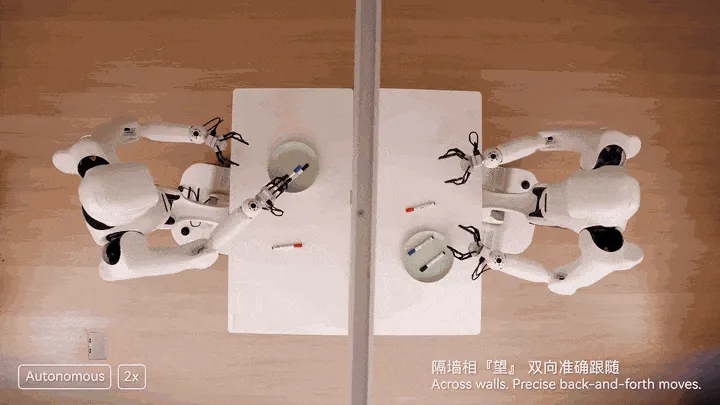
A robot with its view blocked borrows its teammate's eyes to find a box and place an object, with accuracy climbing from 38.9% by blind guessing to 88.9%. Crucially, the information transmission volume was cut by 80% over the whole process.
Less information transmitted—so how did the robots end up collaborating better?!
Borrowing Eyes Through a Wall: A New Way for Robots to Work as a Team
CoMind, just launched by Astribot, is a model framework for multi-robot collaborative manipulation, with the core goal of letting robots proactively exchange task-useful information while making decisions independently.
Astribot summarizes the framework's core capabilities in two points: decentralized proactive sharing, and the selection and compression of task-critical information.
The former lets each robot proactively offer information to teammates and independently generate actions based on the context it receives, reducing reliance on a unified central controller.
The latter changes how information is exchanged. Robots need not transmit full camera frames; instead, they extract key visual features and manipulation states according to task needs, helping teammates judge the next action.
Put simply, robots can make their own decisions and also know what to tell their teammates.

Astribot demonstrated six real-robot tests for this, including picking up a pen through a wall, placing objects in a blind box, cardboard box assembly, quilt folding and storage, refrigerator restocking, and dumbbell assembly (real-robot videos can be found at the link at the end of this article).
The six experiments cover different types of collaboration challenges, such as visual occlusion, deformable-object manipulation, and precision assembly.
Take two robots assembling a cardboard box together as an example.
A seemingly simple task actually requires both parties to jointly open and flip the box and continuously adjust their grasp positions. Flipping the box also blocks the view, preventing the robots from directly observing their teammate's operations.
With CoMind, the two robots can exchange manipulation states and task progress, continuing the assembly even when their view is obstructed.
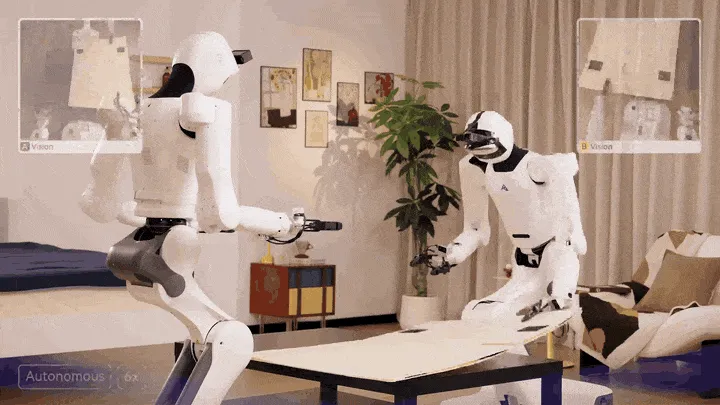
Quilt folding is even more complex. A quilt is soft and easily deformed; as the robots lift, fold, and move it, its shape, edges, and force states keep changing.
For two robots to complete the task together, both must control their own motions and adjust in real time based on their teammate's operations.
In the demo, the two robots successively completed lifting, folding, and storing operations without a human issuing step-by-step commands.
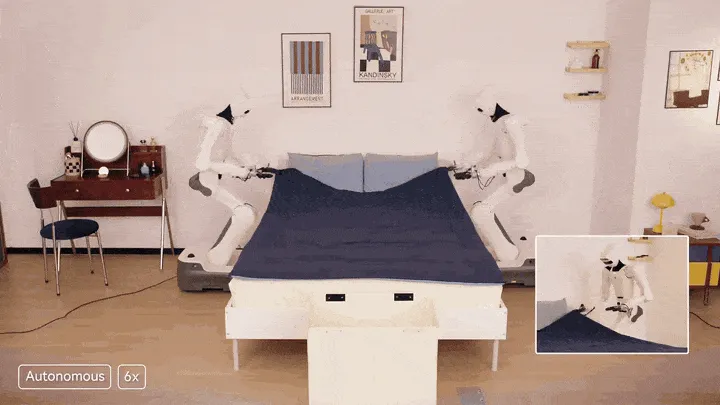
There is also dumbbell assembly. One robot is responsible for sliding a weight plate onto the bar, but limited by its own viewpoint, it struggles to see the relative position of the bar and the hole at the same time.
The other robot provides key spatial information from a different viewpoint, helping its teammate dynamically adjust its motion to complete alignment and assembly.
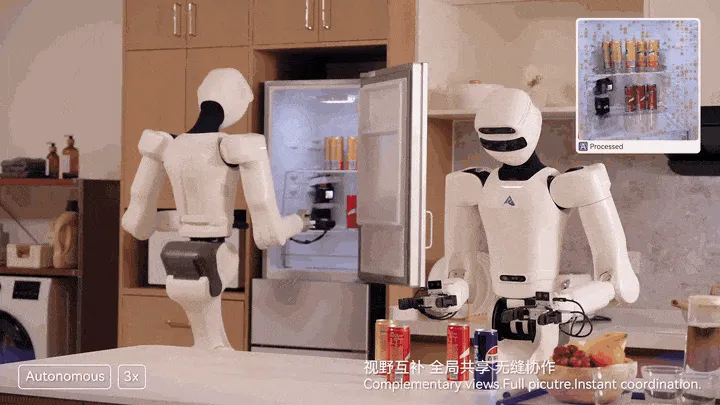
Then look at this refrigerator restocking, which demonstrates information complementarity across different locations.
One robot notices the refrigerator is short on drinks, while the other can see the drinks on the island counter. The two exchange visual information and then cooperate to complete the handover and restocking.
Behind these experiments are actually two different collaboration capabilities.
One is perceptual complementarity, letting a robot use a teammate's viewpoint to obtain information it cannot observe itself; the other is motion coordination, letting a robot use its teammate's state and progress to adjust its own behavior during continuous manipulation.
The latter is especially important. Just because two robots individually have the abilities to carry, grasp, and fold does not mean that combining them will complete a task smoothly.
When carrying an object together, one party's motion directly affects the other's operating conditions; when assembling complex parts, both parties must continuously adjust their poses based on the object's state.
Single-robot manipulation can achieve independent decision-making, but collaborative tasks require robots to continuously understand each other's actions.
Getting robots to each do their own job well is only the first step; letting them know what their teammate needs at this moment is the key to collaboration.
More Important Than Sharing a View Is Learning to "Say What Matters"
CoMind's two core capabilities correspond to two real-world challenges in multi-robot collaboration: how to coordinate decisions, and how to exchange information efficiently.
In traditional multi-robot collaboration, one common approach is centralized scheduling, where a unified control system assigns tasks, plans actions, and then issues commands to each robot.
This approach suits clear task division, but for fine-grained operations that require frequent adjustment, centrally processing the perception and control information of multiple robots tends to bring extra computation and communication overhead.

Another category of approaches uses distributed decision-making, letting robots independently complete perception and motion control.
This approach reduces reliance on a central system, but each robot has limited information.
Once the target or a teammate is occluded, it may lose critical decision-making input. Even if robots are allowed to communicate with each other, the problem of information transfer still needs to be solved.
A robot may generate a large amount of visual data every second, but only a very small portion of it is actually related to a teammate's actions.
For example, when assembling a dumbbell, the robot responsible for inserting the weight plates needs to know the relative position between the bar and the holes. Surrounding furniture, walls, and other objects are not directly helpful for the current operation.
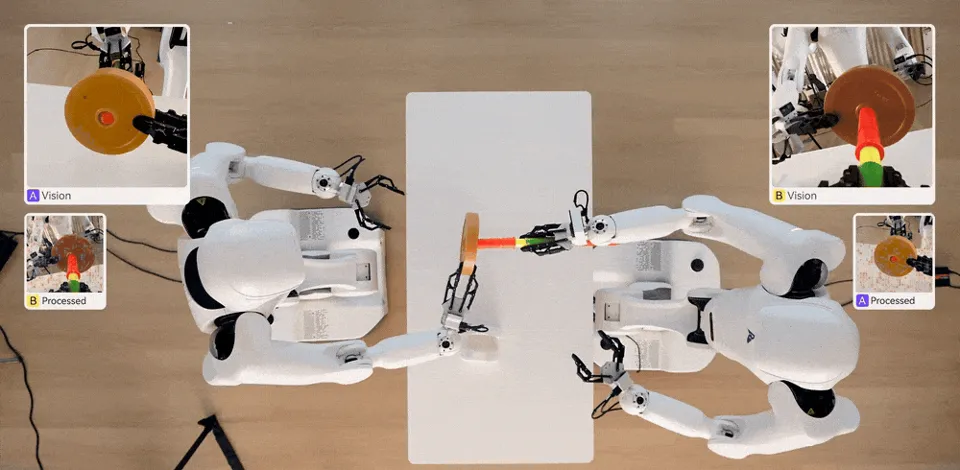
If the full video is sent to a teammate, it not only increases the communication burden but also requires the receiver to re-extract useful information from massive amounts of data.
CoMind's technical design is centered precisely on information extraction and collaborative decision-making. Specifically, it is divided into two stages:
The first stage is task-relevant context extraction.
Through a context encoder, CoMind filters and compresses key information from multi-camera observations, retaining visual features valuable for the current task and subsequent actions.
The model also learns to predict future visual changes and, combined with task progress, enables the robot to understand the stage of the operation.
The second stage is bidirectional sharing and collaborative action generation.
Both robots can independently extract and send key information, and can also receive context from teammates.
The receiver combines the shared information with its own visual observations, task instructions, and proprioceptive state, then feeds it into a vision-language-action model (VLA) to generate continuous actions.
Both parties possess the ability to send information and make action decisions, no longer relying on a single central controller to generate all operation commands.

The entire framework also has a key design: action-level backpropagation.
Simply put, it lets the teammate's action outcomes in turn determine what information one should provide.
Take the blind-box shelving experiment as an example. Robot A cannot see the target and needs Robot B to provide information.
If A ultimately reaches the wrong position, during training the action prediction error can be backpropagated to B's information encoder, helping the model adjust how it extracts key features.
After repeated training, B becomes more inclined to provide information that helps A complete the correct action.

As a result, a direct connection is established between information sharing and the final action. The goal of robot communication is no longer limited to accurately describing the surrounding environment; it also needs to serve the teammate's operational decision-making.
Experimental data also reflects this change. In the blind-box shelving task, the accuracy rate without information sharing was 38.9%; with another context transmission scheme, the accuracy rate reached 72.2%.
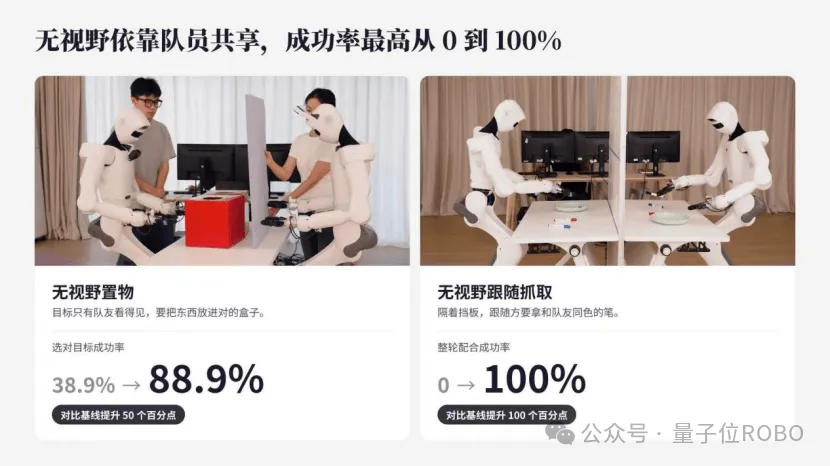
CoMind further raised the accuracy rate to 88.9% while reducing the amount of communication information by about 80%.
Giving robots more information does not necessarily lead to better collaboration. The relevance between information and the task is what truly determines the role it can play.
Collaborative intelligence is filling in the boundaries of single-machine intelligence
Multi-robot collaboration is now becoming an important research direction in the field of embodied intelligence.
As models such as VLA continue to evolve, robots' ability to understand environments, execute instructions, and complete complex operations continues to improve.
But a large amount of work in the real world inherently requires multiple executing agents to complete together.
For example, carrying large objects, assembling complex equipment, and handling continuous production processes all involve coordination between different positions and different actions. No matter how intelligent a single robot is, it is still limited by its own field of view, mechanical structure, and operational range.

△Image generated by AI
Therefore, more and more research teams are turning their attention to collaboration mechanisms among multiple robots.
For example, a Stanford University team proposed CHORUS in 2026, attempting to enable different robots to use the same VLA policy and achieve collaboration under their own independent perception conditions.
CHORUS does not require robots to communicate explicitly at runtime. Each robot independently generates actions based on its own visual observations and the shared policy, and coordination emerges by observing teammates' behavior.
The research demonstrated tasks such as jointly lifting a laundry basket and passing books.
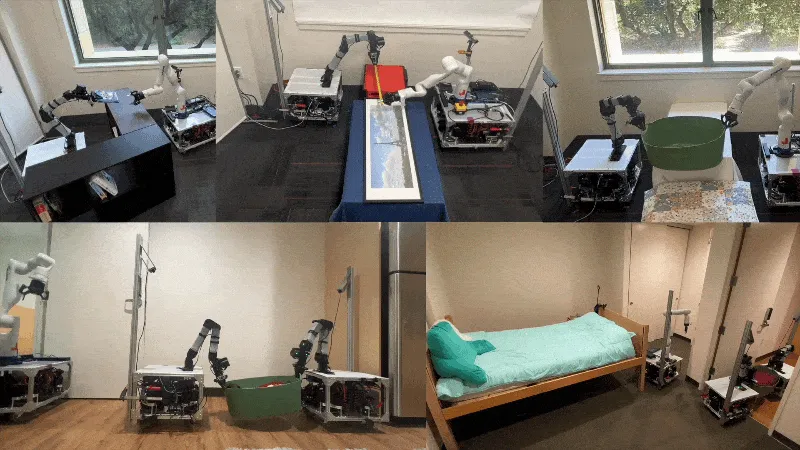
LatentToM, published in 2025, adopts another technical route.
Researchers have different robots learn shared latent representations to establish a common understanding of task states and teammate behavior, and support the exchange of compact representations through communication to achieve collaborative operation.
DuoMind, made public in October 2026, uses vision-language models for high-level task reasoning and semantic communication, with VLA models responsible for low-level action execution, exploring distributed collaboration among different robots.
The three studies demonstrate different approaches: forming tacit coordination through a shared policy, building consensus through latent representations, or organizing actions through semantic information.
What Stardust Intelligence's CoMind focuses on is another problem closer to the action level: how to make the information shared by robots directly improve teammates' action decisions.
It jointly optimizes task-relevant visual information extraction, bidirectional sharing, and action policies, establishing a connection between communication content and final operational outcomes.
This research direction is also related to Stardust Intelligence's previous technical accumulation.
Stardust Intelligence was founded at the end of 2022. Founder and CEO Lai Jie was formerly an architect at Tencent Robotics X Lab and an early core member of the lab. He previously also led R&D work related to Baidu's Xiaodu robot.

The company has chosen the relatively uncommon tendon-driven technical route and has successively launched robot products such as Astribot S1 and T1, building an integrated software-hardware technical system around AI models, an embodied operating system, and a tendon-driven body.
At the model level, Stardust Intelligence previously launched the Lumo series of embodied foundation models.
Lumo-2, released in July this year, already incorporated human-robot collaboration and multi-robot cooperation into its capability demonstrations. This time, CoMind pushes the research further into information exchange and action decision-making among robots.
Extending from single-robot operation to multi-robot collaboration, Stardust's technical roadmap also reflects the new challenges the entire industry is facing.

Whether in industrial assembly, warehouse logistics, or home services, robots can hardly always possess complete environmental information, nor can they handle all operations on their own.
Robots at different locations naturally hold different perspectives; different task stages also involve tight action dependencies. Whether this scattered information can flow effectively directly determines the efficiency of the entire system.
Thus, collaboration is no longer limited to task allocation, path planning, and action coordination. Robots also need to understand their teammates' information needs and adjust their own perception and communication behaviors accordingly. On real hardware, this capability directly determines task success or failure.
Collaboration is shifting from rules written by engineers to a capability that models acquire through training.
Humans organize limited individual capabilities through division of labor and collaboration, forming a complex social production system. Today, this principle has also been integrated into the logic of robots.