FCC Clears SpaceX to Launch One Million Space Data Center Satellites
The US Federal Communications Commission (FCC) has authorized SpaceX to deploy a constellation of one million satellites for space-based data centers. The European Southern Observatory (ESO) warns the project would profoundly affect astronomy and fundamentally alter the night sky for everyone, underscoring the urgent need for international mechanisms to assess activities with cross-border impact. ESO had previously published a peer-reviewed technical analysis quantifying the effects of large, bright satellite constellations on observations.
Related Entities
Full Report
Contents4 sections
On 25 November, the Federal Communications Commission (FCC), a US federal agency, announced that it has authorised SpaceX to deploy a constellation of one million satellites for data centres in space.
“As approved, this project would not only have profound consequences for astronomy, but also fundamentally alter the night sky for everyone on the planet. We demonstrated these impacts in an extensive technical analysis, and raised them in a response to the US FCC, as did other organisations worldwide. This approval highlights the urgent need for international mechanisms capable of assessing activities whose impacts extend far beyond national borders and affect a global common good,” said Andreas Kaufer, Director General at the European Southern Observatory (ESO).
A peer-reviewed technical analysis [1], led by ESO expert Olivier Hainaut and published earlier this year, quantified the impacts of launching large and bright satellite constellations into space on observations of the night sky. Planned constellations, including SpaceX’s data centres, would hinder humankind’s ability to observe faint cosmic targets, like far-away galaxies, some Earth-like planets around other stars, and even asteroids potentially dangerous to Earth.
While satellite companies, including SpaceX, are making their individual satellites less bright, the sheer number of satellites approved in these projects means that the total number of streaks in images will go beyond what can be mitigated. Beyond optical astronomy, one million satellites would generate radio noise, impacting radio astronomy, pollute the atmosphere from the multiple launches and satellite reentry, and crowd low-Earth orbit, risking major chain collisions.
ESO supports international governance frameworks that balance innovation in space with the protection of the night sky, scientific research, and the long-term sustainability of the space environment. As space activities expand rapidly, decisions with global consequences should be informed by scientific evidence and assessed through appropriate international mechanisms.
Notes
[1] Earlier this year, when the FCC invited public comment on the SpaceX and Reflect Orbital proposals, ESO submitted a response based on this technical study, outlining the threats to astronomy, in collaboration with the UK's Royal Astronomical Society and the International Astronomical Union.
Links
- AAS statement: https://aas.org/press/spacex-data-center-fcc-approval
Contacts
Olivier Hainaut (for technical questions on the impacts on observations) ESO Astronomer Garching bei München, Germany Cell: +49 151 2262 0554 Email: [email protected]
Beatrice Kioko (for legal questions) ESO Institutional Affairs Officer Garching bei München, Germany Cell: +4915155640771 Email: [email protected]
Bárbara Ferreira (to arrange interviews with ESO’s leadership; general press queries) ESO Media Manager Garching bei München, Germany Tel: +49 89 3200 6670 Cell: +49 151 241 664 00 Email: [email protected]
Connect with ESO on social media
Images
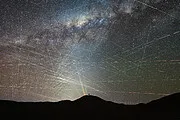 PR Image eso2614a One hour of satellites over the northern Atacama Desert in Chile (October 2025)
Send us your comments! Subscribe to receive news from ESO in your language Accelerated by CDN77 Terms & Conditions