Tencent WorkBuddy Hits $500M Annualized Revenue in Eight Months
Tencent President Martin Lau disclosed at the Q3 earnings call that WorkBuddy's trailing seven-day gross revenue annualizes to over $500 million, more than double that of Tencent Meeting after seven years, with Q3 revenue up over 5x quarter-over-quarter. The product has surpassed 10 million DAU and consumes over 100 trillion tokens daily, which Tencent cites as making it China's largest AI application by token usage. WorkBuddy was incubated in January by the CodeBuddy team on an existing Agent SDK and has run only about eight months since its March public beta.
Related Entities
Full Report
Contents2 sections
Tingyu reporting from Gua Fei Temple QuantumBit | WeChat Official Account QbitAI
In this round of AI product racing, whether inside or outside Tencent, WorkBuddy has undoubtedly broken through the pack and secured its footing.
After all, the term "wb" used to be shorthand for Weibo, and now it has become WorkBuddy...

On November 18, Tencent President Martin Lau disclosed at the third-quarter earnings call that WorkBuddy's gross revenue over the most recent 7 days, annualized, exceeded $500 million—more than twice that of Tencent Meeting, which has been online for seven years.
Looking at Q3 alone, WorkBuddy's revenue was more than 5 times that of Q2. Over the same period, Tencent Cloud's Model-as-a-Service (MaaS) revenue also reached more than three times the previous quarter's level.
Pony Ma named WorkBuddy at the opening of the earnings report, listing it as one of the drivers behind the acceleration of Tencent Cloud's revenue growth.
Usage has climbed as well. According to Tencent, WorkBuddy's daily active users have surpassed 10 million, and users collectively consume over 100 trillion Tokens per day.
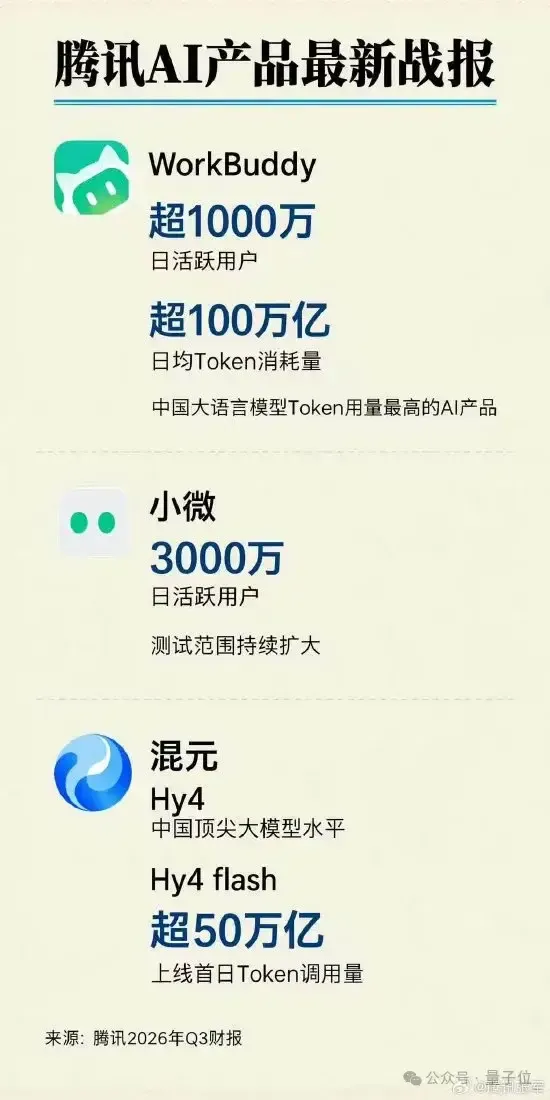
Measured by large-model Token consumption, Tencent believes WorkBuddy has become the largest AI application in China. The enterprise edition, launched only in June this year, has already been deployed across more than 50 industries.
Counting from its public beta in March, WorkBuddy reached this position in just over eight months.
So, among the batch of Agents that debuted around the same time, how did WorkBuddy break through?
How Did WorkBuddy Grow?
On a weekend in mid-January this year, Wang Shengjie and several colleagues pulled two all-nighters to rush out the first internal version of WorkBuddy.
At the time, they already had a ready-made Agent framework in hand, derived from Tencent Cloud's coding assistant CodeBuddy.
CodeBuddy was released in May 2024, also built by Wang Shengjie's team. In July 2025, it was upgraded to CodeBuddy IDE—an AI workbench that lets users complete the entire pipeline of product ideation, design, development, and deployment through natural conversation.
But the IDE interface was designed for developers. For people who don't normally write code, just opening the IDE might leave them unsure where to start.
Wang Shengjie noticed, however, that a team at the Tencent Research Institute—a group of non-programmers—was already using CodeBuddy to search for papers, organize materials, and have it generate analyses based on those materials.
Coincidentally, Anthropic also launched Claude Cowork around this time, bringing Claude Code's Agent capabilities into a desktop workbench so that people who don't normally write code could use it for everyday work.
Inspired by this, Wang Shengjie decided to build a web-based workbench for ordinary office users, reusing the foundation and Agent SDK that CodeBuddy had already established.
The team named the product WorkBuddy.

△WorkBuddy's early public beta interface
The whole process was remarkably fast. After two all-nighters, Wang Shengjie and his colleagues sent a demo video to their superiors: a minimalist chat interface, preloaded with a curated set of Skills, ready to use out of the box.
Their superiors gave the go-ahead that same night. On Monday, an internal beta was launched on Tencent's intranet.
Everything unfolded at a breakneck pace from there. Internal access opened on January 19, external beta applications opened on February 6, and on March 9, WorkBuddy officially entered public beta.
Non-technical roles—HR, administration, operations—including people who had never touched CodeBuddy before, began using WorkBuddy for data analysis, report generation, and office automation.
According to TMTPost, by the time of the March public beta, more than 2,000 non-technical employees at Tencent were already using WorkBuddy daily.
On the first day of public beta, general developer users overwhelmed the service, rendering it inaccessible for about one to two hours.
Around that same period, OpenClaw went viral in China, and major tech companies began building their own "lobsters."
Around the time of WorkBuddy's public beta, Tencent's PC Manager team also released a product based on OpenClaw called QClaw. Among those involved in building it was Zhang Shuyu, a product manager born in 1999 with a background in auditing.
Zhang Shuyu later recalled that QClaw was the first consumer-facing product she had helped build.
QClaw solved one problem: how does an ordinary person get the "lobster" installed? The team turned OpenClaw into a desktop client that could be deployed with one click. Once installed, users could message the Agent on their computer via WeChat, asking it to handle files or set reminders.
QClaw became wildly popular. After opening its beta in March, it gained millions of registered users within a week. On March 20, QClaw opened its full public beta and dropped the invitation code requirement.
At the time, Pony Ma even shared an introduction to Tencent's full lineup of "lobsters" on his WeChat Moments, ticking them off one by one:
Self-developed lobster, local lobster, cloud lobster, enterprise lobster, cloud desktop lobster, secure isolation lobster tank, cloud security guard, knowledge base... and a batch of products on the way.

At an earlier earnings call, Pony Ma also shared his thoughts on "raising lobsters":
Lobster applications can bring AI into a rich variety of scenarios, rather than concentrating everything in ChatBots as in the past. This allows Tencent to better leverage its resources and unite its various business lines, and it has also inspired the WeChat Agent currently in development.
WorkBuddy and QClaw emerged almost simultaneously, and both let Agents operate computers, so talk of an internal Tencent "horse race" quickly arose.
After leaving Tencent, Zhang Shuyu responded on social media that the two products reported to the same boss, and for a period, even the growth teams were the same people.
By late May, Tencent's desktop Agent lineup had gained another member. The Yingyongbao team launched Marvis, which lets users install software and organize files on their computer with a single sentence.
By then, WorkBuddy—two months into its public beta—had already reached the top spot in daily active users among domestic productivity AI agents, according to Tencent's Q1 earnings report in May.
After accumulating a user base in personal office scenarios, WorkBuddy began extending into enterprise office. At that time, enterprise customers were already able to use WorkBuddy through Tencent Cloud packages.
On June 5, Tencent released WorkBuddy Enterprise Edition. What was originally one person assigning tasks to an Agent on the desktop has now become employees collaborating with the Agent in the same project space, and enterprises also have a backend for unified account and permission management.
By July, Tencent's desktop Agent horse race had become clearer. Judging from monthly active user data, the gap between WorkBuddy and QClaw had already widened.
According to QuestMobile's PC client metric, QClaw's monthly active users that month were 2.259 million, while WorkBuddy reached 6.582 million, nearly three times that of QClaw.
It was also in this month that Tencent adjusted its organizational structure. According to Leiphone, on July 20, QClaw-related business and some teams were transferred into Cloud Product Department Six, where WorkBuddy is based.
By August, Tencent's internal choices among several competing AI products became even more obvious.
At Tencent's second-quarter earnings call, Tencent Chief Strategy Officer James Mitchell told analysts that after seeing WorkBuddy's rapid growth, the company significantly raised its priority within the existing AI investment budget, while lowering the priority of some other new AI products.
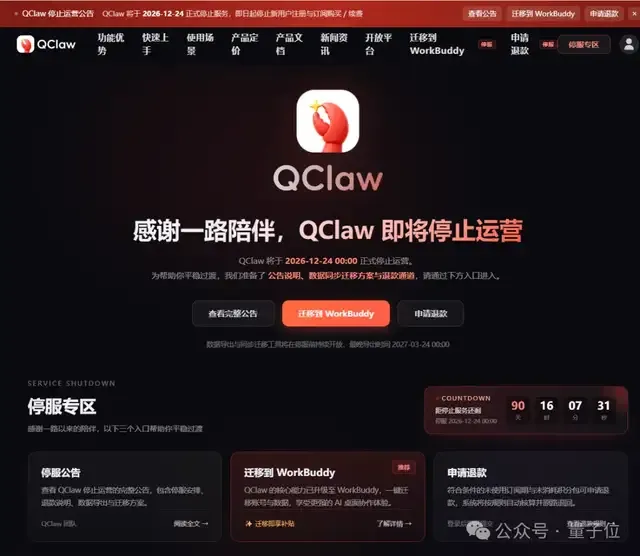
QClaw ultimately lost to WorkBuddy. On September 24, QClaw announced that it would cease operations three months later, while leaving existing users a migration entry point whose destination was WorkBuddy.
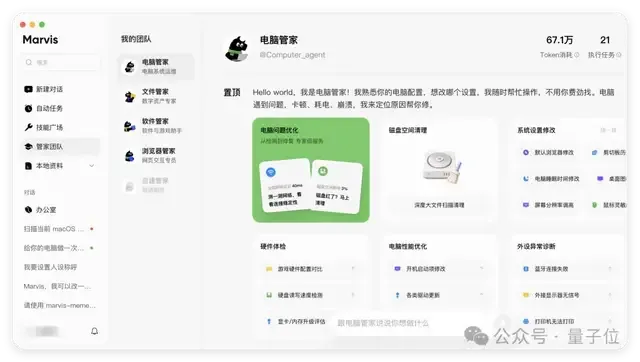
Compared with QClaw and WorkBuddy, Marvis's path is somewhat different. It focuses on personal devices, aiming to help users manage their computers, as well as the software and files on those computers.
On September 20, the person in charge, Cai Jiantao, disclosed that Marvis's user scale had grown nearly fourfold since launch, remote control features had been used more than 18 million times cumulatively, and per-user Token consumption had risen from about 1 million in the first month to 5.9 million.
Four days later, on the same day QClaw announced it would cease operations, Marvis released a new version.
The Yingyongbao team gave it a new positioning, calling it an "AI butler." The team found that 40,000 to 50,000 people use Marvis every day to install software, and cleaning the C drive, organizing files, and disabling startup auto-launch are also common uses. The new version brought these features to more prominent positions.
By November, Marvis was managing one more type of device—it was listed in the UGREEN NAS App Center.
NAS stands for network-attached storage, which can be understood as a small file server connected to the home network, where photos, videos, and documents can all be stored centrally. After installing Marvis, users can give it an instruction on their phone and have it help find videos and organize files.
Back to WorkBuddy. By autumn, Tencent was already promoting it as its main office Agent. Management not only explicitly raised its investment priority, but also prioritized computing power to guarantee its inference needs.
In October, Tencent's own office products were also connected one after another.
On October 14, WorkBuddy and WeCom were connected bidirectionally. For example, after a requirement has just been discussed in a group, employees can assign tasks to it within WeCom. WorkBuddy reads group messages and related files according to permissions, organizes them into documents, and then sends the results back to the group.
On October 29, Tencent released Buddy One at the Global Digital Ecosystem Summit, allowing Tencent Docs, Tencent Meeting, Tencent Drive, and ima to share WorkBuddy's Agent foundation. After linking accounts, AI credits can also be used across them. When searching for external materials, WorkBuddy can also call Yuanbao Search.
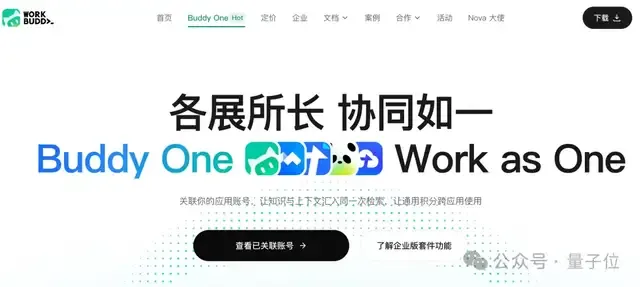
It was also at this summit that Dowson Tong gave WorkBuddy a clear positioning—an important strategic product for Tencent at the current stage.
By November, Tencent underwent another organizational restructuring. According to China Entrepreneur, the ima team had already begun working in a mixed office setup with the WorkBuddy team, and some members also transferred to WorkBuddy.
It is evident that Tencent's internal resources, manpower, and computing power are all converging on this young AI product that is only eight months old.
The current "tripartite standoff" among Tencent's AI entry points
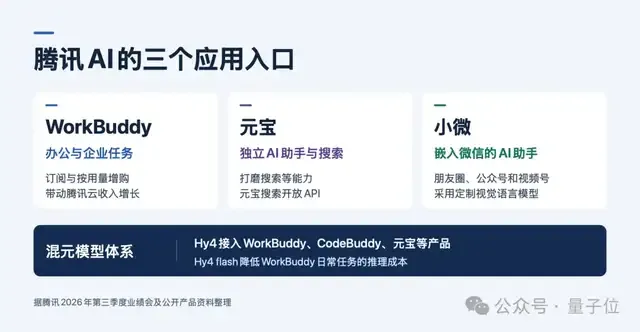
At the current stage, Tencent has three main AI entry points.
WorkBuddy handles office work, Yuanbao is an independent AI assistant, and Xiaowei puts AI into WeChat.
First, WorkBuddy—it has already begun contributing revenue to Tencent Cloud.
In the third quarter, the year-on-year growth rate of Tencent Cloud services revenue rose from 21% to 35%, with WorkBuddy, Model-as-a-Service (MaaS), and GPU leasing jointly driving growth.
According to Liu Chiping, WorkBuddy adopts a revenue model combining "free use, paid subscriptions, and additional purchases by usage."
Users can first try it for free, obtain more usage quota after subscribing, and also purchase additional quota based on task requirements. Tencent said that the increase in paying users and early adoption by enterprise customers were the main reasons for WorkBuddy's revenue growth in the third quarter.
△AI-generated
Yuanbao's focus has returned to capability building.
When discussing AI investment returns, Liu Chiping acknowledged that Yuanbao's previous performance was below expectations, and Tencent had significantly cut related investment. Yuanbao's current focus has also shifted from expanding user scale to improving product capabilities.
For example, Tencent turned Yuanbao's search capability into a standalone product. In November, Yuanbao Search opened to the public. Enterprises and developers can also integrate this capability into their own applications or Agents through Tencent Cloud APIs.
Xiaowei is expanding its coverage within WeChat.
After Meta launched Personal Agents such as Muse, how Tencent can amplify the value of Agents within the WeChat ecosystem, which has more than 1.4 billion monthly active users, also became a focal question on the earnings call.
According to Liu Chiping, Xiaowei is still in grayscale testing and has reached 30 million daily active users. The number of Xiaowei entry points within WeChat has increased to more than 30, covering scenarios such as Moments, Official Accounts, and Channels, and the average number of interactions per daily active user is also increasing.
To control inference costs, Xiaowei uses a vision-language model customized for WeChat scenarios. Tencent expects that even if Xiaowei is opened to all 1.4 billion WeChat users, its quarterly cost will still be lower than Yuanbao's quarterly cost earlier this year.
Tencent is also advancing Xiaowei's integration with more mini programs and merchants, and integrating it with WeChat Stores to help grow WeChat's advertising and transaction revenue.
Meanwhile, deploying the model is key to empowering Agents.
Hunyuan Hy4, developed by the team led by Yao Shunyu, has already been directly deployed across Tencent's full lineup of AI products, including WorkBuddy, CodeBuddy, and Yuanbao.
In WorkBuddy, Hy4 handles more complex long-horizon tasks, while Hy4 flash handles high-frequency daily office tasks at a lower cost.
Liu Chiping explained the business logic behind this division of labor at the earnings call: models like Flash are well suited to customer acquisition and can support free trials at low inference cost; once users need more capabilities, there is an opportunity to convert them into subscribers. More capable models like Hy4 are better suited to deep research, long-document analysis, and complex tasks that require multi-step execution.
WorkBuddy handles office work, Yuanbao serves as the mass-market AI assistant and search entry point, and Xiaowei brings Agents into WeChat. Three main application entry points, backed by the Hunyuan model system, form the "three-horse carriage" of Tencent's AI products at this stage.
The strategy is gradually coming into focus, and Ma Huateng's sense of urgency is now out in the open. According to minutes published on the "Tencent Culture" official account, in an internal speech at Tencent's anniversary celebration on November 11, Ma Huateng said:
This intelligent revolution—if we do not actively invest in and embrace it, we will be disrupted. It is a matter of survival.
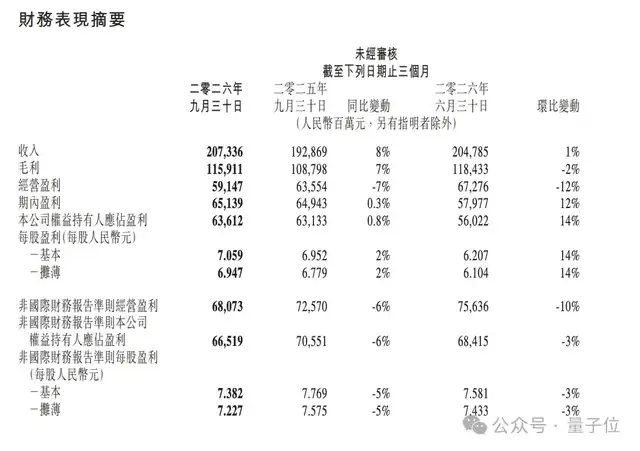
The third-quarter report published a week later already shows the impact of new AI products on profit. Tencent's Q3 revenue was approximately 207.3 billion yuan, up 8% year over year, while adjusted operating profit fell 6% year over year to 68.1 billion yuan. Excluding the contribution of new AI products, operating profit on a comparable basis rose 8% year over year.
WorkBuddy has already established a firm foothold. With its strategic position now clear, the first round of horse racing among Tencent's AI applications has come to an end.
References: [1]https://www.hkexnews.hk/listedco/listconews/sehk/2026/1118/2026111800449_c.pdf [2]https://stockanalysis.com/quote/hkg/0700/transcripts/731168-q3-2026/ [3]https://earnings.opennash.com/companies/tencent/2026-q2/#t-4029 [4]https://tech.ifeng.com/c/8rU4OKaHPzh [5]https://www.tmtpost.com/7992670.html [6]https://finance.sina.com.cn/stock/s/2026-11-20/doc-inizitct0484837.shtml