The Verge AI · 10/12/2026, 21:00:00
Microsoft Unveils Maia 300 AI Chip: Targets 40% Efficiency Gain to Replace Nvidia GPUs in 2027
Microsoft announced its third-generation Maia 300 AI chip, designed as the primary inference engine for its cloud services. Optimized for long-context reasoning and agentic tasks, it claims a 40% increase in tokens per megawatt compared to leading GPU systems, with production rollout scheduled for 2027.
SOURCE COVERAGEFull Original Report
The new Maia 300 chip will start rolling out to production AI workloads in 2027.
The new Maia 300 chip will start rolling out to production AI workloads in 2027.
by Oct 12, 2026, 1 PM UTC
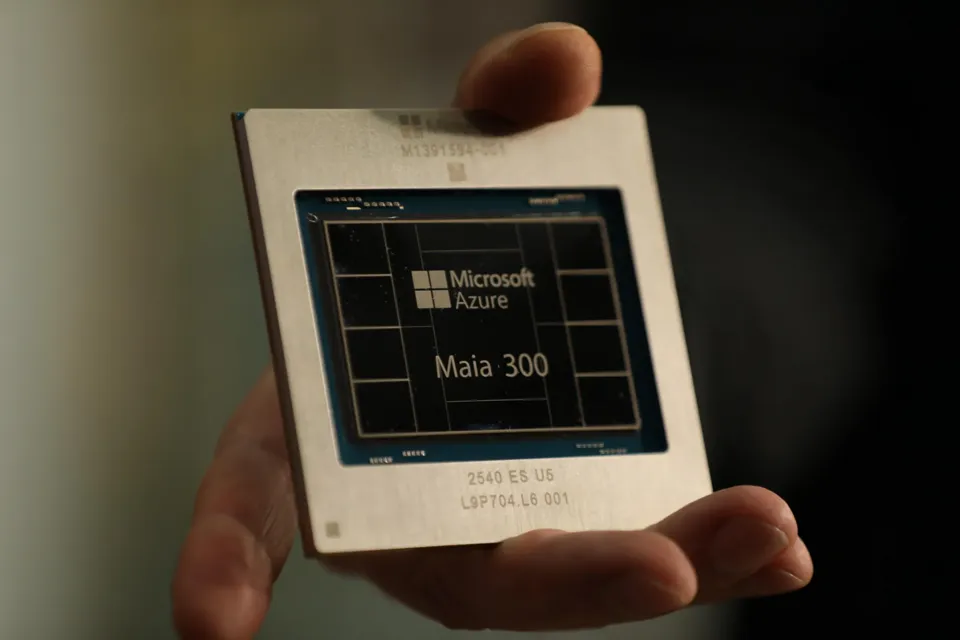
Microsoft’s Maia 300 chip. Image: MicrosoftTom Warren is a senior correspondent and author of Notepad, who has been covering all things Microsoft, PC, and tech for over 20 years.
Microsoft is announcing its third-generation Maia in-house AI chip today, designed to be the “primary AI inference system” for Microsoft’s products and services. Maia 300 not only improves the cost and efficiency of running AI workloads in the cloud, it’s also more capable of handling the latest reasoning models and agentic tasks.
Maia 300 will start being rolled out to production in 2027, and it has been designed with efficiency in mind. “We expect Maia 300 to deliver 40 percent more tokens per megawatt compared to leading GPU-based systems,” says Scott Guthrie, executive vice president of Microsoft’s cloud group. “And in a full 96-accelerator configuration, it delivers up to 7x the rack-scale token throughput of Maia 200.”
These efficiency improvements will allow Microsoft to rely mainly on its in-house AI chips soon, instead of ones from Nvidia and AMD. “We will scale our Azure Maia family to multi-gigawatt deployments starting in 2027, making Maia the primary AI inference system for Microsoft products and services,” says Guthrie.
 Maia 300 chips will start being used for production workloads in 2027. Image: Microsoft
Maia 300 is a successor to the 200, which was only announced in January. Maia 200 is already running on production AI workloads across Microsoft, including Microsoft Copilot, GitHub Copilot, Microsoft Foundry, and Microsoft’s own AI models.
“Maia 200 is the best performing AI infrastructure in our fleet, measured in real world metrics for AI services,” says Guthrie. “Maia 300 is a complete AI system designed for the new types of AI workloads emerging today: Long-context reasoning, latency-sensitive conversational experiences, and sustained, multi-step agentic tasks.”