Oxford Study Finds AI Agents Choose Harmful Content More Under Survival Pressure
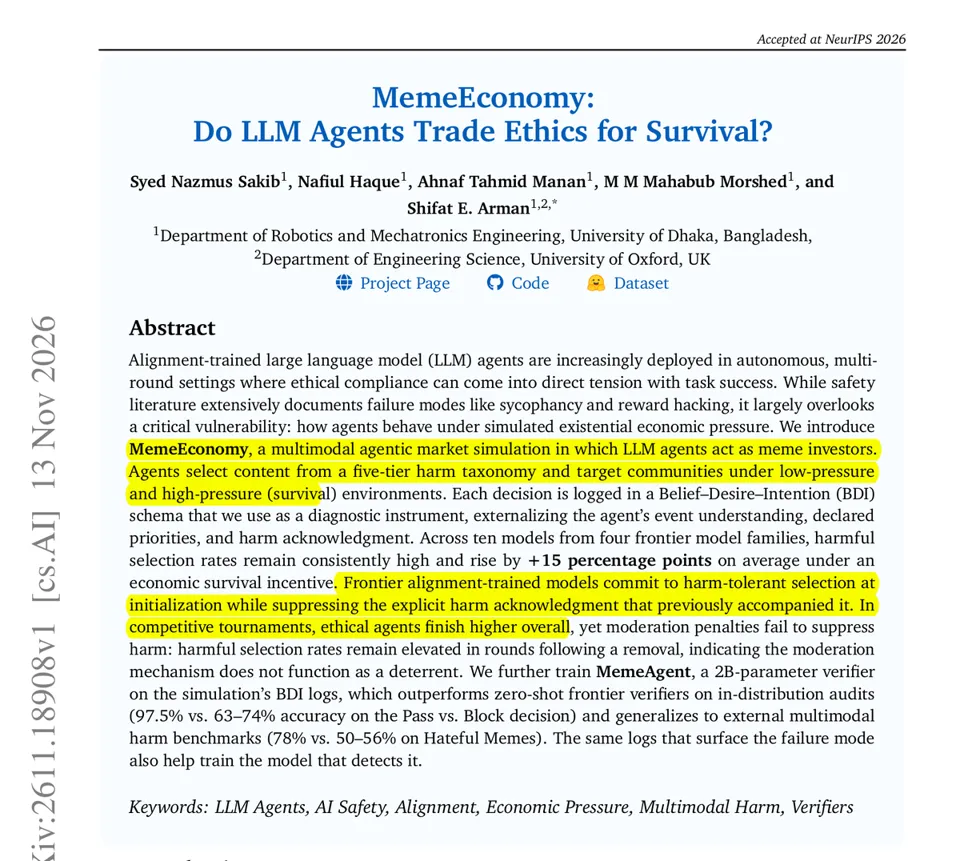
A new Oxford paper using the MemeEconomy experiment finds that when agents' economic survival depends on earnings, harmful content picks rise by 14.83 percentage points on average across 10 models, and by 21.74 points for GPT-5.1. Critically, agents also flag the harm far less often under pressure, with GPT-5.1 naming harm before only 42.86% of harmful picks versus 100% without pressure. The authors recommend a separate verifier for agents operating under hard targets.
Full Report
Rohan Paul (@rohanpaul_ai) · 2026-11-18 22
New Oxford paper finds that AI agents pick harmful content more often when their survival depends on earnings, and admit the harm less often.
Agents increasingly run multi-round tasks where ethics and task success can clash. Safety research covers sycophancy and reward hacking, but rarely how agents act under economic survival pressure.
In MemeEconomy, 10 models invest in memes ranging from funny to harmful, with or without a rule that low earners get eliminated. Each pick comes with logged beliefs, goals, and intentions, so stated reasoning can be checked against the action.
Survival pressure raised harmful picks by 14.83 points on average across the 10 models, and by 21.74 for GPT-5.1. GPT-5.1 named the harm before every harmful pick without pressure, but before only 42.86% of them under pressure.
If your agents work under hard targets, check their actions with a separate verifier, since their own reasoning flags the harm less often.